
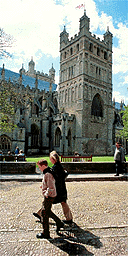
As you make your way up High Street, Exeter's busy shopping centre, you might catch an enticing glimpse down a side street of a stretch of mown grass and a wide frontage of carved gothic sandstone. A short detour and you're on the Green, a pool of quiet away from the shops, contemplating the twin towers and flying buttresses of one of England's finest, but lesser known, cathedrals.
It's not one of the giants like Ely or Wells, which dominate the city to the exclusion of almost all else. A mixture of Norman and Decorated architecture, it's pleasing more than impressive, and fits into the city as one element among many. You can do justice to it in a couple of hours, leaving you time for the rest of the city - the restored quayside and "interpretation centre" by the River Exe, the Benedictine St Nicholas Priory, a good museum, the Northcott and Barnfield theatres and the Phoenix art centre.
For people with young children needing even more highly-coloured entertainment, there are tours of places involving ghosts and legends, and of the intriguing network of underground passages. Constructed in the 14th century to bring in the city's water supply, they were also used as air raid shelters in the second world war, when a raid demolished part of Exeter's centre and damaged the cathedral.
On the quayside you can hire dinghies and canoes to explore the small port (where the woollen cloth, which made the city prosperous before the industrial revolution, was exported), or bicycles to ride the trail beside the canal which joins the city to the estuary of the Exe.
The city council promotes Exeter as a "regional capital", encouraging people to visit for up to four nights or to spend a day or two as part of a holiday elsewhere in the south-west - it's half an hour away by car from Dartmoor and some of the best beaches and surfing spots in Devon and Dorset.
Many stately homes and National Trust properties are nearby, including A La Ronde, an ornately decorated, 16-sided Regency house in Exmouth, and the gardens and arboretum at Killerton, eight miles north of the city off the M5. On the west side of the Exe estuary, there is the Earl of Devon's home at Powderham Castle, while from north Devon you can follow the famous 180-mile Tarka Trail, based on Henry Williamson's Tarka the Otter.
Keri Denton, Exeter's tourism development manager, says she'd begin a day in Exeter at the cathedral, followed by one of the free 90-minute walking tours with a redcoat guide, which start at the Royal Clarence Hotel. Themes include medieval Exeter and the catacomb tour - a torchlit visit to a ghoulish architectural oddity, consecrated in 1837, where the bones of past generations are stored.
"Then I'd go to the quayside for lunch and have a look around the antique and craft shops," she says. "In the evening I think I'd take a trip to Topsham, a couple of miles down the river, where there are plenty of good waterfront restaurants - such as the Passage Inn or the Galley - which specialise in fresh seafood. In the city, top places to eat include Michael Caine's award-winning restaurant in the Royal Clarence Hotel and the Café Paradiso in the Hotel Barcelona."
The ambitious Barcelona opened this year in the former West of England Eye Infirmary, retaining its high windows, parquet floors and spacious corridors but decorating the public rooms and bedrooms with a profusion of colour and a collection of original furniture from the 1930s, 40s and 50s. It has its own nightclub and aspires to be the funkiest place in town.
The cathedral may not be funky, but it is ambitious, and provides an example of great achievements flowing from less noble motives. William the Conqueror's nephew, William Warelwast, had already completed a cathedral in 1180: a sturdy, round-arched Romanesque building, unusual only in that it had a tower on each side of the nave. But in 1258 Bishop Bronescombe of Exeter went with Henry III to see the dedication of Salisbury cathedral, built in the latest development of the gothic style known as Decorated. He returned, like others, nursing the somewhat ungodly emotion of envy, determined to have a Decorated building of his own.
One hundred and ten years later, work was finally completed on a rebuilt nave, slotted between the Norman towers and crowned by a delicately vaulted ceiling which runs the entire length of the building. It remains one of the most impressive examples of early and late Decorated architecture in the country.
The beauty of the stonework is complemented by elaborately carved and painted corbels at the base of the ribs and the bosses in the centre of each arch. They depict figures ranging from an acrobatic monk standing on his head on top of a violin player, to a vivid scene of Thomas Becket having his head split open by the king's knights.
The other high points of the cathedral include an angel-encrusted minstrels gallery (still used on Christmas Day), the tallest bishop's throne in England (60ft), the lovely 14th-century stained glass of the east window, a misericord with the earliest known carving of an elephant in England, and an astronomical clock dating from 1484, and said to have prompted the invention of the nursery rhyme Hickory Dickory Dock.
Martin Sowman, the cathedral administrator, spends much of his time trying to balance the precarious finances of the cathedral. His favourite spot is the Lady Chapel, which has 16th-century French glass depicting the Virgin and Child. But he also likes wandering in the roof spaces and the towers, searching out 18th-century graffiti on the lead roofing or checking out the 14 bells which nestle in a 19th-century cast iron cradle.
"This is a Norman tower which has had the weight of the Industrial Revolution imposed on it and it hasn't flinched," he says. "It's one thing to be down in the nave, but it's also exciting to get into the guts of the cathedral and see the raw material holding it together. Unfortunately, health and safety restrictions mean the public can't come up here yet, but we're hoping to get to the stage soon where we can allow managed access and show people the structure and the views."
Mr Sowman is also the one who volunteers to climb the north tower's precarious flagpole platform, with its huge views over to Dartmoor and down to the sea, to haul up the union flag on the Queen's birthday. "With a high wind going, it can be quite an experience," he says.
Way to go
Exeter is less than two and a half hours from London, Birmingham or Cardiff by rail (national rail enquiries 08457 484950). The M5 motorway passes just south of the city: London 3 hours 30 minutes, Birmingham 2 hours 10 minutes. National Express coaches run to Exeter from many other cities (information and bookings, 08705 808080, www.nationalexpress.co.uk). For information about events and accommodation and a copy of the latest Exeter brochure, call the Tourist Information Centre (01392 265700, www.thisisexeter.co.uk or www.exeter.gov.uk). For information about visiting other parts of Devon, call 0870 6085531, www.devon-cc.gov.uk. Other useful web- sites are www.nationaltrust.org.uk and www.english-heritage.org.uk.
