
In the everyday rush of life, from shopping trips and school runs to visits to the local dump and Sunday lunch at the in-laws, it's easy to think that driving is all about just getting from A to B and then back again. Factor in the rush hour and endless traffic jams, and what little pleasure you get from slipping behind the steering wheel soon withers away.
But a long-weekend break to the Netherlands and northern Germany awakened the memory that driving can be fun - and made me realise it's possible to go from A to B and on to C and D and, in fact, right through to the end of the alphabet. Of course, there are countless fly-drive holidays on offer these days, but there's undeniably something special about throwing some bags into the boot of your own car, heading off on an adventure and not knowing exactly where you're going to end up.
My trip began with an overnight ferry crossing with Stena Line from Harwich to the Hook of Holland on a Thursday night. That in itself is a treat. It seems like the closest feeling to being back in the womb - cosseted in a small cabin in the pitch black, with the gentle humming of the ship's engine and swell of the sea to lull you to sleep.
Once on the other side, the biggest immediate obstacle to overcome was getting out of the mentality that driving is about getting from one place to another as fast as possible. This is particularly true in the Netherlands. While the scenery isn't stunning, the countryside often has the feeling of a well-kept garden and is dotted with pretty towns and villages - perfect for a stroll, followed by coffee and cake in one of many cafes.
One of the highlights of a visit to the eastern part of the Netherlands is the Kroller-Muller museum, set deep inside the Hoge Veluwe National Park, the country's largest. It's not just the forest setting that impresses, but also the fantastic collection of Van Goghs and other masters - as well as one of the largest sculpture gardens in Europe, boasting works by Rodin, Moore and Hepworth.
And when you've had your fill of culture, it's possible to pop outside and take one of the free 1,700 white bicycles to explore some 42km of cycling paths. It may seem trivial, but there's something really special about just being able to jump on a bicycle and head off. It's partly about the trust that's implicit in having such a scheme, but it's also about a sense of spontaneity and fun. No need to track down a bicycle rent shop, fill in forms, and pay a deposit in case you don't return.
After an overnight stay, the drive took us across the German border to a tour of some of the nine "Wonderful Cities", a collection of picturesque towns in Lower Saxony that are rich in myths, legends and fairytales. First stop was Hameln, made famous by the legend of the Pied Piper, a story which is re-enacted every Sunday at noon during the summer months on an open-air stage in the centre of the town.
While the town has a number of back streets full of beautiful half-timbered houses and a main thoroughfare of old, splendidly decorated merchant houses, it's no surprise to learn that Hameln trades heavily on its association with rats. There's the Rat-Catcher Fountain, the Rat-Catcher House, the Rat Inn, the Rat-Catcher Hall and, of course, the local museum, which explains the historic background to the legend. In the shops and restaurants, there are soft furry rats, rat spirits, rat breads and cakes and so on. For those rats that live in the town's sewers, it must feel like they're venerated as gods.
A visit here comes with only one word of warning - avoid the tourist office's official Pied Piper. (Garbed in jester's outfit and equipped with flute, he's not difficult to spot.) His exasperating commentary and annoying habits are more likely to have you fleeing the town rather than following him to the "magical place" of legend.
35 miles away is the city of Hanover, which has had a long relationship with Britain ever since 1714, when Elector Georg Ludwig became King George I of England. While Hanover is famed for its international trade fairs, it also has a wide range of attractions and amenities and offers a varied nightlife including its well-known transvestite show, which the local German tourist official heartily recommends to all visitors. Its profile will also rise markedly this year and next, being a host city for the Confederations Cup 2005 and the FIFA Football World Cup in 2006.
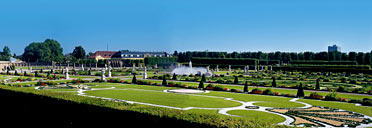
A Hanoverian must-see is the Royal Gardens of Herrenhausen, which have been left unchanged in more than 300 years. While the space is renowned for its fountains, sculptures and lavish flower and bedding-plant arrangements, what really catches the eye is something altogether more modern. The old grotto has been transformed by the French artist Niki de Saint Phalle into a modern-day Aladdin's cave: three rooms have been decorated with astonishingly intricate mosaics of glass, mirrors and stones.
After an overnight stay in Hanover, travel another 85 miles along the back roads of Germany and you enter another architectural glory, the town of Bremen. Like Hameln, this town is famous for a fairytale, this time Brothers Grimm fable of the Town Musicians of Bremen, in which four farm animals, mistreated by their masters, cheerily band together and head for the city so that they can live in freedom. The town has also been put on the map by Unesco's decision last year to add the late renaissance town hall and the Roland statue in front to its world heritage list.
A short hop and a skip to the German port of Cuxhaven, and it's aboard a waiting DFDS Seaways ferry bound back to Harwich. After another great night's sleep, I'm back to England on Monday morning. Looking back, it felt as though the trip had lasted for weeks rather than just a long weekend.
And what would have happened if I'd stayed at home? I'd have spent most of the time in the car doing the shopping, recycling at the local dump and visiting the in-laws - and cursing the traffic the whole time.
Way to go
The Dutch and German tourist authorities have joined forces to encourage motoring breaks in the two countries. Their brochure, Drive Dutch, Drive Deutsch, offers a variety of itineraries, ranging from trips for those with kids to travellers who want to concentrate on city culture or spend more time in the countryside. The brochure also lists events, exhibitions and festivals taking place throughout the year.
For Stena ferry bookings, call 08705 421168 or visit the Stena website.
For DFDS sailings from Harwich and Newcastle, call 08705 333111 or visit the DFDS website.
