
Ross Island must be the perfect place to be a recluse. Its sole inhabitant left a career as a laboratory technician in Edinburgh a few decades ago to set up camp on this hillock poking up above the waters of the river Dee.
Gary McKie, who takes parties out on river excursions in his little motorboat, explained to us as we bobbed up and down on the swell that he was virtually self sufficient: he collected rainwater, drew his own solar power and grew vegetables; deer volunteered themselves for his consumption by swimming over to the island. (Not that he has completely abjured company: it is possible to visit the island, with permission.)
The views must have been another lure for Ross Island's resident No 1: his home is caught between the jaws of the Dee as the river flows into the Solway Firth. On one side he would see the sea, on the other the forest, and a mile or so downstream the cluster of white buildings along the river bank that make up the town of Kirkcudbright (pronounced "kir-coo-bree").
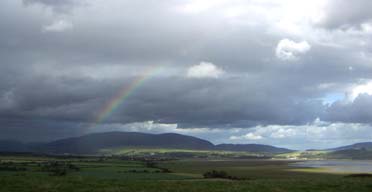
The whole is softened in a grey light, a kind of visual Valium that is an immediate balm to the senses. This was the constant backdrop to our autumn tour through Dumfries and Galloway, the south-western region of Scotland.
A gay friend of mine from Australia once told me small towns made him feel so uneasy he always drove through them with his eyes shut. His doubtless irrational fear probably explains why I was immediately struck by the tale of one unfortunate who passed through Kirkcudbright. You can still see the cramped cell under the stairs in the restored tollbooth - the old Scottish world for a combined town hall and prison - where they kept Elspeth McEwen of Dalry before her execution in 1698 as a witch.
You would avoid being singled out in those times. Thick iron rings remain in place, set into the outside of the building, where they were once used to shackle miscreants by the neck for the edification of the townsfolk.
Modern Kirkcudbright is still colourful - but in the literal sense of the word: for more than a century the town has been a beacon for artists. The connection began when a group of painters led by Edward Hornel, a member of the iconoclastic Glasgow Boys, began to congregate here in the 1880s. They formed what appears from paintings, photographs and contemporary accounts to have been a jolly, bohemian creative colony, like a rural Scottish offshoot of the Paris of the period.
Hornel settled permanently in the town towards the end of the 19th century. The house he bought on the high street is being restored to a condition as close as possible to that in which he left it - and this world - in 1933. His vaulted, expansive, light-soaked studio, which like the other settler-artists in the town he converted within the existing building, looks out over a garden filled with his collected curios - among them a child's stone coffin, now covered in lichen.
The house reopens early next year and is well worth visiting, if only for the fact that the painter, in the period when "artist" and "garret" formed their collocation, could buy such a magnificent residence largely from the proceeds of his work - indeed, from the sale of a single painting, as one story has it.
The beauty of the rent, as much as that of the surroundings, is what still draws artists to the region. We visited a couple of them, a painter and a sculptor, at work in their studios in a farm building. The sweet smell of fermenting silage was thick in the air as Bea Last explained how she drew on the lines of the landscape - a throbbing, verdant rectangle of which was visible through her picture window - for her Rothko-like abstracts. Her neighbour, Lizzie Farey, uses local birch, willow and bog myrtle to weave baskets and "living sculpture".
Surrounded by like-minded people and with fields of creative material on the doorstep, this must be a nice place to live and work. For the past several years, during an event called the Spring Fling, participating studios have thrown their doors open to the public for a few days (May 28 to 30 in 2005). For the interested public it is an opportunity to observe the creative process; for the artists and crafts people it is a chance to sell their work.
On the face of it, Wigtown, west of Kirkcudbright, had some qualities that might have tempted my friend to shut his eyes: melancholy shops with cheerful names; signs anticipating - and forbidding - almost everything; locals whose features appeared to have been sharpened by the wind. Yet he would have missed a lively literary culture fuelled by an annual book festival.
Books have been the salvation of Wigtown, which was in a ghostly state of dilapidation before being nominated as Scotland's official "book town" a decade ago. Its stock has risen steadily since then (as have its property prices). It is not quite Hay-on-Wye yet, but it could get there.
The line-up at this year's festival included the current Booker favourite, David Mitchell, the precocious novelist Gwendoline Riley and the Radio 4 broadcaster Libby Purves. We stopped in at a session to hear Joanne Harris read from her new short story collection, Jigs and Reels. I found it no less twee than her novel Chocolat, but I am sure a lot people will like it, if the sales of the latter are any guide.
A word about the lodging and victuals in Dumfries and Galloway - that word being "substandard". In Kirkcudbright we stayed at a four-star First Western hotel, the Selkirk Arms. Quite what the Scottish tourist board was referring to with those four stars, I am not sure - four fading sitcom stars who may have stayed there in the 70s, perhaps.
The cheap, chipped room furniture, the pervasive smell of meat and the self-slamming doors all suggested a considerably lower grade. Scallops in the restaurant sounded nice, given that we were by the sea. But why did they overcook them and then serve them lost in a line-up of anonymous vegetables and the odd olive? Huge portions catering, I think, for the silver citizenry who made up the bulk of the clientele did not compensate.
The admirably chintz-restrained rooms in the Creebridge House hotel in Newton Stewart were, by contrast, inviting, and the scallops I had for my entrée in the hotel restaurant could probably not have been bettered: their just-sweet taste and just-resistant texture are a fond memory. But my request for a medium-rare steak was obviously a hyphen too far for the chef: he rubberised a Scottish speciality.
Of the Black Sheep Inn nearby little should be said except that I see no point in having a menu when everything tastes of meat and three veg. If the region wants to attract an international crowd it is going to have to lift its game in the kitchen.
Yet the dull food seemed incongruous against a landscape so exquisite you could imagine poetry springing from it without the intermediary of thought. There were pleasing incongruities, too, such as the Logan botanic gardens, with their southern hemisphere species thriving in a mild microclimate stoked by the Gulf Stream, and the Logan fish pond, a sort of natural aquarium carved out of the coastal rock during the last ice age and used in the 18th century by the local laird, Andrew McDouall, as his personal cod larder. Galloway wooed me; be wooed - but bring a packed lunch.
Local contacts
Gary McKie - 0797 010 9814
Edward Hornel's house - 01557 330 437
Lizzie Farey
Spring Fling - 1387 262 084
The Selkirk Arms - 01557 330 402
Creebridge House hotel - 01671 402 121
The Black Sheep Inn - 01671 404 326
The Logan botanic gardens - 01776 860 231
The Logan fish pond 01776 860 300
Kirkcudbright info
For more on Scotland tourism, see visitscotland.com
