
We are in the back of a battered old silver Merc taxi, a bouncy castle on wheels. Over dunes, ditches, shrubs, rocks and landslides we pound, thinking no beach can be worth this limb-dislocating journey. Then the driver swings left and there it is below: Paradise Beach - about two miles of flat, golden sand glimmering in the midday sun, lapped by big noisy waves and enclosed at either end by mighty cliffs.
Where the road runs out, bony donkeys are hauling cartloads of food, drink and pale western sunworshippers down to the ragbag collection of makeshift cafés along the edge of the near-deserted sands. Out towards the horizon, little boats are nodding inshore to provide freshly-caught sardines for the lunchtime tajines - delicious traditional Moroccan stews spiced up with anything from almonds to olives, pickled lemon rind to prunes.
The sardine tajine cost little more than £7. It could have easily fed four.
Paradise Beach lies on the edge of Asilah, a lovely, bite-sized Moroccan town about 45 minutes by taxi or train down the coast from Tangier. With its brightly-painted old quarters, its ramparts straddling the rocks, its palm trees swaying in the coastal breeze and its not-too-pushy market traders - Asilah is the perfect place to ease yourself into Morocco.
And it is worth trying to ease yourself into this country, for big-town Morocco can be a big-time culture shock. There's the hassle in the streets, the haggling in the bazaars, the maelstrom of the medinas, the hustlers, hash-sellers and conmen, and the beggars young, old, desperate and dying. Then there's the money, the taxis, the drinking laws, the food, the heat - and the pitiful attempts to get by on what little French you can remember from school.
On top of all this, there's the fact that Morocco is an Arab country, a detail that takes on a whole other significance in this fearful new world. But the country, or at least the main cities and coastal resorts, seem so geared up for and dependent on tourism that it's hard to imagine a hostile reception. If you're willing to take the risk and fly off into the year-round sunshine, you could find prices even cheaper, and have the whole place practically to yourself.
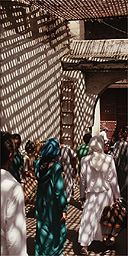
Fes was a half-day on the train from Asilah and a first-class ticket cost 30 dirhams (£1.80) extra, so it seemed churlish not to. Once the hub of Moroccan trade, culture, religious life and politics, Fes is today chiefly of interest for its gigantic, sprawling medina - a kaleidoscopic maze boasting several outstanding mosques swaddled by about one million narrow, winding, hilly lanes crammed with men, women, children, cats, dogs, donkeys and shops selling everything from traditional Arab clothing to ceramics and, of course, carpets of every size, shape, pattern and form.
There are four entrance gates, and whichever one you choose will lead you, as a westerner, into a storm of attention from young boys wanting to be your guide. Rather than trying to get rid of them, which is exhausting and virtually impossible, you might let one tag along with you and kid on he's taking you places, then bung him 10 dirhams (60p - a fortune to a young boy) afterwards. If nothing else, it will keep other guides at bay. and once you're done, he can show you the way out.
It's no great worry getting lost though. In fact, that's half the fun. Wander in and just get caught up in the dusty, jostling, deafening flow, meandering from stall to shop to café greeted by a regular chorus of: "Yes please, where you from?"
Another half-day in a first-class compartment took us to Marrakesh, where we dropped our bags at Hotel Ali, a mecca for backpackers in the medina, and signed up for one of its three-day trips (£57 a head including accommodation and evening meals) that took us up over the wild Atlas mountains, through some stunning gorges and on to a camel trip across the Sahara. As the sun set behind us, berber tribesmen led our camels on a two-hour trek towards our tents, where mint tea and a fabulous cous-cous stew awaited. Only half the party slept in the tents, the rest choosing to lie back and gaze at the stars and comet tails, listening to the camels regurgitating what sounded like entire fields of shrubs.
Back in Marrakesh, it was time to hit the legendary Djemaa El Fna, the manic square where Morocco in all its madness comes at you like a lorry. There are boys boxing, monkeys dancing, bands busking, men charming cobras, story-tellers ranting, and, among all this, are foodstalls, herb doctors and, inevitably, henna tattooists in case you want to look like a human doodle. If it all gets too much, there are rooftop cafés around the square.
Less than two hours away by bus, the 18th-century coastal town of Essaouira has wood workshops the way some houses have mice. Everywhere you look, there are crates with American addresses written on the side containing tables, chairs and ornaments so magnificently ornate that any self-respecting tree would be happy to have been turned into them.
Just off the main square are the fish souks, about 20 bright white stalls with shade and seating, offering the morning's catch barbecued before your eyes. Ten pounds bought us salad and prawns, followed by sea bass, turbot, crab, sardines and anchovies. Then the main course arrived: lobster. Delicious - and we were probably overcharged.
Moroccan salads come drizzled with argan oil, a remarkable, nutty-tasting foodstuff unique to the country. The delicious dark amber fluid is extracted from the yellow seeds that fall off the argan tree (it is too thorny for humans to pick). But, someone told us, there is another way. Goats have a craving for the seed though their stomachs can't crack its hard casing if swallowed uncrunched. So Moroccans recover the seeds from goats' droppings.
Not the sort of thing you put on the side of the bottle.
Way to go
Getting there: STA (0870 160 6070, tatravel.co.uks) offers return flights to Marrakech from £233, to Tangier from £242.
Where to stay: Rooms at Hotel Ali, Rue Moulay Ismail, Marrakesh (04-444 4979) cost £6-10 with a buffet evening meal on the rooftop for £3. The Hotel Mogador, 116 Riad Zitoun Kadem (04-442 6323) costs £20-25 for a double room around a central fountain. Budget Fez hotel: the Central, 50 Rue du Nador (05-562 2333) rooms about £5. Medium: Grand Hotel, Bd Abdallah Chefchaouni (05-593 2026), about £20. Hotel de Mechouar in Essaouira on Avenue Okba Ibn Nafia (04-447 5828) about £20. La Licorne restaurant, 26 Rue Scala, Essaouira, is great for traditional Moroccan food and serves drink, provided you keep the bottle under the table.
Further information: from the Moroccan Tourist Office, 205 Regent Street, London W1R 7DE (020-7437 0073).
Country code: 00 212. Flight time to Tangier: 3 hrs. Time difference: GMT all year. £1 = 16 dirhams.
