
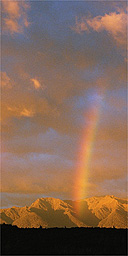
Tolkien's Middle Earth in the Lord of the Rings is a spectacular other world, a land of broad rivers and vast lakes, gentle valleys, dark forests and foreboding mountain ranges. On the page, it is so varied and spectacular that the books had long been considered unfilmable.
Director Peter Jackson knew something Hollywood did not, however. Jackson is a Kiwi, and he knew that his home country was more than a match for the imaginative breadth of Tolkien's vision. The Lord of the Rings trilogy, filmed in New Zealand and released this month, blows the secret - there is simply no more spectacular place on Earth.
I spent two weeks touring New Zealand, mainly on South Island, and developed a condition unique to visitors: Scenery Fatigue Syndrome. In the early stages, you wander around muttering "Awesome!" occasionally qualified by an expletive, before falling into a wide-eyed state of contentment and then longing for an undemanding view, say Norfolk, to recover.
If there's a peak, it will be snow-capped. Show me a river and I'll show you a 6lb trout. Watch the sea long enough and you'll see a pod of dolphins, and yes, that bird up there is an eagle. At times New Zealand feels less like a country than a nature reserve.
The only mystery is why there aren't more people there, though the success of the Rings trilogy will undoubtedly change that. Not that everyone wants to see more tourists. I met one lady, who, on discovering I was a reporter, muttered: "Oh Christ. Don't go telling everyone about this place; they'll only come and ruin the view."
Marlborough Sounds
A short ferry ride from Wellington, the deep waters and steep green hillsides of the Marlborough Sounds are a good introduction to the splendours of South Island.
The Sounds are steeped in New Zealand's colonial past. Captain Cook laid up here in 1771 and discovered that this great southern land was in fact two islands. He quickly claimed South Island for George III and gave himself a bonus by naming the gap between them the Cook Strait. His footprints are everywhere: Ship Cove, Resolution Cove, Cannibal Cove and Queen Charlotte Sound itself were all named by Cook as he mapped what must have seemed a truly weird land, inhabited as it was by tattooed cannibals and dozy flightless birds.
The largest of the sounds, Queen Charlotte Sound, a network of deep-water bays fringed with typical New Zealand bush - tea trees, tree ferns and NZ beech - is a magical place to spend a few quiet days.
Boats operating from the picturesque port of Picton serve the numerous isolated guesthouses and lodges that occupy the remote bays of the Sound. Despite the scale, the Sounds is a small community, and many of the people running tourist concerns have been here all their lives. It gives the place an intimate feel that complements the staggering scenery.
Arriving under powder blue skies, the contrast between the sea and the flourishing green hillsides is barely credible. As the boat hammers through the choppy waters - these are working vessels and travel at a frantic pace - exquisite untouched bays emerge and then disappear behind headlands, and all eyes are peeled for a sight of a dolphin.
The Sounds is packed with them and they are not shy; they regularly surf the bow waves or play in the wake of the boats. Gannets, cormorants, blue cod (delicious as well as pretty) and the blue penguin are all native to the Sounds, too, and once a year, in November, orcas gather here to mate in the deep water.
Aside from the orcas, the main attraction of the Sounds is the walking. The Queen Charlotte track runs 76km back to Picton. A four-day trek, it is a relatively gentle introduction to the NZ pastime of tramping. There are huts about a day's walk apart equipped with the basics - bunks and some form of toilet - but many prefer the more salubrious guided tramp. As you walk and soak up information about the bush, your baggage is hauled by boat to the nearest comfortable B&B.
What to do: guided walks, sea kayaking and mountain biking with the Marlborough Sounds Adventure Company (+3 573 6078, marlboroughsounds.com).
Kaikoura
Near the top of South Island's east coast, edged by the ocean and overshadowed by snow-capped peaks, is Kaikoura, once an unremarkable fishing town on a peninsula jutting into the Pacific. Today, the sea still provides the major industry, but the fish involved are a lot larger. A mile or so off the coast, the continental shelf plunges from a depth of 90m to more than 1,000m. The abundant fishing grounds therein make Kaikoura the world's only permanent whale feeding ground, and tens of thousands of people flock here to see the giant sperm whales that call it home.
It is a humbling sight watching them feed, re-oxygenate and then dive, even if imagination is required to grasp the full scale of the beast; just a third of its 80ft length is visible.
The boat then heads off in search of dolphins, leaping duskies, the smallest of the species, and a quick cruise past a fur seal colony.
What to do: Whale Watch Kaikoura (+3 319 6767, whalewatch.co.nz).
Queenstown and Wanaka
Near the bottom of the South Island is Queenstown, the outdoor capital of New Zealand. The bungy jump was invented here - on purpose, apparently - and jet boating, canyoning and other adrenalin-fuelled lunacy still draw huge numbers. Near-death experiences are far from the only reason to visit however.
It is a staggering spot, on the edge of the 70km-long Lake Wakatipu and surrounded by the peaks of the Remarkables range. All around, the hills are streaked yellow with gorse and broom, and towering lupins grow like weeds. The walking alone could keep you occupied for a week.
Now attracting what they call "an international crowd" (ie not backpackers), Queenstown is increasingly aimed at a more monied, less daredevil visitor, and has the accommodation to suit. One among them deserves special mention.
The Matakauri Lodge, halfway to laid-back Glenorchie (the Elvish Kingdom in Fellowship of the Ring), must be one of the most spectacularly located five-star billet in the world. Its eight slate-and-timber palatial lodges have floor-to-ceiling windows overlooking the lake and the mighty Cecil's Peak. They are ludicrously well appointed, from the Olympic-size beds to the minor genius slaving in the kitchens over dinner a deux. This is honeymoon territory: children under 12 are barred, the staff are discreet and, at £300 a night, you're unlikely to stay their every summer.
Wanaka, on the shores of Lake Wanaka an hour north of Queenstown, is a gentler variation on the theme. It sits on a plane surrounded by mountains and cut through with roaring, crystal clear rivers stuffed with enormous trout. Fly fisherman arriving here have the look of pilgrims finally reaching Mecca. For the rest of us, some of the finest tramping, mountain biking and climbing locations are just outside the hotel door.
What to do: Endless possibilities for outdoor pursuits in both towns. See queenstown-nz.co.uk and wanaka.co.nz for details.
Fiordland
The south-west corner of New Zealand feels like what it almost is - the end of the Earth. Here, in possibly the wettest corner of the globe, is New Zealand's jewel: the 14 granite-walled canyons of Fiordland.
This is true wilderness, a drenched and inhospitable place defended by mountains on one side and the Tasman Sea on the other and boasting the most spectacular scenery imaginable. An overnight cruise on one of the strictly regulated number of boats operating in Milford Sound (reputed to be the most spectacular) or Doubtful Sound (the largest) should be compulsory.
The journey into Doubtful Sound is an adventure in itself. First, you cross the chill waters of Lake Manapouri, 600m above sea level, the surrounding mountains shrouded in mist. From here, you have to take the most remote road in New Zealand, over an alpine pass and then down to the edge of the fiord.
The Fiordland Navigator, a brand new purpose-built cruise ship with berths for 70, is an unmissable experience. The trip begins with a cruise west towards the Tasman, cutting through dark deep water in the shadow of the vertical fiord walls cut millennia ago by glaciers. Within 15 minutes of setting sail, we had seen a dolphin pod beneath our bow-wave, as well as blue and crested-penguins. Fur seals live at the western tip of the fiord, and the grandeur of the views never fades.
The boat anchors in one of the sheltered arms of the fiord and we take kayaks or tender rides along the shoreline, a wall of impenetrable bush. The whole area is stringently protected - no shore landing is permitted and the number of boats operating is strictly restricted.
As night falls, a hearty meal is served and 40 strangers share their wonder at the surroundings as the stars of the southern sky come into their own. Here, in a calm anchorage, 15,000 miles from home, surely is the most beautiful place on (Middle) Earth.
Further information: Fiordland Travel (+3 442 7509, fiordlandtravel.co.nz).
Wild side
New Zealand's natural history is unique; until the first humans arrived 1,500 years ago there were no land-based mammals. As a result, it became a haven for the bizarre, a sort of accidental evolutionary experiment. Fur seals and two kinds of bat inhabited the trees and shoreline, but the forest floor was dominated by giant birds. With no predators to threaten them they became lazy, eventually flightless, and the moa (extinct), and the kiwi (extant but endangered) flourished. There are no poisonous reptiles or spiders in New Zealand. One land mammal has flourished, the possum - 25 were introduced by Europeans hoping to establish a fur trade in the 1800s, and there are now an estimated 73m munching through 27,000 tonnes of vegetation a night. As a result they are about as popular as Australians. New Zealand's real treats however are in the water. Seals, whales, dolphins, porpoise and penguins fill the oceans, and nowhere is it easier to see them.
Way to go
Getting there:
Bridge the World (0870 4441716, bridgetheworld.com) offers a two-week package staying at its Little Gems properties for £1,552pp (based on two people sharing, B&B) throughout January. This includes flights from Heathrow with Air New Zealand to South Island, and accommodation in The Old Convent at Kaikoura, Punga Cove Resort at Marlborough, Westwood Lodge (dinner inc) at Franz Josef, River Run at Wanaka, and Matakauri Lodge (dinner inc) at Queenstown. The price includes taxes and car hire.
Further information: Tourism New Zealand, 09069 101010 (calls cost £1/ minute) or purenz.com. Flight time: 27 hours. Time difference: +12 hours. Country code: 00 64. £1 = 3.34 dollars.
