
The tide is low in Whitstable harbour, and a crate of cockles is being winched noisily up to the quayside from a rust-stained fishing boat. The smell of fish and sun-warmed tar mingles with the scent of pine from the nearby stacks of Scandinavian timber.
It's obvious that this is a busy working port, but there's evidence of another story, too: a perfectly painted sailing barge, for example, has just cast off from the other side of the harbour and is heading towards the hazy vistas of the Thames estuary with a cargo of visitors.
There's also an old harbour warehouse which has been converted into a fish market, with a seafood restaurant above it. Among the market shoppers are traditional south London types enjoying tubs of cockles, but there's a smarter set as well, climbing out of sports cars wearing wrap-around sunglasses.
"A few years ago no one came near the place," says Peter Steel, arranging a plump sea bass on the ice in his stall. "I went away for a few years, and when I came back the place had gone mad. A woman came in the other day and said it reminded her of Brittany, which surprised me a bit."
Like a number of Britain's small coastal towns, Whitstable has been quietly reinventing itself and attracting more upscale visitors to the fish restaurants, art galleries and smart clothes shops. Yet there's still a pleasantly shambolic atmosphere among the old weatherboarded buildings near the groyned beach.
"There are quite a lot of increasingly popular places which used to thrive on other things which diminished their attractiveness," says Peter Hampson of the British Resorts Association. "There is nothing uglier than a busy working port, but a fading port which has been smartened up becomes an interesting place to visit.
"There is generally a catalyst - in St Ives it was the Tate Gallery, in Padstow it was Rick Stein and his seafood restaurant. There needs to be seed corn of some kind. There's a lot happening in places such as Sheringham and Cromer in north Norfolk and even Morecambe, which has turned its back on the mass market and concentrating on its environmental attractions."
Steve Kessell, tourism officer for North Cornwall district council, says the improvements in Padstow came from individual initiatives: "Nobody said, let's regenerate tourism by building things - there was no prescription. It takes a bit of vision by one or two people, then others follow and that drives the quality up.
"It gives a place an optimistic feel, and I'm sure this is what people are realising all over the place. There's less of that feeling of, 'Oh God, the problem's so big, where do we start?' And quality is the key word."
Here are 10 of the best, but there are many others.
Whitstable
Whitstable has always been famous for its oysters, which thrive in the low salinity of the Swale estuary, and the catalyst in this town was probably the Royal Native Oyster Stores, opened years ago by local businessman Barry Green. Here you can eat smoked eel and sole while looking out on a bay brightly dotted with dinghies and sailboards. "This is the new seaside," sighs one recent customer. "Not so much sitting on the beach as sitting in a decent fish restaurant staring out at the beach."
In Sea Wall, a narrow lane one step back from the foreshore, Jo Carter and Jason Sutherland are sniffing the sea air and checking out places to eat. They're a professional couple, down from north London for a weekend.
"I had a look on the internet and Whitstable seemed to be a good place for oyster bars and interesting shops," says Jo, a 27-year-old executive secretary. "We just had a look at the beach huts and the fish market and we might do a bit of birdwatching later on."
Sue Ball lives in Sea Wall and has observed the recent changes: "I used to have a shop in Harbour Street years ago and no one came because people thought it was the bad end of town. Now it's all boutiques and upmarket gift shops. There's a delicatessen and a fancy French bakery which we didn't have before."
Her friend Paul Hines says the new breed of Whitstable visitor doesn't want fruit machines, fish and chips or candy floss. "In fact, I can't think of anywhere in this town where you can buy a stick of candy floss," he says. "But you can get plenty of olives and sun-dried tomatoes."
Although townspeople welcome the economic boost, there is some unhappiness about house prices being pushed beyond the means of young locals by affluent weekenders - one of Whitstable's beach huts is said to have changed hands for £8,000 recently.
At the Neptune pub in Whitstable, people carry out their pints and perch on the breakwaters as the evening sun tints the estuary pink and silhouettes the distant tower blocks of Southend. The locals mingle happily with what they call the "the DFLs" (down from London) or "the Islingtons", some of whom will no doubt follow the example of Peter Cushing.
The Hammer Horror actor made the transition from DFL to local, beginning as a visitor in the 1940s before buying a house and retiring here. A short step from the Neptune is the inscribed wooden seat he donated in 1990, four years before his death, placed in a spot where he would sit and watch the sea with that bulging, troubled eye.
The town itself has shingly beaches and a short promenade with beach huts behind it. Weekend parking is difficult. It is small enough to walk around, and cycle routes include one to Canterbury, seven miles away. The Saxon Shore Way which follows the Kent Coast from Gravesend to Hastings passes through the town. Whitstable Museum and Art Gallery in Oxford Street tells the story of the local seafaring community. Top Whitstable restaurants include the Crab and Winkle (01227 779377) on the harbourside, the Whitstable Oyster Company (01227 276856) on the Horsebridge and Birdies Eating House (01227 265337) in Harbour Street. Wheelers Oyster Bar (01227 273311) in the High Street - the first of the Wheelers fish restaurants - has a few restaurant tables behind the little bar space and is a treat. Hotels are the trendy Hotel Continental (01227 280280), decorated in art-deco style, and the Marine Hotel (01227 272672). For lists of other accommodation, eating places and general information contact the Visitor Information Centre on 01227 275482 or visit the Whitstable pages on www.canterbury.co.uk. Forthcoming events are Whitstable Regatta and fireworks on July 21 and 22, the Whitstable Oyster Festival from July 21 to 29, and Whitstable Carnival and Barge Race on August 4.
Padstow
On the western side of the Camel estuary in north Cornwall, Padstow is a small fishing port whose traditional attractions have been pushed upmarket recently by the TV chef Rick Stein and the three seafood restaurants he runs in the town. It has pastel-washed medieval houses, an Elizabethan manor house called Prideaux Place, and easy access to some of the best beaches in the country.
There are river trips and a ferry across the estuary to Rock - sometimes called the Sloane Square of Cornwall - where Sir John Betjeman is buried in St Enodoc's churchyard. The latest development is an award-winning waterfront building where Stein has his cookery school and there are a series of marine businesses like a lobster hatchery which carry the message that Padstow is, in the words of one brochure, "a working port which wears a holiday hat".
Highly popular is the Camel trail, a walking and biking route along the old railway line down the estuary, once plied by the Atlantic Coast Express from Waterloo. There are also fine clifftops walks and good surfing and a marine wildlife reserve at Polzeath, near Rock, where Prince William spent one of his summers.
It takes about five hours to get to Padstow by car from London, and about the same by train: you get off at Bodmin Parkway and get a Western National Bus for the last few miles. National Express coaches stop at nearby Wadebridge, also with a bus connection. Two of the smartest hotels in town are the Tregea Hotel (01841 532455) in the High St, and St Petroc's Hotel (01841 532700), which is run by Stein and also has a restaurant. A good B&B is the Althea Library (01841 532717). Top places to eat include Stein's The Seafood Restaurant (01841 532700, book well ahead), and Brock's (01841 532565). For complete lists of accommodation and restaurants, get a Padstow Holiday guide from the Tourist Information Centre, (01841 533449) or visit the Padstow pages on www.north-cornwall.com. In the summer, the cost of renting a three bedroom house can range between £400 and £900 a week.
Southwold
Nothing crass in Southwold, thank you very much: George Orwell, whose parents lived at 36 High Street, gave its gentility a few side-swipes in his novels. But now it is trendy as well, with moneyed visitors driving up from London or buying holiday homes in the Suffolk "Heritage Coast" area, with Aldeburgh the other notable seaside town.
Southwold is as pristine as the fine white lighthouse that sits in the middle of it, opposite the other dominant local institution, Adnam's Sole Bay brewery. There's South Green with its elegant Georgian houses, a small market square, a long sandy beach, jauntily painted beach huts and even a bit of a cliff. From the town the Ferry Footpath leads down to the port at the mouth of the River Blythe, where the fishing fleet is not what it was but plenty of yachts tie up near the pub and you can watch the sun go down over the masts and reed beds.
Southwold is about three hours up the A12 from London, or get the train to Halesworth (eight miles away) or Lowestoft (12 miles away). The two main hotels, the Swan (01502 722186, more Georgian elegance) and the Crown (01502 722275), are run to a high standard by Adnams, and the Acton Lodge B&B on South Green (01502 723217) has its own Victorian Gothic tower. The Crown and the Swan are also among the best places to eat, along with Sutherland House (01502 722260), which specialises in fish. For full information about accommodation and restaurants, call the Tourist Information Centre on 01502 724729/ 722366 or visit www.southwold.blythweb.co.uk.
Poole
Bournemouth may have seven miles of sand, but its next-door neighbour Poole is an ancient port on a huge natural harbour and is in many ways more interesting. Efforts have been made recently to improve the quayside area of the old town, which is a pleasant place to stroll and eat. The harbour contains the famous Brownsea Island, strongly linked with rare birds and the Boy Scout movement. It can be reached by boat from Sandbanks, one of the two spits which form the narrow entrance to the harbour. There's also a car ferry to the far spit for the village of Studland, Corfe Castle and the Isle of Purbeck beyond.
You can get to Poole by train in about two hours from London, and the tourist information office (01202 253253) is on The Quay. The handsome Antelope Hotel (01202 672029) is on the High Street, and one of Britain's best-situated hotels is the Haven (01202 707333), sitting like a white ocean liner at the entrance to Poole harbour. Good restaurants in the old town include Corkers (01202 681393) and Storm (01202 674970), both in High Street, and Warehouse Brasserie (01202 677238) on the Quay. For more information, visit www.poole.gov.uk/tourism.
Dartmouth
Strips of houses cling dramatically to the hills in Dartmouth, where officers are trained at the Royal Naval College and the deepwater harbour swarms with yachties in the summer. It's posh, but not too posh - a pleasant south Devon town, with plenty to do and some classy places to stay and eat. You can wander round the old streets, walk out to the castle at the mouth of the estuary, or cross on the ferry to Kingswear to take the steam train up to Paignton and back. There are boat trips up the wooded river Dart, and Blackpool Sands are not far away to the west, outside the river mouth.
The easiest way to get to Dartmouth is by rail to Totnes, 10 miles away, which is on the main line from London Paddington: it takes two hours 40 minutes on direct trains, an hour longer if you change at Exeter or Bristol. Otherwise, it's the long flog down the M5 and A38. The Carved Angel (01803 832465) retains its reputation as Dartmouth's best restaurant, on South Embankment with views of the harbour; other good ones are Hooked (01803 832022) on Higher Street and the restaurant in the Royal Castle Hotel (01803 833033) on The Quay. The Little Admiral Hotel (01803 832572) in Victoria Road has a reputation for luxury, while the Gunfield Hotel (01803 834843) on Castle Road near the estuary mouth is smaller and quieter with pleasant gardens, fabulous views and a water taxi to town. For general information, full details of accommodation and places to eat, contact the Tourist Information Centre on on Mayor's Avenue (01803 834224) or visit www.dartmouth-information.co.uk.
St Andrews
As a prosperous university and cathedral town and the ancestral home of golf, St Andrews hardly needs reviving. But it has avoided becoming stuffy and remains one of Scotland's smartest seaside places - especially now that Prince William is about to be a student there. The university buildings are integrated into the town, as in Oxford and Cambridge, and there is a castle with interesting siege tunnels beneath it. As well as the famous Old Course, there is a small harbour, two beaches and some picturesque fishing villages along the coast, including Crail.
St Andrews is 55 miles north of Edinburgh and 16 miles south of Dundee. From Edinburgh, a bus takes two hours and a train one hour - you get off at Leuchars, five miles to the north-west, and take a bus into town. Parking can be difficult. The really swanky hotels are the Rusacks Hotel (01334 474321) on Pilmour Links and the St Andrews Old Course Hotel (01334 474371). Highly praised restaurants in the area include the Peat Inn (01334 840206), at Cupar on the B940 five miles south of the town, and the Parkland Hotel restaurant (01334 473620). For details of other accommodation and eating places, contact the tourist office on 01334 472021 or visit www.saint-andrews.co.uk.
Whitby
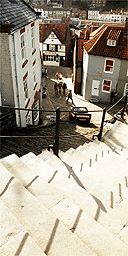
Whitby is a working port with its share of coach tours and amusement arcades, but there's another aspect that shines through: the dramatic location, the medieval streets, the sense of history. On the eastern side of the Esk is the old town, where Church Street leads to the wide run of 199 steps to St Mary's church and the ruined abbey on the headland, and on the other side is West Cliff, with the fish docks and the sands beyond the breakwater.
There are some classy places to stay and eat, and other attractions include the 20-mile cycle path to Scarborough along the old railway line and a wide choice of walking along the coast or among the North York Moors behind the town. In August there's a regatta and a folk week. You can get there by train or National Express coach from London or York. One of the most atmospheric places to stay is the White Horse and Griffin in Church Street, which has open fires in winter and a good fish restaurant. There's also Bagdale Hall (01947 602958) in a street called Bagdale, and 2€ miles outside the town is Dursley Hall (01947 893437), which has plenty of leisure facilities. The old-established Magpie Café (01947 602058) in Pier Road is still the best (and busiest) fish restaurant. Other good places to eat are the Italian restaurant Ditto (01947 601404) in Skinner Street and Green's (01947 600284) in Bridge Street. Another recommended restaurant is the Endeavour (01947 840825) in the spectacular coastal village of Staithes, nine miles, or four hours' walk to the north. For more information, call the tourist information centre on 01947 602674 or visit www.ycc.org.uk.
Tenby
This little town on the southern Pembrokeshire Coast (Dinbych-y-Pysgod in Welsh, meaning "little fort of the fishes") has avoided the worst aspects of commercialisation and caters successfully for visitors ranging from young surfers to the wealthier set. It also has a slightly dodgy reputation as a venue for stag and hen nights. There are two sweeping beaches, an old town dating from Norman times, and narrow cobbled streets winding down to a harbour where the day's catch is sold on the quayside. A big attraction is boat trips to nearby islands, especially Caldey Island 20 minutes away, where a small community of Cistercian monks will sell you perfume, dairy products and chocolate.
Tenby is on a direct railway route from Swansea (1.5 hours) and the tourist office (01834 842402) is on The Croft. Top-of-the-range hotels include the Atlantic (01834 842881) on The Esplanade, the Fourcroft (01834 842886) on North Street and the smaller Penally Abbey Country House Hotel (01834 843033). The best restaurants include the Plantagenet House (01834 842350), the Reef (01834 845258) and the Mews Bistro (01834 844068). For more information, visit www.pembrokeshire-holidays.com .
This picturesque town isn't strictly speaking by the sea, but it was in the Middle Ages. Now the Rother is silted up and it's two miles to some fine beaches such as Camber Sands, but the town - Tudor, with Georgian additions - retains its Fishmarket Road and Rope Court. It's touristy, but retains a certain magic and sense of class. Literary overtones, too - Henry James spent his last years in Lamb House on the sloping, cobbled Mermaid Street, and it was here Radclyffe Hall wrote the pioneering lesbian novel, The Well of Loneliness.
Rye
Rye is 1.5 hours by train from London, via Ashford, and there is an hourly bus between Brighton and Dover which stops here. The tourist office (01797 226696) is on Strand Quay. The Mermaid Inn (01797 223065) on Mermaid Street is a luxurious place to stay, as are The Old Vicarage (01797 222119) and Jeakes House (01797 222828). Best restaurants include the fish-orientated Flushing Inn (01797 223292) in Market Street and the Landgate Bistro (01797 222829) in Landgate Street. For more information about places to stay and eat, visit www.rye.org.uk.
Portrush
Portrush Northern Ireland's seaside towns tend to be cheap and cheerful, but Portrush on the north Antrim coast has formed a management committee to improve the Victorian buildings, restrict the amusement arcades and generally push the place up market. It has a few top- class restaurants, and nearby are some excellent windsurfing beaches, a fabulous, castle-studded rocky coastline and the famous Giant's Causeway.
Hotels in the town itself are modest, but include the newly built three-star Comfort Hotel (02870 826100) in Main Street. The Bushmills Inn (02820 732339) in nearby Bushmills, home of the whiskey distillery, has charm and excellent food, while the Causeway Hotel near the Giant's Causeway (02820 731226) is a delightful, family-run hotel. The Ramore Wine Bar Restaurant (02870 824313) on The Harbour in Portrush has very good food. Snappers (02870 824945) on the road between Portrush and Portstewart, specialises in fish. For further information call 02870 327720 or visit www. causewaycoastandglens.com or www.discovernorthernireland.com.
