
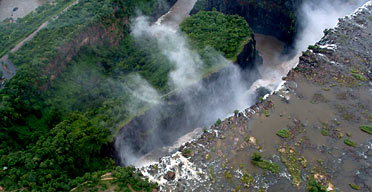
The boat ride along the upper Zambezi river to Livingstone Island is unnerving. Resident crocs and hippos aside, the island is perched at the very top of Victoria Falls. As you approach, a wall of white spray rises hundreds of metres into the air, warning of the cascade's mighty presence. Miss the landing and you'll soon be freefalling 100 metres, swept along by the 550 million gallons of water that tip over the edge every minute.
Thankfully, our powerboat driver delivers us safely to a small sandy shore. As we set off down a narrow path lined with lush creepers, the rising rumble of tumbling water hushes our conversation, spray soaks our cheeks and then the world abruptly stops on a black basalt ledge. Beside us, the two-kilometre wide, languorous river pours over the edge in a linear series of cascades, channelled here and there around grass-tufted islands. Far below, obscured by clouds of opaque, shifting spray, the river reforms as a churning cauldron of foam.
Our view of Victoria Falls is much the same as when Dr David Livingstone became the first European to set eyes on them 150 years ago. Helped by Chief Sekeletu, Livingstone arrived in a dug-out paddled by local Makololo tribesmen. In naming the waterfall after his queen and enthusing that "scenes so lovely must have been gazed upon by angels in their flight", in his autobiographical Journeys in southern Africa, Livingstone put the cascades on the map. Today, 300,000 visitors come every year to marvel at the natural wonder the locals still call Mosi-oa-Tunya, "the smoke that thunders".
Nowadays there are many more ways to view the falls than simply emulating Dr Livingstone's first visit. For an angel's-eye view you can hitch a ride onboard a microlight, Tiger Moth plane or helicopter; to feel the raw power of the river you can zigzag round the rapids of Batoka Gorge; and for a topsy-turvy view you can bind your ankles with a bungee and fling yourself from Victoria Bridge. During the dry season you can even swim across the river, barely an arm's length from the lip of the falls, to a natural pool. Here you can sit and watch water tumble past your shoulders into the abyss, while young tigerfish nibble your ankles.
With the water levels too high to make swimming possible during our rainy-season visit - thankfully - we opt instead the helicopter. Our pilot steers us east along the river before circling twice over the falls to return over the buffalo herds and elephants of Mosi-ao-Tunya national park. Hovering above the falls, it seems as if the Earth has split open in a series of deep fissures. These mark the falls' progressive retreat as the water exploits weaknesses in the basalt. "You can see a new crack opening up at the end of the current falls," our pilot shouts above the chopper's drone, while executing a stomach-churning turn to point out a dark, wedge-shaped inlet directly below our feet. "In a few thousand years that will become the new face of Victoria Falls."
The waterfall is the world's second highest and the Zambezi is Africa's fourth largest river. After bubbling up between the roots of a tree close to the point where Zambia, Angola and the Democratic Republic of Congo meet, it travels 2,700km through six countries before emptying into the Indian Ocean from Mozambique. Above the falls, it slides slowly past tobacco farms and thatched-roofed rondavels, where chickens probe the dust and Tonga children shout "mwabuka buti?" (how are you?) excitedly at passing boats. Below, it flows to the Kariba Dam, then onwards through the Lower Zambezi and Mana Pools National Parks, where its current sustains mopane and acacia forests and quenches the thirst of lions, leopards and elephants.
For 500km above and below Victoria Falls the river divides Zambia from Zimbabwe. In the past, most people on the Livingstone trail headed to the Zimbabwean town of Victoria Falls but political turmoil in the country has increasingly diverted visitors across the river, prompting new hotels to spring up. We spend few nights at one of the latest additions, the Islands of Siankaba. Comprising six tented chalets located on a forested island in the middle of the Zambezi, the lodge blends rustic Africa with contemporary chic. Raised walkways mean we don't have to worry about sharing the river banks with territorial hippos - but the canvas walls ensure their guttural groans, accompanied by a gamelan orchestra of tree frogs, do lull us to sleep.
The closest town to the falls on the Zambian side is Livingstone itself. It was named by the British who administered Northern Rhodesia - as Zambia was formerly known - from the late 19th century until it gained independence in 1964. That it retains the name of the Scottish explorer, while streets such as Empire Way and Royal Mile have long been replaced by local monikers, is thanks to Dr Livingstone's enduring status as a tourist magnet - and also to the Zambians' lingering respect for his crusade against slavery. Though Livingstone initially travelled to Africa as a Christian missionary, he also hoped to end slave trading by opening up the African continent to legitimate commerce. He made many friends in Africa; on his death in 1873, his loyal African companions Susi and Chuma carried his body for 1,600km to the coast, believing he would want to be buried in Britain.
The doctor's life is commemorated in the newly renovated Livingstone Museum, which stands beside the smart red-brick offices of the town's civic centre. Inside are three galleries, one of which is devoted entirely to the explorer's life. Photographs, ranging from straight-faced family portraits to a snap of the shady tree under which Livingstone "proposed love to Mary Moffat", sit beside the explorer's battered medical chest, well-thumbed hymn book and a royal sword presented to him by Chief Shinde. We learn how he became the first European to cross Africa from West to East; how he was mauled by a lion but lived to tell the tale; and of the meeting with New York Herald journalist Henry Morton Stanley, who greeted the explorer with a question that has beome one of the most famous of all time: "Dr Livingstone, I presume?"
This year, Zambia is planning several events to celebrate the 100th anniversary of Livingstone town's founding and the 150th anniversary of the explorer first sighting the Victoria Falls. These range from festivals in Livingstone, attended by local tribal leaders in their traditional costumes, to an Oxford-Cambridge boat race on the Zambezi. In November, the man considered by many to be the world's greatest living explorer, Sir Ranulph Fiennes, will recreate part of the journey that Dr Livingstone made exactly 150 years before.
Over four days, accompanied by local dignitaries and four Zambian dug-out canoers, Fiennes will travel some 180km along the Zambezi, from Mwandi (the original village of Shesheke that Livingstone witnessed in his journals) to the lip of the falls. The group plans to recreate the original journey as faithfully as possible, walking in places and camping at night on the river banks. On reaching Livingstone Island, Sir Ranulph, like us and thousands of others before, will get his very first glimpse of Victoria Falls. He'll then unveil a commemorative plaque in honour of the pioneering man who introduced the "smoke that thunders" to the wider world.
Way to go
Getting there: British Airways flies directly to Lusaka three times a week. Various other airlines offer connecting flights, usually via Nairobi in Kenya or Johannesburg in South Africa.
Accommodation and activities: Scott Dunn (tel. 020 8682 5070) organises trips to Zambia incorporating visits to Livingstone and Victoria Falls, plus game viewing in South Luangwa National Park. Carolyn Fry stayed at the Islands of Siankaba, Tongabezi and Mfuwe Lodge.
Further Information:
· Zambia's National Tourist Board
· Zambian Horizons: This network of safari camps in Zambia aims to spread awareness about the country's lush scenery and diverse wildlife
· The Royal Geographical Society has more information about Dr David Livingstone
Country code: +260
Flight time: London-Lusaka: 10 hours
Time difference: + 2hrs
Currency: £1 = 8,320 Kwacha
