
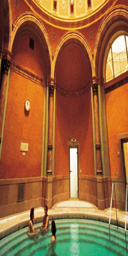
Its sulphur-laden waters attracted so many visitors in the 18th century that the little town of Spa in Eastern Belgium became known as The Café of Europe. Those who cared for its curative baths included Czar Peter The Great and Venetian lothario Giacomo Casanova.
Had either man or the community succeeded in copyrighting the name, their fortunes might have been different. Instead, Spa has spawned a worldwide wave of imitations that are now scaling new peaks of popularity.
While the elderly and infirm may still find comfort in traditional waterholes, today's mainstream client swims unceasingly in search of body- and spirit-enhancing wellness, the watchword of the new century.
No new hedonistic hotel anywhere in the world is complete without the three letter appendage floating in its basement. But what puts the "aah" into today's spa?
Forget clinical white walls and fluffy pink beauty parlours, the best are uncluttered and minimalist, with a library of enticing aromas.
An exotic swimming-pool is a central design feature. They come in marble, black slate, mosaic, or even glass-walled. You can find them with or without rocky waterfalls, statues, Renaissance-style frescoes, or - in one case - a roaring log fireplace.
Must-have extras include whirlpools, saunas, steamrooms, Epsom-salt flotation tanks, relaxation grottoes, modern gyms, and studios offering classes from pilates to yoga.
Latter-day spas ranges from the totally traditional to the hippy-dippy. An average treatment list now reads like a menu in a gourmet restaurant. It includes such inedible delights as seaweed wraps, coconut scrubs, and papaya baths.
Asian spas employ exotically spiced oils, while thalassotherapy spas utilise seaweed and seawater. Then there are volcanic spas where the smell of sulphur overwhelms, and even Bacchanalian vinotherapy spas in wine-growing regions.
North American establishments delight in stone therapy, where hot volcanic rocks are placed on strategic parts of the body, as well as Ayurveda, an holistic healing system from India that majors in massage oils suited to your psyche.
Hands-on massage can be Balinese synchronised, Hawaiian, Japanese, or plain ordinary Swedish. Wraps come in herbal, honey and ginger.
But even the most futuristic spas have their roots in the earth. Italian fango mud, Yorkshire moor peat and glutinous tropical plant extracts are all basic parts of the Wellness Way.
Hydrotherapy, reflexology, acupuncture and other such alternative tools also act as spa benchmarks in the lucrative quest for the Elixir of Life.
Prices start at around £15 for a modest pedicure to £300 for a full day's makeover.
And you can still visit Spa (spa-info.be) - with its seven water wells and springs and Bath House - and drink the water and have a treatment.
