
Unspoilt Symi, a two-hour ferry crossing or 45-minute hydrofoil ride from tourist-heaving Rhodes, has perhaps the most beautifully delineated harbour of the Hellenes. Random stacks of neoclassical houses in cream and yellow pile up the hillside from the horseshoe-shaped bay.
First-time visitors stepping off the boat in the heat of the day need to take their introduction to Symi one step at a time - an exhausting 375 of them lead up from the Kali Strata at the harbour to the district of Horio, the heart of the island where most of the locals live.
Symi was once the sponge-diving centre of Europe and in the 19th century the island's population topped 25,000. Now it has only 1,700 permanent residents, and is still untouched by mass tourism. The only hazards, other than the steps, are the roaming goats, cows and donkeys.
At Villa Hanni, my destination at the top of the steps, the bougainvillea mingled with orange and lemon blossom. I was here to improve my horticultural skills for an English garden in the most unlikely location.
"Learn about gardening... in Greece," said the brochure. "A little basic knowledge is expected, but no one is required to know the Latin names of all the plants." Since all of it was Greek to me, this seemed an apt place to come to learn.
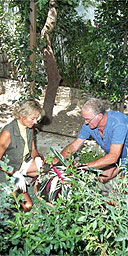
Symi resident Peter Jones runs the gardening courses four times a year, along with his partner Patrick McGivern. Peter may lack the svelte delivery of Alan Titchmarsh and Patrick the charms of Charlie Dimmock, but they certainly know their fuchsias from their foxgloves.
Within minutes, Peter had us scrabbling about on hands and knees. Demurely, we lined our terracotta pots with water-sodden newspapers to retain moisture, and coated the rim with Vaseline to ward off slugs and snails. "Tubs," he explained, "are like fridges. The more you put in them, the more economical they are to run. The idea is to transform a bedraggled pot into one of voluptuous beauty. Never leave a dead plant in a pot, and never leave a pot empty."
Peter was born with green fingers; he knew he was going to be a gardener from the age of six. He trained under Constance Spry and at Cambridge University Botanical Gardens, and has worked in some of the greatest English gardens including Wisley, Sudeley Castle, Ramsbury Manor, Sissinghurst, and for Sir Terence Conran at the exquisite Leonardslee in Sussex.
At the end of our four-hour gardening session it was time to explore. The attraction of Symi was easily apparent. Eight miles long by five miles wide, it has six taxis, scooter hire - but not car hire - and an hourly bus service along the meandering road between the town and the narrow shingle beach at Pedi Bay.
Lack of sand and the fact that Symi can only be reached by hydrofoil or a tedious ferry journey after a four-hour flight has done much to prevent the Captain Corelli knock-on of mass-market tourism and soaring property prices.
The Panormitis Monastery on the other side of the island sits in solitary splendour. It attracts pilgrims who can stay in the attached guesthouse, and you can go there on one of the island's organised day trips.
The monastery also has a museum, which houses such eclectic exhibits as models of crocodiles and more than 20 glass bottles containing messages that have turned up by "sea mail" from around the world, including one allegedly from Halifax in Canada and another from Milan. It seems that the converging currents in the waters off the monastery act as a natural collecting point for international jetsam.
Back at the harbour, familiar characters add detail to the proven holiday tableau of azure seas and shaded restaurants. Theo, at his shop the Symi Sponge Centre, gives a daily lecture on the history of Symi sponges to passersby.
Taverna Katerinette, on the harbour front, is where independence for the Dodecanese was declared on May 8, 1945. Nearby, Manos's fish taverna specialises in fresh lobster and shellfish, while his wife Mina runs a hairdressing and beauty salon fitted out with chandeliers and giant baroque mirrors. The rotund figure of Michalis, the harbour master, is never far from the waterfront and is always dressed top to toe in colours that match the vehicle he is driving - usually red or bright green - tie included.
Laskarina is the fabled Greek heroine whose army and navy fought the Turks during the Greek war of independence in the early 19th century. It is also the name of the tour operator which runs the gardening courses on Symi for four weeks each year.
Owners Kate and Ian Murdoch first fell in love with the Greek islands while spending their honeymoon on Spetses. Ian was in marketing and Kate in the textiles industry. Then came the day in 1976 when they opted out of the rat race and settled on Spetses for Kate to write a book. They rented a house with more space than they needed, let some rooms to friends, and the company was born.
Since then their portfolio of destinations has spread across the Aegean from their base in rural Derbyshire. Emphasis has always been on tranquillity. When prices in Spetses soared with the advent of mass tourism, they shifted their own holiday home to the Villa Hanni where Kate developed her English garden. They enjoy 70% of return business throughout the Greek islands, and have gathered something of a cult following in the 27 years since they started.
The secret is the company's staff. All are aged over 30, and many have married locals or bought properties on the islands on which they work. Jane on Tilos was a Radio 4 presenter, while Sally on Lipsi was an opera singer and Phil on Samos chief hair stylist at Harrods. Simon, also on Samos, is the grandson of the British brigadier who signed the papers to liberate Symi and the other Dodecanese islands from the Germans at the end of the second world war.
They greet their customers as the friends that they often become. "We like being looked after," said Eileen Nichols, a client for 22 years, who writes novels for Mills & Boon and used the island as a setting for one of her stories. "We feel as if we're part of a family and it's like having a summer home on the island."
Jennifer Sollis from South Wales was on her ninth holiday to Symi with Laskarina: "They're so reliable, I just wouldn't trust anyone else," she said. "This time I thought the cookery course would be fun". Laskarina offers cooking weeks in tandem with the gardening, so one of you can cook while the other gardens. The cooking courses are run by Stravos Gogios, from the small kitchen of his Mythos Taverna. There were six of us on the course and the results were as successful as the gardening.
Like the bottles at the monastery museum, the visitors return. I will certainly be back - and not just to hone my gardening skills.
Getting there: Laskarina (01629 822203 Laskarina) offers the Villa Perivoli apartment for three on Symi, with uninterrupted views of the harbour from its large balcony, a modern kitchen and bathroom, and split-level sitting room and bedroom. It costs from £470 to £675 per person per week depending when you go, including flights and transfers.
Courses: Cooking with Stavros costs £220pp, and the Learn about Gardening course costs £275pp; both are for one week in May or October (four courses a year). Painting and walking courses with Laskarina are also available on Symi and other islands. Peter Jones and Patrick McGivern will come to your garden in Britain for £150 per day (plus travel from their base in Cheltenham) to advise you on what you already have and what else to grow in your garden. Contact them on 01242 526040.
Further information: The Greek Tourist Office, 4 Conduit Street, London W1R 0DJ (020-7499469). Country code: 0030. Flight time London-Rhodes = 4hrs. Hydrofoil Rhodes-Symi = around 2hrs. £1 = 1.52 euros.
