
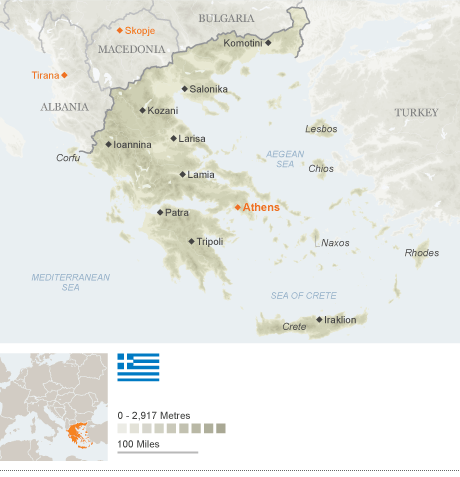
Sun-drenched beaches, extraordinary archaeological sites, spectacular landscapes and good food make Greece a favourite European destination. Situated on the Balkan peninsula in the Mediterranean, it is surrounded by some 1,400 islands to which thousands of Britons are drawn each year. Paros, Santorini, Crete, Karpathos and Patmos are highlights; Mykonos and Lesbos are popular on the gay scene.
The capital Athens is not a long-stay destination, but many visit the ancient Parthenon (minus Elgin's Marbles) and nearby Plaka. Sites of historical interest run the gamut from Roman, through Byzantine, Venetian and Turkish. Key sites are: the Byzantine city of Mystra; Olympia, Mycenae and Corinth in the Peloponnese; Knossos in Crete; and the rock-cut monasteries of Meteora.
Of the 10.6m population, 97% are Greek Orthodox. The Ottoman Turks ruled Greece from 1450 until 1829, and had a lasting influence on the cuisine, culture and music. Little love is lost between the two nations today; ongoing territorial disputes exist with Turkey in the Aegean, and Cyprus remains divided. Intensive fishing, tourist development and sea pollution has taken its toll on sea life, such as the giant turtles whose habitat on the island of Zakinthos is under threat.
News and current affairs
Greece's online publications from the world news guide.
Language
Greek; English widely spoken, even by those not in the tourism industry.
Climate
Mainly Mediterranean, though the far south is subtropical. Summer can be extremely hot and dry, often exceeding 38C (100F) especially in the interior. Coastal areas and the islands are usually cooler due to sea breezes. Winter (November to March) is mild and wet, much colder in the north.
Health
Long term visitors should consider hepatitis A immunisation.
Food
Typical dishes include pastitsio (pasta baked in meat sauce), moussaka and grilled meats. Mezzes will include vegetarian elements such as dips, feta and haloumi cheese, vegetables and olives. Greek salad - tomato, olives, cucumber and feta cheese - is available everywhere. Vegetarians can also request spanakopita (spinach and cheese pie), dolmades (rice wrapped in vine leaves) or yemista (vegetables stuffed with rice). Seafood, particularly kalamari, is widely available. Fruit is often a dessert option. Worth noting that restaurants are commonly open past midnight.
Events
Orthodox Easter: Usually a week or two behind Easter in most of the EU, celebrated with processions and fireworks.
What to buy
Silver jewellery, often in the shape of animals important to ancient Greek myths such as dolphins or owls; reproduction terracotta, black vases and rude statuettes; and byzantine icons. Those who'd rather decorate their cocktail cabinets can buy ouzo, a colourless aniseed flavour drink, local brandy, or retsina wine - an acquired taste, guaranteed to transport you back to the taverna. But if you can't be bothered to drag it home, retsina can also be found at Waitrose.
Embassies and Visas
UK: The Embassy of Greece, 1A Holland Park, London W11 3TP (7229 3850, visa information line 09001 171202).
Greece: The British Embassy, 1 Ploutarchou Street, 106 75 Athens (30 1 72 72 600).
Visa requirements: UK, EU and US citizens do not need a visa for tourist visits of up to three months.
Currency
£1 buys approx. 1.45 euros.
Timezone
GMT +2. Daylight saving time (GMT +3) from March to October.
Getting there
Direct scheduled and charter flights from the UK to several cities and islands including Thessaloniki, Crete, Rhodes and Corfu. The national carrier, Olympic Airways (0870 606 0460), flies from London and Manchester to Athens and Thessaloniki, with connections to 35 domestic destinations. Ferries link Greece with Italy, Turkey, Israel and the Republic of Cyprus, as well as the islands; but some are in poor repair. Bus connections with Turkey, Albania, Macedonia and Bulgaria. Rail links to Macedonia and Turkey.
Related literature
The Heroic Age, Stratis Haviaris: Set in north Greece in the late 1940s, this moving novel gives a child's viewpoint of events during the civil war which ended with the defeat of communist forces at the border with Albania, and Greece's joining Nato.
Prospero's Cell, Lawrence Durrell: First published by Faber in the 1930s, this 'guide to the landscape and manners of Corfu' is still of interest, if now largely historical.
The Colussus of Maroussi, Henry Miller: Miller's unusual personal experience and perception of Greece.
