
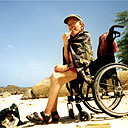
There's nothing I like better than being packed up and ready for adventure - whether it's a trip to an unfamiliar part of the UK or somewhere on the other side of the planet. Being a wheelchair user makes no difference to the feelings of excitement and trepidation, but sometimes we need to have other ways of doing things; a little foreknowledge and planning can be invaluable. I'm well aware that 'disabled' is not a synonym for 'wheelchair user' but here are a few pointers.
For the independent, backpacking disabled traveller, detailed information on remote and exotic locations can be hard to come by. Like your able-bodied counterparts, you should aim to be as self-reliant as possible. Travelling with a strong companion is certainly advisable, though it's worth remembering that one is rarely devoid of willing helpers wherever one happens to be. In my own experience, which was of travelling in Thailand, this was certainly the case. Incidentally, there is a thriving deaf community, fluent in sign language, who run their own market stalls along the Khao San Road in Bangkok.
Of the many guide books available I prefer Lonely Planet, but whichever you choose this will be one of your most important bits of kit. Lonely Planet also has a website which has a disabled area in its 'Thorntree' section, where travellers can talk to each other. It's always a good idea to talk to fellow travellers 'on the road', too. Search the Disability Now archive for disabled travellers' experiences. Rough Guide and Lonely Planet both now have sections dedicated to the disabled traveller, but these often just tell you how hard the going is. Hopefully bits of information like gravel warnings and hard-going approaches will start to creep into the main body of these guides.
I took far too much stuff on my first trip and ended up ditching a good deal. Now I take a very small rucksack which hangs on the back of the wheelchair, containing a guide book, a few clothes, a medical kit and little else. The advantage of travelling light is that you can manage your own gear should you have to. Practise lugging your stuff around and you will discover the easiest ways of doing things before you leave. Be prepared to improvise, forget convention and do whatever's necessary to get about, even if this means crawling or shouting for assistance. You are unlikely to find stairless accommodation outside of urban hotels. The tropics are prone to frequent flooding and kerbs can be high, up to around a foot, meaning pavements are pretty much blocked all the way (this is also true of much of Europe), so the wheelie can be a useful trick.
Disability equipment should be the best you can afford while remaining as low-tech as possible. My own 'chair is very light and can be lifted and dragged about easily. I always take a small tool kit for emergency repairs and solid 'green' tyres mean no disastrous punctures. Where local people are used to making do with old bikes and motors they tend to be handy with mechanical repairs, too.
Before going anywhere I make the effort to get some exercise and lose any excess weight as these trips can be very physically demanding and it's a good idea to be as fit as you can be.
Activities such as boarding trains and boats can be hazardous. Sometimes the only way is to be manhandled or to crawl along narrow gangplanks. The advantage of being beyond western disability provision is that no one is worried about their insurance and will 'let' you do whatever's necessary. All at your own risk, of course, but to me it's well worth it: between the difficult bits there are protracted stretches of lazy living, interesting characters and amazing sights.
