
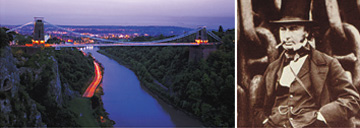
As my pen bounces and my drink threatens to spill, I think of Isambard Kingdom Brunel, Britain's most famous civil engineer. If he had won his "battle of the gauges", this railway would still be seven feet wide (rather than the standard 4'8") and much more stable. Faster too. But the fares would undoubtedly be higher. Brunel, a diminutive 5'3", always wanted the biggest and the best; he wasn't much bothered about economics.
I am travelling from London's Paddington station (designed by Brunel and opened in 1854) on his Great Western Railway. The gauge may no longer be broad, but it is still Brunel's bridges, viaducts, cuttings and tunnels that carry the rails. My destination is Bristol, home to the greatest concentration of surviving Brunel structures and a city about to go Brunel-mad for the great man's 200th birthday on April 9, with celebrations and exhibitions, many of which last until the end of the year.
Right next door to today's Bristol Temple Meads station is Brunel's original station, the oldest surviving passenger terminus in the world (opened in 1841). The engine shed is now home to the Empire and Commonwealth Museum (worth a visit in itself, especially with kids) but the rest of the station, and the viaduct arches beneath it, open to the public for the first time on April 8. The passenger shed still has its platforms, and the recently restored, vast cream-painted roof - modelled on Westminster Hall - was, in its time, the widest-span wooden roof in the world. Upstairs is the original GWR boardroom, site of many a heated argument as the railway's directors tried to rein in Brunel's more extravagant ambitions.
Unlike the Stephensons, Brunel was never interested in transport for the masses; his grand plan was to create integrated first-class travel from London all the way to New York. He built the Great Western Hotel (the façade of which survives as Brunel House, a council office near Bristol Cathedral) to accommodate his passengers overnight and, as engineer of the Great Western Steamship Company, set about building the world's largest and most luxurious ships to carry them on to America.
In the dock
The SS Great Britain - recently renovated and housed in the dry dock in which she was built - is still a hugely impressive vessel. At 104 metres (322ft) long, she was, at the time of her launch in 1843, by far the biggest ship ever built. With her vast iron hull and revolutionary propeller, many people believed she would never float. During construction, she was described as "the greatest experiment since the creation".
The first great ocean liner, SS Great Britain was the Concorde of her day. Her black and gold bulk towers above the water - now just a thin layer, shimmering on a glass floor, part of a piece of modern design I think Brunel would have appreciated. We walk down some steps and find ourselves below "water level" (glass floor becomes glass ceiling) and we are able to wander right round the ship, examining her hull as well as the huge dehumidifier that preserves the metal.
Back on the surface, we board the great deck - feeling like real first-class passengers as we pass below the six tall masts and multicoloured bunting, in front of the thick black funnel (and the ship's cow, pig and chicken coop), down the elegant wooden staircase and into the gilt mirrored promenade, where wealthy travellers could gather and exercise away from the wind and the waves. And the waves could be serious. There is some remarkable 1880s film footage in the ship's museum of waves crashing over the deck as men clamber in the rigging.
There is also - among many other exhibits - a mock-up of the ship's wheel, complete with steaming funnel, ship's compass and shouted directions "from the bridge". In my case, the directions were soon mixed with abuse as I discovered just how difficult it was to steer a ship of this size and weight.
The SS Great Britain is a wonderful place to visit. There is almost complete freedom to roam and to touch, so it is great for children too. Cabin doors open to reveal absurdly small box bunks and historically real passengers and crew (now waxworks) surrounded by their belongings. Visit the African barber, the dying consumptive, the captain's tiny cabin (right next to the first-class ladies' boudoir), the ship's surgeon and the seasick stewardess - whose cabin even smells!
Look into the engine room - as curious passengers did - and from May '06 you will see pistons pumping on a full-size working model of Brunel's engine. Open the loo doors and from one a voice booms out, "go away ... I'm thinking," (childish guffaws all round). This may sound tacky, but the ship actually achieves a perfect balance between a light touch and serious history. Explore, too, the cramped quarters in steerage (also a bit smelly). This was the cheap class added when the ship worked the emigrant route during the Australian gold rush. Apparently 2% of Australians are descended from passengers on the SS Great Britain.
Exhibitions
Next to the ship in the Maritime Heritage Centre is the new Nine Lives of IK Brunel exhibition, with a replica broad-gauge locomotive, one of Brunel's notebooks, the working - and very loud - whistle from the SS Great Eastern (the even larger and financially disastrous ship Brunel built after SS Great Britain) and an interactive challenge relating to the man-sized spinning wheel Brunel rapidly designed to save his own life when, while doing a conjuring trick for his children, he got a coin stuck in his throat.
For more of the science behind Brunel's work, cross the Floating Harbour (also partly designed by Brunel) to another new exhibition. The Forces that Made IK Brunel is full of (child-friendly) interactive exhibits. Race propeller against paddle, build bridges (and in some cases, walk over them!), and travel through a 10-metre tunnel that tells the story of Brunel's first major project, The Thames Tunnel, built with his engineer father Marc Brunel. Still used today to carry tube trains between Wapping and Rotherhithe, the tunnel was the first ever to be dug under a navigable river, and the techniques developed are still at the heart of today's tunnelling machinery.
Pet project
It was after an injury sustained in the Thames Tunnel in 1828 that Brunel first came to Bristol. While convalescing in Clifton, he heard about a competition to design a bridge across the Avon Gorge. The result - once this persuasive engineer had finally convinced the judges that he should win - was Brunel's "darling", the Clifton Suspension Bridge (and another world first - the longest suspended span).
Despite numerous starts, the bridge wasn't actually built until after Brunel's early death, brought on by stress and overwork (and 40 cigars a day) at the age of 53. So he wasn't there to insist on the sphinxes he had wanted to decorate the piers. There was some suggestion that they should be added for his birthday, but you are (perhaps fortunately) not allowed to alter a grade one listed building.
Today, the bridge is managed by the infectiously enthusiastic Mike Rowland - a wonderful guide - who points out the quivering rods and bouncing platform as we (along with numerous cars) cross the bridge. It is really just like a rope bridge in a playground, he says, only stronger and higher. How high? "245 feet, 76 metres or 3 seconds". And Brunel made the crossing in a basket when he was surveying the site.
Having walked across the bridge, the only thing to do is take a ferry ride underneath it. Looking up is at least as spectacular as looking down, and the nighttime view is about to be much enhanced by new illuminations, to be unveiled on April 8, that will wash the bridge and part of the gorge in light.
The ferry ride back takes you through the large harbour lock, within sight of the smaller one Brunel had to widen to get the SS Great Britain out (even he could make mistakes) and past the gleaming bow of the ship herself. We glide through the recently regenerated waterside with its many cafes and restaurants, before arriving back - in a miniature version of integrated transport - at Temple Meads railway station.
Way to go
First Great Western trains between London and Bristol cost from £20.50rtn. From April 1, there has been a limited special fare of £5 each way. 08457 000 125, firstgreatwestern.co.uk/greatfares
Where to stay: The 4* Brigstow Hotel is right on the waterfront. Double rooms B&B from £99/room. www.brigstowhotel.co.uk
Where to eat: Severnshed at Harbourside has excellent food and a "Brunel on the Bridge" cocktail. www.severnshed.co.uk
Brunel in Bristol
Brunel200.com (01275 370 816): information on events including Brunel's Bristol birthday party this Saturday from 7.30pm to 9.30pm around Clifton Suspension bridge. Also see VisitBristol.co.uk and LivingHeritageSouthwest.co.uk.
· SS Great Britain (permanent) and 9 Lives of IK Brunel (April 1 - Oct 31); 01179 260 680; ssgreatbritain.com
· The Forces that Made IK Brunel (Mar 31 - end 2006); 0845 345 1235; At-bristol.org.uk
· Clifton Suspension Bridge, with new visitors' centre opening May; 01179 744 664; clifton-suspension-bridge.org.uk
· The Brunel Tour, Old Bristol Station, April 8 and 9, then two Sundays per month until October (groups by arrangement); 01179 254 980; EmpireMuseum.co.uk
· Ferries: BristolFerryBoat.co.uk 01179 273 416; BristolPacket.co.uk 01179 268 157; WaverleyExcursions.co.uk 0845 130 4647
· New self-guided walking tours: Brunel's Clifton, Brunel's Dockside, Victorian Bristol, available from the tourist office in Wildwalk-At-Bristol, Harbourside 0906 711 2191
Brunel elswhere
· The Thames Tunnel, London. Guided tube train visits April 8 and 9 and occasionally throughout the year; 020 7231 3840; BrunelEnginehouse.org.uk
· The Royal Albert Bridge, Saltash, Cornwall Brunel200.com
· Brunel Manor gardens and Brunel Woods, Torquay, landscaped by Brunel. Open April 8-14 and occasionally throughout the year; 01803 329 333; Brunelmanor.com; EnglishRiviera.co.uk
· STEAM - Museum of the Great Western Railway, Kemble Drive, Swindon; 01793 466 646; Steam-museum.org.uk
Brunel200 Books (to be published April 10)
Brunel: In love with the Impossible - collection of newly commissioned essays, 364 pp, 460 illustrations, £15 if ordered by April 8 or £17.95 (+ £4 p&p). From Brunel 200 book orders, BCDP, Business West, Leigh Court, Abbots Leigh, Bristol BS8 3RA 01275 370 790 Comic-book biography, 96pp, available for a donation (while stocks last) from Brunel200.com 01275 370 816.
