
'Antipasti, pasta, carne o pesce?" said the young man briskly.
"Oh, si." I said.
"Carne o pesce?" he said with a touch of asperity.
"Oh, carne. Definitely carne," I said.
He whisked away. Hardly had I had time to blink when, plonk, came the wine, plonk came the bread, plonk came the antipasti. Hey ho, I thought, and tucked in with a will - there were a couple of slices of mozzarella squeaking between the teeth; a thimble of ricotta like a breath of fresh herbs; a slice of cured ham, cut thick and tasty, sweet and salty; a coil or two of oily grilled peppers; a battered zucchini flower, fried and served cold and, to be honest, not terribly nice. And a substantial quantity of rough-hewn bread, all washed away with a no-name, no-pack-drill wine.
The Cantina di Mustozza at Sapri was not what you would call a smart restaurant. It was clean enough, but slightly beaten around the head, warm and purposeful. You knew you were there to eat. The plate of ex-antipasti disappeared. Plonk, down came a plate of pasta.
"Er, what are these?"
"Cavatelli."
"Oh, thanks." Cavatelli, it seems, is native to this corner of the Basilicata/ Campania borders, and with a heavy-duty tomato sauce made smoky with provola afficumicata (a heavenly smoked cheese) and with that ubiquitous local condiment of olio (olive oil), aglio (garlic) and peperoncino (chilli) served on the side. This was a top-dog pasta dish. "Thank you very much."
Plonk. What's this?
A single raviolo, fat as a down pillow, stuffed with ricotta, lolling in a bright, fresh tomato sauce, brightened still further with clumps of fresh basil. Very nice, too.
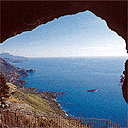
I was travelling by scooter up the left-hand side of Italy, first through Calabria and then along the short coast of Basilicata. Campania lay ahead of me. Of the three regions, Basilicata was the least known to me. It seems to have been by-passed by history since a brief flowering as part of Magna Graecia in the 7th century BC. It's easy to see why. The interior is intimidatingly rugged and mountainous, not made for easy communication or cultivation. Probably because of this inaccessibility, Basilicata has been spared a contemporary invasion by the tourist hordes. The coastline, in particular, is the most spectacular and least accessible in Italy. Sapri, at the northern extremity, is one of the few places where the landscape lowers itself gently to the waters of the Tyrrhenian Sea.
What's this? "Orrechiete con broccoli e peperoncino"
"Another pasta?"
"Si, signore." I was beginning to sweat slightly. I wished that I hadn't hammered the bread with such vigour. Still, it is another potent dish. The broccoli was rather different from the clumps of green stuff in British supermarkets. It was about a thousand times tastier, with a wild, slightly bitter edge, and there was a touch of chilli haunting the edges.
Chilli - peperoncino, if you want to use the Italian - is ubiquitous in southern Italy. So ubiquitous, in fact, that you wonder what they did to ginger up their food before the chilli was introduced to Europe by Columbus. At that time, southern Italy was part of the Spanish empire, and when the southern Italians discovered the capsicum, which grows with easy abundance given enough water and sunlight, they adopted it readily as the spice of the poor. Suddenly all manner of dreary pulses and pastas were given cheery new horizons.
I was feeling rather smug about having managed that third pasta course when a fourth arrived: tagliatelle with prawns in a sauce of prawn stock and tomato. I simply couldn't believe it. Even by the normal generous Italian standards, this was stretching things a bit. Mum popped out of her kitchen to see how I was getting on. I goggled at her, and remembered the meat still to come.
And meat it was, just meat - no sauce, no veg, no sprig of chervil, no dab of this or blob of that, simply a piece of chicken, a chunk of pork, a slab of veal, all grey and inert, and just about as unappetising as it is possible for meat to look. Ah, but to taste . . . the chicken was redolent of the farmyard, the lamb robust with free ranging and the veal subtle and unctuous as an undertaker.
And, yes, I did have cheese after that, and also a little bowl of early-season strawberries, then I mounted my scooter and wobbled off uncertainly in search of a back lane, where I found a peaceful olive grove and fell asleep until evening.
Orecchiette con broccoli e peperoncino
Or ear-shaped pasta with broccoli and chilli. A standard lunch or dinner menu in Basilicata would consist of four courses, and this pasta would be preceded by some antipasti, consisting, say, of a slice of local ham, salami or sorpressata (brawn); a heap of strips of melanzane sott'olio (grilled aubergines); a little mound of ricotta; a sliver or so of grilled pepper; olives. Strictly speaking orecchiette come from Puglia, but let's not get too precious. It would be difficult to find the feral broccoli used for this recipe at the Cantina di Mustozza, so use purple sprouting instead (or even bog-standard broccoli if you can't get hold of the purple stuff). It's almost as good. Serves six.
600g orecchiette 175ml olive oil 600g purple sprouting broccoli, broken up into florets 4 whole dry chillies, chopped fine 4 cloves garlic 3 tbsp breadcrumbs 3 salted anchovy fillets, chopped and rinsed (optional)
Heat the oil in a large pan. Add the garlic and chillies, and fry gently. Cook until the garlic begins to brown. Scoop out the garlic cloves, but leave the chilli. Bring a large pan of salted water to the boil. Plonk in the broccoli for two to four minutes, so that it still has a bit of crunch to it. Scoop out with a slotted spoon and refresh in cold water.
Now it's the turn of the orecchiette. Into the boiling water with them, and cook until al dente (that is, with some bite), around six to 10 minutes, then drain. Now combine the pasta in the pan with the oil and chilli. Toss to coat, then add the breadcrumbs, toss again, and add the broccoli and the anchovy (if using). Mix gently and serve.
Pesce spada in padella
Or pan-fried swordfish steaks. In my long meal at Cantina di Mustozza, it would have been more usual to have not that wondrous meat, but swordfish, which is served universally along the southern Italian coast when in season. Anyway, it's far easier to get swordfish in the UK than meat of a high-enough quality to make that dish work properly. It is critical to make sure that your fishmonger cuts the swordfish thin enough - no thicker than 1cm, preferably half that. The point about this is to cook the fish through very quickly, thus bringing out its flavour without toughening it up. Serves six.
6 swordfish escalopes 170ml olive oil 1 lemon, juice Some fresh oregano (optional) Salt and pepper
Put the fish into a dish. Whisk 150ml of the oil with the lemon juice and oregano. Pour over the fish, making sure each steak is well coated. Cover with clingfilm and refrigerate for four hours. Heat the remaining oil in a frying pan until it is smoking. Put in as many steaks as the pan will hold at a time. Cook for one minute. Turn and do the other side for a minute. Transfer to warm plates. Season, and serve with half a lemon per person.
Cremolata di albicoche
Or apricot ice. Typical of the region is this ice, which I have appropriated from The Food Of Italy by the glorious Claudia Roden. Serves six.
100g or more sugar 200ml water 1 lemon, juiced 500g very ripe apricots, pitted 1-2 tbsp jasmine or orange blossom essence (optional)
Boil the sugar and water until the sugar melts (the amount of sugar needed will depend on the sweetness of the fruit), add the lemon juice, let the syrup cool a little, then blend with the apricots to a cream. Pour into ice-cube freezer trays, cover with clingfilm and freeze for a few hours until hard. Just before serving, put the frozen apricot cubes through a food processor, a few at a time, and blend to a soft cream. You can put the ice cream in a serving bowl and return to the freezer, covered with clingfilm, until just before you serve.
