
"And specially, from every shires ende
Of Engelond, to Caunterbury they wende
The holy blisful martir for to seke
That them hath holpen, when that they were seke."
- Geoffrey Chaucer, The Canterbury Tales
Modern pilgrims to Canterbury, like their medieval counterparts, have to wait until the last minute to catch sight of the great cathedral where one of the most fateful murders of English history took place 831 years ago. While the spires of Salisbury or Ely are visible for miles, and Lincoln sits massively on a high ridge, Canterbury is tucked away modestly in the valley of the river Stour.
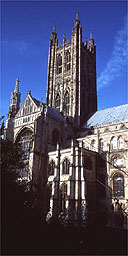
And so visitors arriving from the west have already reached an unattractive roundabout in the suburb of Harbledown before the cathedral comes into view less than a mile away - the twin towers of the west front framing the taller tower of Bell Harry, with its knobbly pinnacles. Rising into a clear sky from the river mists of a winter's day, it is a magnificent and enticing sight.
In Chaucer's times, you'd probably be travelling at a canter - the word originates in the phrase "at Canterbury pace" - to get inside the West Gate before the portcullis came down at dusk. Nowadays your first preoccupation is likely to be the overcrowded parking facilities or the trek from either of the two railway stations to the heart of the city and the cathedral. But you keep glimpsing its creamy Caen stone, shadowed with grey patches of wear and age.
The final obstacle is the pay point at Christchurch Gate, where you'll be asked to hand over £3.50, unless you're a local person with a precinct pass or you declare that you're going in for devotional rather than rubbernecking reasons. There is endless soul-searching over the imposition since 1995 of charges to enter the mother church of the Anglican Communion, but the authorities seem quite content with the results.
One of the most striking things when you finally face the cathedral is that, more than most, it feels like an agglomeration of several different buildings, each with a different appearance and atmosphere. The south-east transept, for example, is an almost intact Norman edifice with multiple dog-toothed round arches and a massive, fortified feel to it, while above it soars Bell Harry tower, delicate and ornate, completed some 350 years later.
Inside, the most dramatic contrast comes between the nave, all height and light and fluted pillars from the heyday of the 14th-century perpendicular gothic, and the more sombre parts beyond. You go up the steps to the quire and presbytery and apse, all built in the more florid and enclosing 12th-century French gothic style with lots of dark marble columns, or down to the huge crypt. This is a shadowy and mysterious place centred on the grotto-like Chapel of Our Lady Undercroft, with its ceiling painted in stars and moons.
But what about Becket? "Everybody asks about Becket," says Barbara Toogood, one of the cathedral guides, leading you from the light and openness of the nave to a dark and hidden place near the entrance to the crypt, beside the steps leading up to the quire. It's called The Martyrdom, and marks the spot where Thomas Becket, Archbishop of Canterbury, was hacked to death by four royal knights as vespers were being sung on the stormy late afternoon of December 29, 1170.
Thomas had been Henry II's chancellor and close friend, but when he was made Archbishop he discerned a higher authority than that of the king. Their quarrels over the jurisdiction of ecclestiastical courts, the appointment of bishops and the right to crown kings ended with Henry's outburst against the "drones and traitors" who allowed him to be "treated with such shameful contempt by a low-born clerk".
The knights confronted Becket in the Archbishop's Palace, and when he refused yet again to agree to the king's demands, they went off to collect their swords and axes while he went across to the cathedral. They caught up with him on his way to the high altar, and when he turned to face them they cut him down: one blow, sliced the top off his skull and spilled out his brains on the floor. The stones which were once soaked in his blood now have the word "Thomas" cut into them in red lettering, and above a simple black stone table hangs a modern sculpture of three jagged, red-tipped, downward-pointing blades. Every year it is visited after evensong on December 29 by a candle-lit procession carrying red flowers.
The simple memorial in the Martyrdom is all that is left: the gold-plated, jewel-encrusted tomb in the Trinity Chapel which housed his body for three centuries, and the casket in the Corona which contained the sliced-off part of his skull, were destroyed very deliberately by Henry VIII when he dissolved the monasteries in 1538. Twenty-six cartloads of treasure trundled off to London, and the bones were burnt.
The cathedral has many other attractions, such as the stained glass and the tomb of the Black Prince. Near the cathedral are the other two components of the Canterbury World Heritage Site - the remains of the Abbey founded in 598 by St Augustine in his Christian mission to Britain, and St Martin's Church, which dates to Roman times and is the oldest parish church still in constant use.
The Canterbury Tales visitor attraction offers sounds, sights and smells from medieval pilgrimages, and the Eastbridge Hospital, with a 12th-century wall-painting of Christ, shows you where footsore pilgrims would stay. There is a decent set of museums, pleasant punting on the river in summer, and the Marlowe Theatre, named after the playwright Christopher, who was born in the town.
There is a pleasant walk with cathedral views along the city walls, past the Dane John gardens with their monument-topped mound and children's maze: the name is a corruption of the French donjon, because it's near the castle. This, however, is as much a disappointment as it was in the days when it capitulated to every passing attacker - the French Dauphin in 1216, Wat Tyler's men in the Peasant's Revolt of 1381 and the Parliamentarians in the Civil War. Any castle-seekers staying in Canterbury would do better to visit the more robust ones at nearby Dover, Bodiam and Leeds.
10 things to see in the cathedral
1 The Nave: clusters of creamy-coloured columns, thinner at the top, with rib vaults and gold ceiling bosses.
2 The ceiling of Bell Harry tower: elegant fan-vaulting and a central painted rose.
3 The Martyrdom: the spot where Archbishop Thomas Becket was murdered in 1170.
4 The Quire - especially the view from its entrance towards the Throne of St Augustine and the Apse.
5 The medieval Bible windows in the north quire aisle: three out of 14 showing Biblical stories that survived destruction by Cromwell's soldiers.
6 The tomb of the Black Prince, teenage warrior, complete with replicas and originals of his colourful funeral vestments.
7 The Chapel of Our Lady Undercroft in the Crypt, with statue of Virgin and Child and newly-restored moon-and-stars ceiling.
8 The Hales Memorial in the Nave, vividly depicting death at sea in Elizabethan times.
9 The fan-vaulted cloisters and water tower. The cathedral turned down a bid to film Harry Potter here - it was done at Gloucester Cathedral instead.
10 The "wagon-vaulted" ceiling of the Chapter House, painted in gold and red in the 15th century.
Way to go
Getting there: Canterbury has two stations, East and West, reached in 1one and a half hours from London Victoria or Charing Cross: National Rail enquiries: 08457 484950. By car, use the M25, the M2 and the A2. There are long-term car parks and a park-and-ride system. National Express coaches run from London and other cities; enquiries: 08705 808080. Kent County Council public transport information line: 0870 6082608.
Where to stay: Canterbury Visitor Information Centre (general enquiries, tel: 01227 766567, canterbury.co.uk) publishes an accommodation guide and operates an accommodation booking service, tel: 01227 455567. The County Hotel (tel: 01227 766266) has four stars, and two three-star hotels are the Chaucer (tel: 01227 464427, thechaucerhotel.co.uk) and the Falstaff (tel: 01227 462138, corushotels.com/thefalstaff).
Where to eat: Sully's Restaurant at the County Hotel (tel: 01227 766266), features in the Good Food Guide. Lloyds Restaurant (tel: 01227 768222, lloydsofcanterbury.com) has a French and modern British menu. Jacques (tel: 01227 781000) has live music at night. There are several good fish restaurants at Whitstable, eight miles away.
Main attractions: The cathedral: for opening hours and times of services (three on weekdays, five on Sundays) phone: 01227 762862 or visit canterbury-cathedral.org. The Canterbury Tales visitor centre (tel: 01227 479227, canterburytales.org.uk). Chaucer Centre, an exhibition on the life work and times of the poet (tel: 01227 470379). Heritage Museum (tel: 01227 452747). Roman Museum (tel: 01227 785575). Royal Museum and Art Gallery, (tel: 01227 452747) Visit canterbury-museums.co.uk for more details on the last three.
