
'And this is your room.' Standing at the wraparound windows, chilled by the air-conditioning, I look out over the clipped lawn that edges into reeds and mud. On the other side of the olive-coloured Sand River, impala are grazing, while a giraffe noses at an acacia. There's another slow movement at the edge of my vision and, turning to the right, I see eight elephants - a few adults and about three babies - out for a riverside stroll. It takes a couple of hours for them to parade past Main Camp, what with the feeding, the dust-tossing and the water-spraying, but we keep an eye on them as we unpack, as we eat lunch under a parasol, as we sit on the submerged shelf at the edge of the swimming- pool, in between lengths. They pass within a quarter of a mile of the camp and by 3.30 have vanished into the bush.
Shane, the ranger who has been assigned to look after us during our stay at Mala Mala, says we will catch up with them later. After introducing us to David, the Shangaan tracker, he clips a rifle on to the bonnet of a large, roofless Land Rover and hops up into the driving seat. 'I have a feeling we might see some lions this afternoon. But we'll look for the elephants first,' he says, adjusting the radio earpiece which allows the rangers to stay in touch with each other. 'Ready to go?'
Of course, we nod and climb aboard. We do not say that the thought of going out into the South African bush to look at lion in a vehicle that lacks a lid seems, on a visceral level, the height of folly. We are already in thrall to Shane, with his gun, big boots, Oakley shades and deadpan manner. He made quite an impression at lunch, with his Dr Dolittleish small talk with the green-spotted dove.
The Land Rover leaves Main Camp, a network of comfortable, thatched rondevals splashed with bougainvillea, and heads into another world, where bush opens on to plains littered with blackened tree stumps (hungry elephants find it more convenient to uproot than stretch). David stands up at the back, methodically scanning the horizon, as clouds of pale dust rise behind him. In an hour and a half, we see countless giraffes, baboons, vervets, warthogs, kudus and waterbucks, the last lucklessly marked with big, white targets on their bottoms.
David whistles to Shane and points to the left: we career into the veldt, bouncing over shrubs that flatten like candyfloss underneath the wheels. Because Mala Mala is privately owned (it's the largest tract of privately owned game land in South Africa), vehicles are not confined to the roads, as they are in the Kruger National Park. And since the 19-mile boundary between the Kruger and Mala Mala is no longer fenced, so the animals can move freely from one to the other, the chances of getting really close to the big five (elephant, buffalo, white rhino, leopard and lion) are unparalleled here.
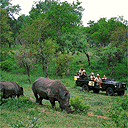
A grey boulder shifts behind a bush. Shane brakes and immediately cuts the engine. There they are, six feet away, ranging in size from the monumental to the tree-ornament, trunks raking industriously through the rushes, shovelling greenery into surprisingly pink, dainty mouths. Their small eyes move over us without much concern: all the animals at Mala Mala are accustomed to the rangers getting close and, since the vehicles never do any harm, they are usually tolerated, even ignored.
Shane tells us that scientists have recently found that elephants communicate through low-frequency noises, just as whales do, and sitting there a few feet away, we feel rather than hear the sounds they make: rumbles so deep they are almost imperceptible, beneath the sound of breathing and tearing and munching. Their proximity is electrifying, not least when one female, protective of her offspring, who is bumbling about between her feet, spreads her ears and raises her trunk significantly.
Shane tells a story about one particular guest, an Italian woman who, like Withnail, came on holiday by mistake. It emerged that she was terrified of everything she saw. When the tracker pointed out a leopard, she crawled under the seat. When it mock-charged the Land Rover, she threw up. Shane has a mordant sense of humour, which must come in handy when guests ask questions such as: 'Do giraffes hunt in packs?' and: 'Is that thorn tree carnivorous?'
At night, as we eat supper in the boma - a circular enclosure, where livestock was traditionally corralled at night - he winds up the other rangers by surreptitiously imitating lion roars. Later that night, as my husband and I are dropping off to sleep, we hear the noise again. This time, it's the real thing.
All the rangers at Main Camp are white, but this is bound to change with affirmative action: prospects for the next generation of qualified black rangers are extremely good. The work is tough: the rangers, most of whom have degrees in zoology or grassland science, are up before dawn, spend the whole day driving through rough terrain, and are always the last to bed, since they have to escort guests back to their rondevals after supper. Why? Because there are no fences around Main Camp and lions have been known to mosey around it after dark.
If the hours are extreme, so are the rewards. Another guest turns out to be an ex-ranger, now in business in the UK, who has treated himself to a return trip. Among the other visitors is an elderly couple from Monaco who have visited every year since the Sixties. In those days, cocktails were served every evening in the Treehouse, a platform high in a leadwood tree, while, many feet below, lion dined on a sacrificial impala. The Treehouse no longer exists. It fell off its branch several decades ago, shortly after the martini glasses had been cleared.
The three days we spend at Mala Mala are not restful. They are long, tiring, occasionally frightening, but always exciting. At 5.30am, just after dawn, the alarm call comes through. Half an hour later, after a cup of tea and a muffin, the Land Rover heads off for four hours in the bush. You're back in camp by 10am and spend the middle of the day catching up on sleep and food. At four, as it's starting to get cooler again; there's another five-hour drive: you won't return until the Moon and stars, and some of the biggest insects ever to get tangled in your hair, have come out. The radio link means that sightings are pooled: time is not wasted trogging around in the hope of stumbling across something.
Moments out of camp on the second morning, David is alerted by a monkey alarm call. Guided by the direction in which the vervets are looking, he takes us within three feet of a blasé male leopard, who lets us shadow him along the river for nearly an hour. When he lies down in the shade and grooms himself, we can hear the soft, rasping sound as his tongue tugs through fur. Watching him slink past the truck, just two feet away from my knee, I have to struggle not to reach out and stroke him. The urge dies abruptly the next day, as we see two cubs disembowelling an impala. As Shane predicted, we see lions a couple of times. We also see a rhino on a route march, a hippo lurking watchfully in the river, a stinky pack of blond-and-black wild dogs fooling around before an evening's hunting, and three cheetahs sunning on a termite mound.
It's a wrench to leave Mala Mala, but as our plane takes off from the tiny airstrip at Skukuza, and the adrenaline is left behind with the giraffes and the baboons, a holiday - a proper holiday, with lie-ins - has never seemed more medicinal.
We finish our holiday on the other side of the country. Driving out of Cape Town on the N2 motorway, reality kicks in as we pass through the Cape Flats, mile upon mile of shacks made of old crates, tyres and scraps of tarpaulin, strung along the side of the road. The extraordinary natural advantages of the Western Cape - the Alpine scenery, the balmy Mediterranean climate, the vineyards and strawberry fields and purple puffs of jacaranda blossom - point up the fact that it's the few who have so much here.
Fact file
Getting there: Harriet Lane travelled with British Airways Holidays (0870 2424 245). A seven-night trip to South Africa including three nights at the Mala Mala Private Game Reserve - with meals, game drives, game walks and transfers - and four nights at the Lanzerac Manor, Stellenbosch - with breakfast and four days' car hire - starts at £1,658 per adult for departures in October. The price includes return scheduled flights from London, internal connecting flights, accommodation based on two adults sharing with a varied meal plan. National park entrance fee is not included. UK connecting flights are available at £40 per person from regional airports.
When to go: The best time for big game viewing is the dry season (July to October) when grass is low and water sparse.
Reading: The Greenwood Guide to South Africa (£12.95, Greenwood Guides)
