
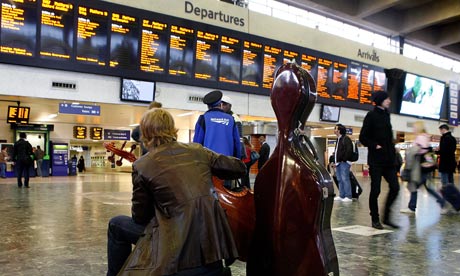
Network Rail is removing replacement bus services from major train routes following widespread criticism of the disruption caused by weekend and bank holiday engineering work.
The owner of Britain's rail infrastructure joins train operators today in pledging to keep 20 routes open, including London to Edinburgh and Glasgow, Leeds to Manchester and Birmingham to Nottingham. However, Network Rail admits that it will take two years to safeguard the lines as it waits for new equipment to arrive. Some passengers on protected routes will still have to take buses because services will have to be diverted around certain stations, such as Grantham and Newark on the London-Edinburgh line. Diverted journeys could also last nearly a third longer.
Iain Coucher, Network Rail chief executive, said passengers were "flocking back" to the railways and deserved a better service outside weekdays. "Their expectations for a decent service at weekends and at bank holidays have grown and we must respond. Keeping passengers on trains and off buses is our aim. We're working towards that and today's commitment sets us firmly on that path."
Earlier this year Network Rail was criticised by the transport secretary, Lord Adonis, after booking engineering work on both rail routes between London and Scotland over consecutive weekends. In a letter to Coucher, Adonis accused the company of a "serious failure to take account of passenger interests". Chastened by that, the company will always keep one rail route to Scotland available as part of today's commitment.
Network Rail staff will be instructed to plan upgrading and repair projects on the 20 routes with the aim of keeping passengers on trains. It will mean more overnight work, keeping at least one track open on two-track routes with modified signalling systems, and diverting trains on to alternative routes. The list of protected journeys includes London to Liverpool, Manchester, Cardiff, Sheffield and Brighton. Regional routes include Birmingham to Plymouth and Doncaster to Leeds.
The Association of Train Operating Companies said providing interruption-free services at weekends would attract more passengers to a network that carries more than 1bn journeys a year. However, one train operator source warned that the announcement gave Network Rail the opportunity to extend some of those journeys by hours. "Sometimes the bus is a better option," said the source.
