Australia is one of the most popular holiday destinations in the world but its beaches, rainforests and deserts can take a deadly toll on tourists. According to official statistics, 2,433 overseas visitors, including 25 children, have died in the last seven years. Causes of death include drowning, heat stroke and even a jellyfish sting.
The figures released by the Australian Bureau of Statistics and the National Coroners Information System suggest many tourists are taken unaware by the country's harsh natural environment or die during recreational activities.
Between 2003 and 2005, seven visitors to the country died while scuba diving or snorkelling, two died while hiking, one died while paragliding, another died on a parachute jump, three people lost their lives on fishing expeditions and two died after games of tennis and golf.
Heat stroke claimed the lives of three tourists while 65 were killed in car crashes and six people died in falls. A further 276 deaths in the same period were attributed to natural causes.
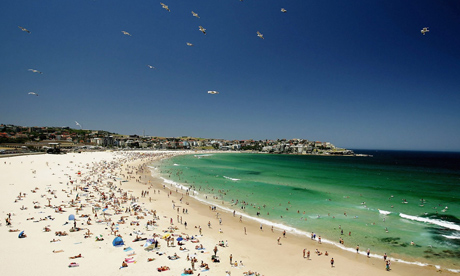
Australia's idyllic beaches also hold hidden dangers. Among the drowning fatalities over the past seven years were eight children aged under 10 on holiday with their families while a further 17 victims aged between 10 and 19 were also pulled dead from the water.
Sean O'Connell, a spokesman for one of Sydney's lifeguard organisations, said tourists flock to beaches without realising the dangers and suggested people on flights to Australia should be informed about dangerous sea currents.
"You could conceivably hop off a plane, go to your backpackers' hostel, hop on the bus and be swimming at Bondi within four hours, and there is this terrible rip [tide] you wouldn't even know about," he told the Sydney Daily Telegraph. "In some cases the rip appears to be the calmest part of the water."
With at least one tourist dying after a jellyfish sting and others injured by animal bites, visitors are also being warned to admire Australia's wildlife from a distance.
Ranger Craig Adams of the Australian Reptile Park said crocodiles can hide in a few centimetres of water and pounce without warning. "People don't realise a koala will give you a nasty bite or carve you up with its claws," he said. "A wombat can knock you over."
More than five million people visit Australia every year, among them 800,000 British visitors, and most go home without injury.
During the last fortnight, however, there have been two shark attacks, while last weekend hundreds of swimmers on three of Perth's most popular beaches were warned to leave the water after a two-metre-long shark was spotted near the shore.
In another incident, a 25-year-old man was airlifted to hospital for multiple bluebottle jellyfish stings. He was treated and later released.
In an editorial, the Sydney Morning Telegraph described the tourist fatalities - and those of Australians who have died - "the price paid for a country where nature has not been totally cowed by human development".
British victims
2004 Clare Barnes, 24, died when her parachute failed to open.
2003 Thomas Sykes, 35, a Londoner, broke down in the Great Sandy Desert in Western Australia and died walking 34 miles in 42C (108F) heat to seek help. He died near a town.
2002 Richard Jordan, 58, from Yorkshire, died after being stung by the irukandji jellyfish.
2000 Jason Walsh, 28, a backpacker from Cornwall, died in a car crash in northern Queensland. Four other British travellers were also injured.
