
“Nur die harten kommen in den garten” (only tough guys get into the garden). With this Teutonic exhortation our guide, Richard Oberkalmsteiner, leads us – a group of “soft Scottish mens” – up into the mountains of the South Tirol for a week-long trek around the Sarntal (or Sarentino) Valley.
There are six of us: three Daves, an Alastair, an Alex and a Ruaridh. Our collective mountaineering level amounts, approximately, to the endurance required to huff and puff up a few munros. But we have previously undertaken one Alpine trek together. That was six years ago in the North Tirol – on the Austrian side of the border – when our average age was 40 and we took to the hills to shake off a collective midlife crisis.
Now we’re back, this time on the south side, technically in Italy, but still noticeably Austrian in its mountain culture. National distinctions are only a part of the complexity. The Tirol is a mosaic of valleys, self-enclosed with their individual dialects; worlds unto themselves.
Richard is clearly more wiener schnitzel than cappuccino. Lean muscle with a weathered exterior, he has walked or skied the Tirol his whole life. From the age of 10 he was hauling 30kg hay bales up vertiginous slopes to summer grazing.
He walks “the walk” – the modest stride, the unhurried pace, the serenity that requires no destination. To walk in this zen-like state (if you can achieve it) is to be impervious to the differences between ascent and descent. Seemingly ageless, Richard is definitely one of “die harten”.
Where he glides, we creak and moan. The average age of our group is now nearer 50 and midlife issues remain unresolved. One of the Daves, an internet entrepreneur, has only just made it on time, having been delayed in Edinburgh by what he describes as a “sex injury”. (In fact, he fell into a borrow pit on a construction site after partying too hard with his fiancée and spent the night in A&E; group therapy sessions will evidently need to be more rigorous this time.)
From the bus ride out of Verona into the hotel in Sarentino village, most of our first day is spent preening and faffing over kit. Almost all of us have forgotten things, apart from Alastair, an actor, who looks fabulous. After a first night of pampering in the delightful Hotel Höllrigl – delicious meal, our final taste of individual rooms – the staff wave us off in the morning with gifts of penknives. Richard leads us away from such trifling luxuries. It has been the wettest, coldest summer in living memory, he says.
Day two: a 1,742m ascent. It rains heavily. We do not walk “the walk”.
On our way through mountain meadows we pass picture-book Alpine cattle, still and silent. To compensate for their bovine silence, Online Dave finds a “cowbells app” on his smartphone, which ring-a-ding-dings as we ascend one side of the Sarntal.
Somewhere on the edge of a forest, the rain and cosmopolitan chatter eventually subside; Richard leads us through the mist into an improbably romantic hut. (To picture this, imagine a cultural space somewhere between The Lord of the Rings and The Sound of Music.) There, the farmer Goasl and his wife Rosi cook us dumplings of nettle, wild boar and cheese, served in steinpilz and pfifferlinge sauces.
The cuisine gives a hint of Italian influence: more subtle and inventive than the sauerkraut north.
Having fed us, Goasl cracks his whip in farewell – literally. The whip is several metres long and requires a wildly graceful flourish of his body from side to side. It retorts loudly, like rifle-fire, echoing around the valley.
What kind of holiday is this? A bunch of emotionally bruised men slogging from hut to hut, across peaks, the luxuries decreasing the further they go. At the first overnight hut we drown our sorrows in kaiserschmarrn pancakes and weissbier. Next day we suffer the pains of middle age in body and mind. Online Dave’s shoulder hurts, but he sweats it out.
We agree a formula for suffering: there are existential anxieties, about which you can do nothing, then there are “hole in the ground” struggles: practical problems with engineering solutions. Hills and human bodies are problems to be surmounted. Actor Alastair gets a smartphone message telling him that his decision to be here has cost him a crucial audition. It’s not clear which category of angst this fits.
The Tirolean Alps are young mountains – a mere 160 million years old – which is why their peaks are high. They are pimply adolescents next to the Grampians of Scotland, which are geologically ancient at 470m years old, worn down by eons of deep time. Scotland is on our collective mind as we walk, as this is last September (the best time to walk here), and the referendum is just days away.
Day three: the aches subside. The walking falls into a rhythm. We begin to disappear into ourselves. The landscape shifts from green pastoral to grey waste. We leave the Alpenrosen Hof at 2,214m, traversing a glacial bowl of scree and frostbitten geological debris, until we arrive at the fabulously bleak Flaggerschartenhütte at 2,481m. Despite its isolation, it is full; we are grateful for our crammed dormitory space and the warmth of smelly bodies.
We squeeze ourselves next to the fire in an eating area packed with steaming Gore-Tex-clad hikers. By some biblical catering trick, the proprietor supplies each guest with wine and beer and a surprisingly interesting stew. The bread is home-baked. A guitar appears.
In a scene that would be a cultural cringe anywhere else, we sing Robert Burns songs. The Austrian speakers in the room – who experience no such thing as embarrassment – join in the choruses. When they reply with their own folk classics, Richard yodels sweetly. Climactically, the entire crowd inside the cold grey stone of the Flaggerschartenhütte sings the German-language version of “Auld Lang Syne”.
Day four: hungover but happy, oddly limber and free, time slows, clouds lift, the sun breaks through. The beauty of the Tirol is flabbergasting. There is no feeling of effort. We begin to walk the “walk”. Flattening out at 2,200m, we find ourselves in a vast grassy meadow. Alastair the actor wanders off to whisper to grazing horses.
We eat ham rolls and apples in blazing sunshine. We are in the garden. “Nur die harten kommen in den garten,” Richard sighs. “All my life, that saying has depressed me.”
We laugh.
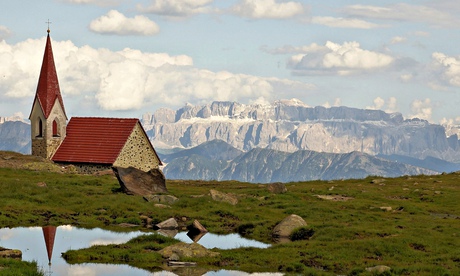
That afternoon comes the culmination of our South Tirolean trek, as we inch round a shoulder of the Penser Joch Pass and reach Rifugio Santa Croce Di Lazfons, a mountain hut whose small chapel was built in 1860 on the ruins of a 16th-century pilgrim church. To our left, we look out on what must be one of the most impressive geographical sights in Europe: the Dolomites, rising like the spikes of a grey geological eruption from green surrounding hills.
We drink beer at the rifugio. From there, we climb to 2,600m and revel in the splendour of the views. All of us, that is, except for Online Dave, who takes to his bunk with a mysterious fever. The three-day walk back down to Bolzano is mere pleasure by comparison, eating and drinking and laughing and arguing all the way down. We walk the walk and talk the talk. No other form of “exercise” releases your body like this, or gets you close to this kind of communion. There is no better way to be with friends.
We did not need to be hard get into the garden. We walked to be together and to climb out of a midlife hole – and we did. But when Online Dave got back for a check-up, his doctor told him he had walked the entire trip, back-pack and all, with a broken shoulder. As it happens, one of us really was a tough guy.
Essentials
For information, go to suedtirol.info. British Airways, EasyJet and Monarch fly to Verona. Book accommodation first by calling the huts directly. Rooms start from €20 a night. Guides can be booked via bergfuehrer-suedtirol.it and cost from €200 a day
