Cork is Ireland's second city, sunk into the valley where the river Lee meets the sea. Its centre is a small arrowhead-shaped island ringed with quays, just over a mile long and half a mile across.
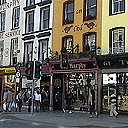
The city's architectural looks are difficult to define, but can be dated from the late Georgian period through to Victorian. Terraced townhouses, often individually painted, on three and four floors, mingle pleasingly with shops and ornate public buildings reflecting Cork's prosperity as a major European trading port throughout the 1800s.
The city centre, being an island, has developed its own distinct calm "village" ambience. And with the nation's new prosperity, Cork has become a centre for arts and culture, attracting poets, painters and sculptors and especially those connected with music and dance.
There is no sign of Celtic heritage. Cork's history begins with St Finn Barre in the 600s, followed by the Vikings and the Normans in the 12th century. It came to prominence in the mid 1700s as the staging and trading port primarily to America and the West Indies. Ships would be provisioned for long voyages carrying local exports of beef, butter, tallow and hides. Shipping also spawned the thriving industries of sail making and cooperage.
What to see
A trip on the open-top bus (I£8) is the quickest and most informative way of getting to grips with the city . The main sights, such as the Beamish Brewery on south Main with a 10.30am tour (I£3), are located centrally. St Finn Barre's Cathedral, built in the 1860s on the site of the hermit saint's dwelling, is spectacularly executed in mosaics, stained glass and more than 1,200 carvings.
Cork's thriving arts scene is enthusiastically competing with Dublin. The Crawford Art Gallery, built in 1724 at Emmet Place, shows the works of contemporary Irish artists as well as some old masters. The Vanguard Gallery on Careys Lane specialises in emerging Irish artists, while the Triskel Centre promotes visual and performing arts.
The city's commercial and industrial history is best sampled at the public museum in Fitzgerald's Park, The Cork Vision Centre on North Main Street and the Butter Museum at Shandon, while the Old City Gaol of the 1800s gives an insight into the horrors of the convicts' lot.
Entertainment
Try to take advantage of the theatrical dance and music events. The comedy club on Coburg Street is one of Europe's best, while the Victorian Everyman Theatre on MacCurtain Street is well respected for the quality of its production. The Firkin Cran Centre across the bridge at Shandon is home to the city's ballet company, while the Opera House at Emmet Place plays host to touring plays from Dublin, as well as concerts and musicals.
"The dogs" are intrinsic to Irish culture, and the new Greyhound Stadium, which has racing every Wednesday, Thursday and Saturday, is only an eight-minute taxi ride from the centre. Entry, inclusive of an excellent three-course dinner, is I£25. However, all racing is suspended at present due to the foot and mouth restrictions.
Out of town
If you are seeking the "eloquence of the silver tongue", the Blarney Stone is 25 minutes away by bus. To the south lies Kinsale, where Charles II was crowned before going into exile.
To the east is Cobh, just a short train-ride away. The 42-bell carillon at St Col man's rings out the Angelus. The Queenstown Experience, a reference to the period when the town was renamed in honour of Queen Victoria, has a much-praised interpretative centre that portrays the heartbreak of emigration.
The extraordinary cult of road bowling is practised every Sunday at locations on the outskirts of the town. There are 100 clubs, so simply look for groups of people blocking the highway and lobbing steel balls down the road. There's also fishing, ranging from deep sea to catching trout on the Blackwater river. Or why not try your hand at sailing: Cork has the oldest yacht club in the world, established in 1720 - (00353) 21 4831023 www.royalcork.com - plus plenty of nearby golf courses.
Eating out
On one side, there is the sea, so think fish. The other three sides are cattle country; so think quality beef.
The Farmgate Café , Old English Market, Princes Street, Cork (021 278134). The owner Kay and "her gals" always have an Irish "traditional" on the menu, such as lamb stew or tripe and drisheen (blood sausage). Around I£6.
Another "must" is Ballymaloe House, Shanagarry, 20 miles east of Cork (021 4652531). A large country house set amid 400 acres. Lunch costs I£10-20; dinner I£20-plus; booking is essential. The house incorporates a renowned cookery school, and if you decide to book a room, facilities included an outdoor swimming pool, tennis court, and children's play area. B&B from £85 for a single; £135 for a double. The owners of the Ballymaloe also run the Crawford Gallery Café, Emmet Place 021 4274415.
At Café Paradiso, 16 Lancaster Quay, Western Road (021 4274415), creativity is Bridgette and Dennis Cotter's theme. Try their almond pastry gallete with spinach, sheep cheese, aubergine and beans. Lunch: I£ 3.50-£7; Dinner: I£ 15-18. Extensive wine list.
Isaac's, 48 MacCurtain St (021 503805), is close to the Everyman theatre; booking is essential. Starters such as Caesar Salad from I£5. Mains, such as king prawns, I£20pp. Wines from I£12.
Proby's Bistro, Proby's Quay, Crosses Green (021 431 6531). Close to St Finn Barre's cathedral. Contemporary Euro cuisine. I£25-plus per person.
Getting there
British Airways (0845 7733377, www.britishairways.co.uk ) flies to Cork from a number of UK airports for £142. Ryanair (0870 3331231 www.ryanair.com) flies to Cork from London Stansted from £98. Swansea Cork Ferries (01792 456116) operates return services between March and November from £149 for a car and up to five adults. For more information and hotel availability, contact the Irish Tourist Board (00353 1602 4000, www.ireland.travel.ie).
St Patrick's Day special
• 'I was heading 60 miles out to sea, to a pirate's hangout' Sally Kindberg heads for the wild west of Ireland to visit a pirate queen's haunt 60 miles out to sea
• Manhattan transfer Parades may have been postponed in Irish cities because of the foot and mouth crisis, but New York's Irish Americans will be painting the town green, says Annie Mills
• Shamrock rovers Joanna Israelsohn finds herself spoilt for choice when planning a trip to the Emerald Isle
• The 'fast show From war-torn province to hip weekend destination, Belfast has been quick to reinvent itself, says Katharine Viner
• The middle way Far from the tourist trail but only an hour from Dublin, Roly Smith explores the Irish Midlands and finds his perfect home in the hills
