
The joys of urban walking may not be immediately obvious to countrygoing types frustrated by the present foot-and-mouth restrictions. But walking the streets of a large city gives a completely different perspective to the one from a car or bus. The first thing you notice is the architecture - looking above the neon-lit shopfronts, a whole new world of ornate Victorian windows and gables is often revealed, bristling with details the motorist cannot see. The other advantage is that you need no equipment, other than a stout pair of shoes, to do it.
The following are a few suggestions of how to explore some of our most interesting cities on foot.
Bath
You need to revert to the pace of the pedestrian to really appreciate the architectural glories of this Georgian city.
Start from the Great Baths in Stall Street, where the Romans built their naturally-heated baths complex next to a temple they cleverly dedicated to Sulis Minerva - Sul being an ancient Celtic god and Minerva, the Roman goddess of healing. Adjacent is the Pump Room that became the social centre of the fashionable spa during Bath's heyday under Richard "Beau" Nash during the 18th century. Just behind the Baths stands stately Bath Abbey, built between 1495 and 1503 and famous for its soaring internal fan vaulting and the ladder-climbing angels on its western front.
A two-minute walk down Abbey Green takes you to Sally Lunn's House, built around 1622 and now a delightful tearoom, where you can enjoy the delicious Bath (or Sally Lunn) Buns. Head north up Terrace Walk and you soon arrive at the Grand Parade and a stupendous view of the River Avon as it flows under the Italianate Pulteney Bridge. Built by William Pulteney, 1st Earl of Bath, in 1770, it was inspired by the Pontevecchio in Florence and is still lined with tiny shops, shoehorned in across the width of the bridge.
About half a mile away, down Upper Borough Walls or Quiet Street and along Gay Street, you pass John Wood's Queen Square, to reach the classical columned fronts of his Circus. From here, Brock Street leads to perhaps the greatest glory of Georgian Bath, John Wood the Younger's magnificent, golden-stoned curved terrace of the Royal Crescent.
• Recommended tea shop: Sally Lunn's House, Lilliput Alley, Bath. Further information and map from: Bath Tourist Information Centre, Abbey Chambers, Abbey Church Yard, Bath (Tel: 01225 477101)
Birmingham
Birmingham has only recently rediscovered its canal heritage. At least six major canals come right into the heart of the city, the hub of which is the unglamorous-sounding Gas Street Basin off Broad Street, now a fashionable inner-city rendezvous, surrounded by modern red-brick and smoked-glass apartments and theme pubs. Here the Worcestershire & Birmingham; Old Main Line; Birmingham & Fazeley, and Warwick & Birmingham (leading to the Grand Union - the M1 of its day) Canals all meet, and colourful narrowboats jostle for moorings in the shadow of Birmingham's re-invented West End. Apart from the miles of quiet canal walks which can be enjoyed in Birmingham, a short walk away from Gas Street is the city's famous Jewellery Quarter, where two trails marked by stainless steel information plaques set into the pavements have been laid out. The first starts from the Millennium Apartments and runs to British Telecom House, while a giant charm bracelet is the basis of the second starting from Sandpits Parade, with each "charm" revealing a new fact about the Jewellery Quarter, until you reach the Chamberlain Clock Tower near the Town Hall.
• Recommended pub: for a traditional pint, try the Tap and Spile, Gas Street, Birmingham. For a leaflet describing the walks, contact the Central Library on 0121-303 4511, or the Birmingham Tourist Information Centre, 130, Colmore Row, Birmingham (Tel: 0121-693 6300).
Durham
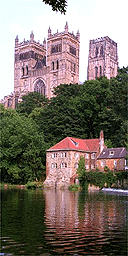
A short walk around the great Durham peninsula - formed by a hairpin loop of the River Wear - takes in most of the city's great buildings and shows the cathedral in its magnificent setting towering above the river. Start from the cobbled Market Place, which is overlooked by the Guildhall and Town Hall, and ascend the mainly Tudor Saddler Street, which leads up to the open space of Palace Green and the imposing sight of the northern side of the 12th-century cathedral. In the right-hand corner of the Green, a cobbled lane leads to Durham Castle, which now doubles as University College, Durham, and is open for guided tours.
After exploring the cathedral and castle, turn right down Dun Cow Lane to the North Bailey and back into Saddler Street. Turn right down the Magdalen Steps on to the Souterpath, which leads down on to the Riverside Walk, which is followed for about a mile and a half through pleasant woodland around the great peninsula. You pass the modern Kingsgate Bridge and The Last Supper, a wooden sculpture by Colin Wilbourn, before reaching Prebend's Bridge and the classic view of the triple towers of the cathedral across the weir of the Old Fulling Mill, now the city's Museum of Archaeology. Cross the bridge and turn left under the cathedral to the 12th-century Framwellgate Bridge, where you ascend the steps to return to the Market Place.
• Recommended tea shop: Vennell's in Saddlers' Yard, off Saddler Street. For further information and a map, contact: Durham Tourist Information Centre, Market Place, Durham City (Tel: 0191-384 3720)
Glasgow
When Glasgow was designated both European City of Culture and UK City of Art and Design a couple of years ago, the rest of Britain suddenly woke up to its immense cultural and artistic heritage.
To explore that heritage, start your walk from George Square in the centre of the city, where Sir Walter Scott, on his 80ft-high slender Doric column, faces the classic Italianate façade of the City Chambers. Turn left up North Hanover Street and then right into Cathedral Street for the long climb up to the rather gloomy 12th-century St Mungo's Cathedral, the city's patron saint. Nearby is Provands' Lordship, the oldest house in Glasgow, built in 1471 and now a museum, and the St Mungo Museum of Religious Life and Art, worth a visit if only to see Dali's Christ of St John of the Cross.
Turn left from the cathedral and walk down the High Street until you reach the distinctive clock tower of the Tolbooth Steeple, built in 1626. Turn right along Trongate and Argyle Street, Glasgow's main shopping streets, then right into Buchanan Street and into fashionable Prince's Square arcade. Turn left into Gordon Street and then right into West Nile Street which eventually reaches the famous thoroughfare of Sauchiehall Street. Turn left here and, after a few yards, you pass a black-and white-painted shop bearing the sign Henderson's the Jewellers. The ground floor is a jewellers, but upstairs is the Willow Tea Rooms, one of the finest examples of the work of Glasgow's art deco architectural genius, Charles Rennie Mackintosh.
Shortly after leaving the Willow Tea Rooms, turn right into Dalhouse Street to take in Macintosh's tour de force, the tall, elegant structure of the Glasgow School of Art in Renfrew Street (guided tours available). Return to George Square the way you came via West Nile Street and Vincent Street
• Recommended tea shop: Willow Tea Rooms, Sauchiehall Street, Glasgow. Further information and map from: Glasgow Tourist Information Centre, St Vincent Place, Glasgow (Tel: 0141-204 4400).
Norwich
Stuck out on that East Anglian limb and badly served by motorways, Norwich's very inaccessibility has been its salvation, because it is now probably the best-preserved medieval city in Britain.
We start our short stroll around the city, which follows in part the Norwich Scenic Walk, in the colourful Market Square. Flanking the market are the 15th-century but much-restored Guildhall, the 200ft white concrete monolith of the City Hall, opened in 1938, and St Peter Mancroft, one of Norwich's collection of fine medieval churches which reflect its past importance.
North up Dove Street is St John's Maddermarket, another fine church, the Maddermarket Theatre and Strangers' Hall, a rambling 16th-century mansion said to be named after Flemish weavers. Turn right down St Andrew Street past St Andrews Church and, in Bridewell Alley on the left, The Bridewell Museum, devoted to the traditional life of Norfolk and The Mustard Shop.
Bear left into Princes Street and immediately left again into cobbled Elm Hill - a riot of colour-washed Tudor houses that lead down into Wensum Street, where you turn right into the grim-sounding Tombland (from the Saxon "toom", which meant an open market). This mainly Georgian street leads to the 15th-century Erpingham Gate on the left and into the tranquility of Cathedral Close. Caen-stoned Norwich Cathedral is a masterpiece of Norman architecture
Back into Tombland, turn left into Upper King Street to reach the tree-moated Norwich Castle, standing on a motte first erected in the 12th century. From the castle, drop down through the maze of narrow streets and ginnels back to the Market Place.
• Recommended pub: The Adam and Eve Public House, Bishopgate, Norwich. Further information and map from: Norwich Tourist Information Centre, The Guildhall, Gaol Hill, Norwich (Tel: 01603 666071).
York
Start your tour from the Minster, famously struck by lightning in 1984, the same year the Jorvik Centre living history exhibition (recently refurbished) opened in Coppergate. Don't miss the reconstructed South Transept roof and refurbished Rose Window.
From the Minster, walk up High Petergate to Bootham Bar, one of the finest of the city's medieval gates in its surviving walls for a short excursion along the wall walk, turning right and admiring the fine views across the pantiled roofs of the old city towards the grey towers of the Minster. Walk round to 14th-century Monk Bar and then descend into Goodramgate, which leads into King's Square. This leads into the famous Shambles, with its cobbles and leaning, half-timbered gables which almost touch overhead.
The Shambles leads into Newgate Market and the Pavement and into Coppergate, the Jorvik Centre and St Mary's Castlegate, which is now the setting for a museum telling the York Story.
Castlegate leads towards Clifford's Tower, a classic motte put up just two years after the Norman Conquest to subdue the northern English and now topped by a stone keep dating from 1270, with fine views across the city. The Castle Museum opposite, housed in what was once the Debtors' Prison, is one of the best of its kind in the country and the reconstructed streets and shops are a precurser of the modern Jorvik. After your visit, retrace your steps back to the Minster via the riverside walk of King's Staithe to Lendal Bridge and Museum Street leading into High Petergate.
• Recommended tea shop: Betty's Tea Rooms, St Helen's Square, York. Further information and map from: York Tourist Information Centre, 20, George Hudson Street, York (Tel: 01904 554488).
