
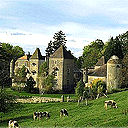
It helps to like cheese. Not just any cheese, but one of the kings of French cheeses, comté, aged in Jurassic - or Jurassian - cellars for eight, 12 or even 24 months. It is a cheese that tastes of hazelnut and smells of fruit, but never in quite the same way, as the precise balance of flavours changes from season to season, producer to producer.
It takes about 140 gallons of milk to make one 90lb round of comté, and the traditional small-scale producers, or fruitières, of the Jura - a region of valleys, peaks, forests and mountain streams bordering Switzerland - make an awful lot of it. Along with some genuinely remarkable local wines, wild mushrooms, and cured and salted meats, comté - plus a couple of other memorable mountain cheeses such as Morbier, Bleu de Gex and Mont d'Or - is one of the staples of Jura's cuisine. It is difficult to escape at least one of them, whatever you're eating.
Even more than a regional cuisine, this is a strictly local cuisine, what the French call "simple and true" cooking. Starters will include mountain cured meats, hams, knuckles and sausages smoked - hopefully - in the huge hearth around which the Franche-Comté farmhouse was once built. There is also a porridgy soup, les gaudes, of very humble origins, based on grilled cornflour and served with either sugar or salt and cream; and croute aux morilles, which is essentially mushrooms on toast.
Heartier appetites will opt for a cheese tart of comté, eggs and cream; petits choux aux comté, which are what they say they are; or feuilleté comtois au jambon (ham and that ever-present comté, cooked in puff-pastry envelopes). Perhaps the best-known Jura dishes, moving on to the more serious business, are coq (or truite, or poularde) au vin jaune.
If coq au vin does not suit your mood, then local cheeses will loom large on the menu, adding body to the other classic Jura main-course dishes: escalope de veau comtoise is a veal cutlet and slice of cured ham, covered with mushrooms and, yes, a comté sauce; and escalope de veau jurassienne replaces the comté with the milder-flavoured bleu de Gex.
True addicts will not want to miss three dishes that are in fact nothing but cheese: michon, which is comté mixed with flour, water and salt, and fried in a pan; "une Morteau", the local name for a Mont d'Or in its spruce case, melted in the oven with a half-glass of wine in the middle; and Cancoillote, sold in a jar and eaten like fondue. Typical desserts are poires au vin, galettes and fruit tarts, but the tempting if cholesterol-rich pets de nonne de Baume-les-Dames (small spoonfuls of dough dropped in hot oil and served covered with sugar) are worth trying if only for the name, which translates - not to put to fine a point on it - as Baume-les-Dames nun's farts.
When it comes to the wine list, the opportunity to try vin jaune should not be passed up. Considered by many to be one of the world's superior white wines, it is produced traditionally at Château-Chalon, but also in the Jura winemaking centre of Arbois with Savagnin grapes. The colour is a bright yellow or gold shot with amber, the nose is mainly walnut. The region is also more or less the only one in France that still produces vin de paille, or straw wine, a sweet wine made of a blend of savagnin, chardonnay and poulsard grapes that, before being pressed, have been thoroughly dried on beds of straw. It is honeyed, potent stuff, and goes brilliantly with foie gras.
Oeufs brouilles au fromage
Or posh scrambled eggs with cheese. Very simple. Very cheesy. Very Jura. Serves six.
6 eggs 55g butter 500g comté or Gruyère cheese 2 tbs double cream 25ml cold water Croutons
Break the eggs into a bowl. Add salt, pepper and water. Beat with whisk. Melt the butter in a non-stick saucepan. Chop up the cheese roughly and add to the pan. Melt it gradually, stirring all the time. Add the eggs, stirring them gently to make sure they mix with the cheese as they thicken. Add the cream, and mix it well in. Serve with some crunchy croutons.
Côtes de veau Jurassienne
Or veal chops, Jura-style. Meat, veg and, of course, cheese. Serves six.
6 large veal chops 1 knob butter 1 dssp oil 6 slices cured ham 1 glass white wine 280g mushrooms (morels if possible) 300g bleu de Gex, comté or Gruyère 250ml cream
Preheat oven to 180C/350F/gas mark 2. Dry the chops. In a frying pan, heat the butter and oil. When the butter has stopped foaming, add the chops, two or three at a time, and cook for three to four minutes to brown. Turn over, season, and brown the other side. Transfer to a roasting pan. Fry the mushrooms for three or four minutes. Transfer to the roasting pan. Pour any fat off the frying pan and deglaze with white wine, scraping up any bits and pieces off the bottom. Pour the reduction over the chops.
Place a slice of cured ham on each chop. Grate the cheese and add to the cream. Mix and pour over the chops. Bake for between 15 and 20 minutes, then serve.
Pets de Nonne
Or sweet, deep-fried dough balls, known locally as nun's farts - what, no cheese? Serves six.
100g plain flour 200ml water 20g salt 80g butter 55g sugar 5 eggs 1 litre vegetable oil Caster sugar
Sift the flour into a large bowl. Combine the water, sugar, salt and butter in a pan and bring to a boil. Remove from the heat and pour in the flour, stirring vigorously with a wooden spoon. Return to a mild heat. Cook for a minute then, off the heat, beat in the eggs one by one. Heat up the oil in a deep-fat fryer to 160C/325F, then carefully drop in dessertspoonfuls of the mix into the hot fat - they will puff up as they hit it. Fry until golden brown, about four minutes. Remove with a slotted spoon and drain on kitchen towel. Sprinkle with caster sugar and serve at once.
