
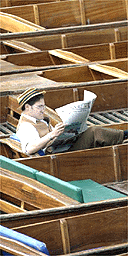
Punt
River Cam, Cambridge
The basic punt design, a flat-bottomed boat without a keel, provides a stable vessel that can be used in shallow water propelled by someone standing up with a pole. In England until the end of the last century, they were commercial craft and were only introduced as pleasure boats in Cambridge in Edwardian times.
Sadly, in the 1950s and 60s, punts were driven off most of Britain's rivers by the less gentle waves made by the increasingly popular motor boats. Even so, punting continued on the Thames, the Cherwell and the Isis at Oxford, the River Cam at Cambridge and the Avon at Stratford.
Punting is a splendid way for the whole family to while away an afternoon or even a whole day. Take the children, the dog, a picnic or some music, and you can swim or fish along the way.
If you do take the plunge, it would be good to heed the advice of Harold Winstanley, winner of the 1920 Thames Punting Championship: learn to swim first, never go out without a spare pole or paddle, and if your pole sticks hard in the mud, let go.
Despite its image of being a gentle pastime, punting is actually a pretty physical activity requiring good balance. Beginners tend to zigzag across the water, but the basic technique is not difficult to master. In Cambridge the punt is usually propelled from the front, in Oxford from the back.
The mile-long stretch of the Cam known as the Backs is particularly popular for punting as the best views of the university Colleges can be seen from the river and you pass popular sights including the Bridge of Sighs, King's Chapel and the Wren Library at Trinity. Punt jams are plentiful on this stretch in the summer months.
* Scudamores (01223 359750) hires out punts for £12 per hour which accommodate up to six people. They also offer overnight hire and chauffered tours starting at £8 per adult for 45 minutes.
Gondola
Venice
Depending on who you talk to, Venice is either a magnificently beautiful and romantic city or a ghastly, expensive tourist trap. And drifting down its splendid canals in a gondola is either an enchanting experience or a terribly naff thing to do.
But no less an authority than John Julius Norwich advised in these pages recently that whatever the cost, you should take a gondola trip at least once in your life. "Do it at night and ask to go through the little canals," he said. "On a summer's night, it is the most beautiful thing you will ever do."
For added effect, you can enlist the services of a would-be Pavarotti to serenade you as you drift along. City-break tour operators like Eurobreak (020-8780 7700) and Kirker Holidays (020-7231 3333) can incorporate an hour- long Gondola Serenade into your itinery for an extra £21pp or so, with singers and musicians performing traditional Italian songs during the journey.
Hiring a gondola independently will set you back around £38pp for 50 minutes from 8am-8pm, with an extra £19 for an additional 25 minutes. After 8pm, this rises to about £48 and £24 respectively. Be sure to confirm the price beforehand with the gondolier. Expensive gondola trips can be supplemented or substituted by far cheaper rides on the traghetti gondolas that cross the Canale Grande.
* Go (0845 6054321) flies daily to Venice from £100 return; Ryanair (0870 1 569 569) currently flies from £9 each way; Cresta Holidays (0870 161 0900) has two- night breaks by air from £248pp. Italian State Tourist Board (020-7408 1254).
Mokoro
Okavango Delta, Botswana
At 10,000 square miles, the Okavango Delta is the largest oasis in Africa and stuffed with exotic wildlife. You can explore a wilderness of remote lagoons on a mokoro, a dug-out canoe guided by pole by delta tribesmen.
The pole silently thrusts the mokoro along as you sit back and drift past a beautiful endless watergarden of lilies, reed beds and rushes. You can stop for walks or try your hand at fishing.
"He who pushes his pole too deep stays with it," goes an old swamp saying. And it's advisable not to rock the shallow boat too much: the waters are infested with crocodiles. At least you don't have to worry about the hippos - the polers keep to the reed and lily lagoons to avoid them.
As well as being experienced navigators of the maze of winding waterways and islands - some mere termite hills, others the size of a city - many of the polers are skilled trackers. Not only will you see plenty of plantlife, fish, birds, butterflies, frogs and baboons, but your poler may lead you to lion, elephant or giraffe.
* Flights from London Heathrow to Maun, Botswana via Johannesburg with Air Botswana and British Airways (0845 7733377) cost from £805. It is often cheaper and easier to organise a flights/ accommodation package with a specialist like Okavango Tours and Safaris (020-8343 3283) which offers light- aircraft flights from Maun into the Delta at £96 return, and accommodation at Delta Camp from £210pp per night. Its more basic neighbour, Oddballs Camp, costs from £107 a night including tent, meals and mokoro excursions. Thomas Cook Holidays (01733 418650) has 12-night tours that include the Okavango Delta from £2,719, and Travel 2 (0870 607 3222) has 9-night tours from £2,057 and 6-day walking tours from £792, all excluding airfares.
