
I never wanted to have a gap year. Gap years were for rich kids who mistakenly believed that they had something to offer the third world. I wanted to go to university and expand my mind. When I discovered that there was only one acceptable way to expand your mind at Sussex University - and it wasn't in the library - I quit, piously, and went home to Shropshire, making excuses about wanting to take a joint major in English and French.
It was a dreadful time. I had dropped out of university, with no guarantee of another place, and I had to find a way to leave home again. Because I had taught myself to type at the age of five on my mother's 1950s German typewriter - producing a precocious publication entitled The Taylor News - and could use Amstrad LocoScript's program, I considered myself perfectly capable of secretarial work, and took a job at Shropshire county council's property and planning department.
Those were peaceful days. The department, which was chiefly concerned with trees, applications to build conservatories and bylaw infringements, was coming to terms with the introduction of Microsoft Word. I was able to explain what the little button with the disk did, and how to make a table. My spelling was praised. I earned a small amount of money, joined in conversations about eyebrow-plucking, demanding husbands and the merits of various ready meals, and plotted my next move.
The Ironbridge Gorge Museum paid minimal expenses to volunteers willing to dress up in Victorian costume and prop up the 'living exhibits' in its nineteenth century town. Those who performed well in the bakery were promoted to the candlemakers; those who excelled among the stinking wax were given a better uniform and sent to the photographer's shop; the most loquacious ended up in the chemist's. Unfortunately, my ability to speak French confined me to the candlemakers, where I presided over a vast tub of hot, fake tallow, tripped over my three petticoats, and checked the watch hidden in my boots as soon as the school parties had finished buying up my smelly bougies.
It was an enormous relief when the Youth Hostels Association accepted my application for the post of assistant warden. Not only was this a residential post, but it paid £150 per week - which covered a week's training in the teaching of English as a foreign language. The YHA posted me to Arundel in Sussex, where I cooked, cleaned, administered and lusted after the archaeology students from London University who were taking part in a local dig. I met an unusually liberated Danish student; we spent our free afternoons by the Arun river or on the coast. I was surprisingly, intensely happy.
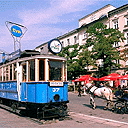
On reflection, paying a couple of hundred pounds to teach English in a Polish summer school was a foolish thing for a 19-year-old with a week's teacher training to do. But as I and the Bradford student assigned to the same school travelled by coach to Brzezna, a hamlet near the Slovakian border which I couldn't even pronounce, it seemed immensely exciting. On arrival in Krakow, we were bundled into the back of a van and transported to a fruit experimentation centre, still run on communist lines, in the mountains. The next day 50 children between five and 18 turned up to the centre. We had no textbooks, no classroom equipment, and very limited photocopying, and the children's Russian was better than their English.
I've no doubt I did a questionable job. But I loved it. In one of my more enjoyable lessons, we compared the noises Polish animals produced to those made by England beasts; I remember the teenage Poles laughing hysterically at the notion that English pigs oinked. Poland had not changed much in the four years since the end of the cold war. Most of the harvest was done by hand or with horses, Brzezna was joyfully building its own church and waiting for phone lines to be installed, and the Poles were immensely hospitable. One of my older students, apparently in all seriousness, proposed to me at the end of the stay.
By the time I returned from Poland, it was time to tackle the reading list for my first term at UEA. This time I managed to avoid dropping out; it's hard to imagine, now, having done it any other way.
