
Well, I've made it to the far east - and how far it feels. I think Japan is the strangest place I have been to so far; it really is another world. I'm not sure if I ever really had a clear idea of how I imagined it to be, but now I'm here I can say that it is like nowhere else on earth.
My first thought was: toy town. Everything looks small and brand new. There are bright lights everywhere and very narrow streets, with narrow buildings to match. There seems to be a 24-hour convenience store on every corner and each step takes you past a vending machine, even when you're out in the villages.
The whole place is incredibly clean; a bit too clean, perhaps. The Japanese seem obsessed with hygiene: the public toilets come with a 'heated-seat' button, not to mention the 'we'll wash your bum' button, and various other strange appliances. Great for long-term visits - or for when you're bored.
Fashion is a Japanese obsession, but it's all a bit hit and miss - lots of 80s clothes teamed with horrid, bleached, backcombed, mullet haircuts. There are even some afros knocking about, although to be fair, I also saw some beautifully dressed and well-groomed ladies about town.
The cash machines are a bit of a nightmare for foreigners. You can't just go to any machine with a visa sign. There's often only one place you can use in a whole city, and it's usually in the basement of a department store with limited opening hours. Very odd. Internet cafes are also surprisingly rare. And from what I can see, they only export the boring Japanese cars to the UK. They keep all their amazing, futuristic creations out here.
The Japanese customs official took an instant dislike to me and insisted on opening all my bags. She produced a flip chart with pictures of every drug on the planet in every conceivable form. She spoke no English, but kept pointing at them and then at me. I didn't know what to say other than 'no'. Drugs are a real no-go area in Japan. Marijuana is classed as being as dangerous as cocaine, although, strangely, magic mushrooms are still legal (the only legal drug). I ended up showing her all my pills and the contents of my medical bag, until she finally got bored and let me go. Phew!
This delay meant I didn't reach Kanazawa in time to see my friend. I had a moment of panic as it was getting rather late, nobody spoke English, the information desks were closed, and I had no Japanese currency, but I caught the last train with seconds to spare (they leave on the dot) and ended up in Kyoto.
A kind man gave me a lift to the hostel. It was tiny. Japan really does have a space problem. I could hardly squeeze my rucksack and myself into the place. You are given a mattress in a vacuum-packed dormitory, which in no way conforms with fire regulations. This was all a bit of shock for me after weeks of $2-a-night hotel rooms in India.
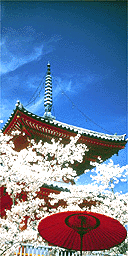
I spent the next day exploring Kyoto, especially excited to be there after reading Memoirs of a Geisha. I actually saw some geisha girls in the Gion district, tottering along on those strange wooden chunks they call shoes. They looked amazing: painted up like dolls with combs hanging from their perfect hair.
That night I took the train to meet my friend Merv, who has been teaching English in Japan for two years. It was lovely to see a familiar face after five months on my own. We spent the first weekend up on the Noto Peninsula, which was verdant and beautiful; I didn't expected Japan to be so green. We had views of the spectacular coastline to one side of us and pine forests on volcanic rock to the other, not to mention all the lush paddy fields.
We had headed to the Noto especially to see a Shinto fire and violence festival in one of the small fishing villages. It really was the most amazing thing I have ever seen. It went on for two days and consisted of about forty people, mainly men, carrying giant wooden carriages on their shoulders (about 50ft long), with children and musicians balanced atop, drumming and chanting.
The first day was about fire and was set by the harbour. It began with a big firework display. Huge crowds appeared and we all watched as these amazingly strong people charged around the fires carrying their loads. The fires weren't just normal bonfires; whole trees were set alight, and flaming branches fell down from them constantly. This went on all night. Fire and safety regulations would never have allowed such a thing back home. Even being in the audience didn't guarantee your safety: I had quite a few near misses.
The second day followed the theme of violence and was better still. A carriage emerged from the temple bearing the effigy of a god, and it was systematically destroyed by a group of about 15 men (probably the strongest in town). The god apparently revels in the violence, so it is not sacrilegious. Meanwhile, 50 more carriages were dragged in procession through the streets of the town. The destruction of the god's carriage was by no means an easy task; it had to be set on fire and thrown into the sea.
Watching those men is something I will never forget. At one point flaming branches were raining down on top of them and their hair and backs were alight, but they just kept chanting. I think the sake helped keep morale up.
The finale was unbelievable. They ended up in the temple grounds and dragged what was left of the carriage in and out of a big bonfire which they themselves had to run through. They must have been so focused on the task - or so drunk - that they didn't notice the flames at their feet. The priest eventually came along and grabbed the god from inside the carriage, and then the men carried the remains up to the temple.
And those were my first few days in Japan. Wow!
