
Up a dark, winding staircase lies a shabby garret room, lit only by a small window set into the sloping roof which throws a weak square of daylight on to the bare wooden floor beneath. The crumbling plaster walls are blank, save for a few holes left by the nails that once held drying canvases of dazzling blues, yellows, greens and reds; colours to warm this dingy room where Vincent Van Gogh lived his last 10 weeks, and died the tragic death of a suicidal painter.
He left behind some 70 paintings and studies in oils, and dozens of sketches and drawings, an extraordinary burst of creativity inspired by the landscape and the people of Auvers-sur-Oise, a pretty village just north of Paris that had already found favour with a number of artists at the end of the nineteenth century.
Van Gogh arrived here on 20 May 1890 to see a certain Dr Gachet who had been recommended to him. He had recently discharged himself from a mental institution and felt the need to get out into the country to paint and regain his strength. Gachet, who was to feature as one of his most famous portrait subjects, was a keen painter himself and friend to Paul Cézanne, Camille Pissarro, Auguste Renoir and Claude Monet, all of whom had visited his house in the village that had been made famous by the landscape painter Charles-Francois Daubigny, who had settled here in 1857.
Van Gogh clambered off the train with his paints and easel and walked the few hundred metres to the Auberge Ravoux, where he found board and lodging at only Fr3.50 a day. He moved into the tiny second-floor landing room, waiting for a few sticks of furniture to arrive from Arles, in Provence.
A photograph taken that year shows Arthur Ravoux sitting at a pavement table outside his inn, with daughters Adeline and Germaine. Adeline, then 13, was to become another of Van Gogh's portrait sitters.
In 1954 she recalled his stay: 'We all respected him. We used to call him "Monsieur Vincent". He would return towards midday for lunch. The menu was made up of all that was served in restaurants at the time - meat, vegetables, salad and dessert. He never returned a dish. He was most accommodating.' Adeline said that at the time she did not like his portrait, The girl in blue, but later saw that he had captured the woman she was to become.
He also captured the village that was to be his last home and resting place. He painted the eccentric roofscape, the town hall, the Château D'Auvers, the river, the gardens and famously the surrounding cornfields and the church of Notre Dame.
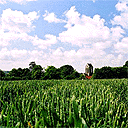
It hasn't changed much today. To visit Auvers-sur-Oise is to experience a strange déjà vu. Walk past the east end of the church and the view is instantly familiar; on up the road a little and there are the yellow cornfields, rippling like water under a blue sky with dark-winged crows suspended over them.
And it is here, amid this familiar landscape, that he is buried, lying in a simple grave in the village cemetery next to his brother Theo, who had supported his work as an artist and had hurried to his bedside from Paris when word came from Gachet that Vincent had shot himself and lay dying in the auberge.
On 27 July, Vincent had set off early for the fields as usual, but returned that afternoon with a bullet in his chest. He had somehow managed to drag himself from the gardens of the Château de Léry back to the inn and slip up the stairs unnoticed. His groans alerted Ravoux and his family who summoned Gachet. An operation was out of the question. There was little that could be done. Vincent lay on his bed, smoking his pipe while his life ebbed slowly away.
The police arrived early the next morning, but could not persuade him to tell them why he had shot himself. Theo came straight from his art dealership in Paris and stayed at the bedside until Vincent died at about 1.30am. 'Sadness goes on forever,' the artist had whispered to his despairing brother.
Stacked under the bed were works that were to be among his most famous: The Church at Auvers, portraits of Gachet, of Adeline Ravoux, and the Wheatfields.
In a letter to Theo from Auvers, Vincent had written: 'One day or another, I believe that I shall find a way to have an exhibition of my own in a café.' Temporary exhibitions of his work have been staged in his tiny room, and now moves are being made to hang one of his pictures here as a permanent memorial.
Auvers-sur-Oise is justly proud of its association, however tragic, with Van Gogh, and with the other painters who came here for the light and the rural tranquillity. Dotted around the village are reproductions of pictures by Van Gogh and Cézanne in the places where they were painted.
While some will argue that Van Gogh was never a true 'Impressionist' he features widely in an impressive multimedia exhibition on this movement at Château D'Auvers. Visitors spend 90 minutes navigating this Trip back to the Time of the Impressionists which features Paris in the 1860s and the rise of Impressionism, and recreates a Parisian café concert, an absinthe bar and a trip on the new-fangled railway (which got the artists out of Paris and into the countryside). It also includes an excellent 3D film on Van Gogh.
The château uses 600 projected works of art in its display, and as such is the biggest Impressionist exhibition in the world, but it has no true paintings. To see those you have to take the train into Paris and visit the Musee D'Orsay. This is a perfect way to finish a weekend in Auvers: learn about the artists and the pictures and then see the real thing amid the splendour of the city that created the movement, for it was the light and space of the rebuilt Paris of the 1860s that first inspired the Impressionists.
Leisure Direction is the first British company to offer a short break in Auvers to individual travellers. Deborah Potts, the company's commercial director, took her son to the region to help him with a school art project and had the inspiration to offer it as a short break. I took my son Nicholas, who is studying art GCSE, and we spent many happy hours wandering the lanes and sitting by the river with our sketchbooks.
Leisure Direction offers several hotels in the area. We stayed at the Hostellerie du Nord, a charming, recently refurbished hotel with views over the famous church. Appropriately, the walls are covered in paintings, but its crowning glory is its restaurant, run by Joël Boilleaut, Matre Cuisinier de France. It was packed both nights we were there, which was hardly surprising since the food is sensational.
The hotel is also just across the road from the station and the trains to Paris St-Lazare, which take about 45 minutes to an hour, depending on connections at Pontoise.
Masters of Auvers
Charles-François Daubigny (1817-1878)
First to recognise the potential of this charming village. Built a studio here in 1857. A forerunner of Impressionism, he was also a patron of the arts, encouraging a new generation of painters.
Paul van Ryssel / Dr Gachet (1828-1909)
This talented painter and engraver was also a physician, often treating his patients with homeopathic remedies. A passionate campaigner for new art, his house in Auvers became a meeting place for emerging talent.
Camille Pissarro (1830-1903)
His visits to Dr Gachet encouraged him to experiment with his painting. He wandered the Oise valley with his easel, walking over the slopes and visiting Auvers from his home in nearby Pontoise.
Paul Cézanne (1839-1906)
Another guest at Dr Gachet's house, Cézanne discovered his Impressionist gifts in Auvers, a talent influenced by Camille Pissarro.
Vincent Van Gogh (1853-1890)
Van Gogh, a patient of Dr Gachet's, spent his last 70 days in Auvers, painting and drawing with immense energy. He ended his tormented life with a single shot from a revolver, dying in a tiny attic room at the Auberge Ravoux.
• Two-night breaks at Hostellerie du Nord for £179 per person (based on two sharing, until end of October) are available through Leisure Direction (020 8324 3030). Price includes return Hoverspeed Dover/Calais crossing for car and passengers, two nights' accommodation with breakfast, and free entry to the Chateau D'Auvers audiovisual display, map of Auvers, and free personal insurance.
