
My first visit to Peru took place almost against my will. As part of Operation Raleigh, the international youth expedition, I had requested projects in Kenya or a voyage across the Pacific Ocean, but was offered the deserts of Chile or the jungles of Peru instead. The mention of giant river otters, one of the world's rarest mammals, made me decide on south-eastern Peru. Sixteen years later, I have yet to visit East Africa or sail any ocean, yet return to the highlands and lowlands of the Inca region surrounding Cuzco at every given opportunity.
What draws me back time and again is the sheer impossibility of boredom. In the course of a day's drive from the ancient Inca capital, one can have breakfast on a glacier at 15,000 feet and dinner in the sweltering rainforest, eight climate zones below. In this remote corner of Amazonia, there are more species of plant and tree than anywhere else on earth. Yet its bio-diversity is merely one of many superlatives. Driest desert, deepest canyon, land of lost cities, heart of the Inca Empire and haven for every kind of adventure tourism.
It has been my great good fortune to work in the area over the years as a documentary cameraman, translator, photographer and tour guide, as well as co-founding the Cross Keys, Cuzco's first pub in 1986. Realm of the Incas, the sum of my efforts, is an attempt to show how much more there is to Peru than good old Machu Picchu. As you read this, I shall be in the mountains walking down to the forests with a charity trek for the Cancer Research Campaign.
A week-long trek around the base of Mount Ausangate takes in several glaciers and begins as it ends, with a long soak in natural hot springs mingling into the streams of molten ice. In the distance, the only buildings for miles are the windowless, thatched stone houses so reminiscent of medieval Scotland. As the herds of llamas and alpacas graze indolently, snowflakes melt on your shoulders reminding you of the imminent chilly sprint from stream to tent.
Lying within the warmth of a down sleeping bag later, the sound of a massive glacial avalanche is one of the hair-raising wonders of a high Andean hike. Local quechua-speaking Runa may visit the camp to offer gifts of trout or guinea pig, or to sell their renowned weavings, and each visitor is given food as a matter of course. Reciprocal acts bind their remote communities much as they did before the Spanish conquest. As the roar of the ice-fall eventually fades, they will murmur among themselves, for their ancestors inhabit the landscape and perhaps it is an omen. They refer to any notable features in the landscape as tirakuna , "the ones who watch over us". The snow peaks surrounding the camp they call Apus, the most powerful of all earthly deities. The reverence of the Runa people extends to nature in general. Though Catholicised, the Virgin Mary is very much identified with Pacha Mama, their Mother Earth. When alcohol is drunk, a drop is always poured on the ground for her first. Visitors gain insights into the culture from the local members of staff hired from villages along the route.
Living in tents and hammocks doesn't have to involve discomfort. Tea and warm bowls of water are brought to the tent at dawn, and cocktail times are keenly observed, but with rising and sleeping times determined by daylight hours, people are in a closer union with nature than they are usually accustomed. The outdoors lifestyle provides a rhythm that many metropolitan types profess to intend keeping up when they get home.
Leading treks out in the wilderness for weeks at a time, the greatest privilege is that of the constant atmosphere of enthusiasm. Whether the group be scientists in the field for the only month that year, or honeymooners on the trip of a lifetime, their reactions only add to the natural drama of the landscape.
Between the barren high plains and primary rainforest, one descends past the treeline into elfin forest that soon thickens into the labyrinthine moss-laden Cloud Forest. Known as Ceja de la Selva, "the eyebrow of the jungle" it is here that explorers search out Inca ruins and the legends of El Dorado. Those who have succumbed include Sir Walter Raleigh, described in Latin American schools as the "English pirate". The existence of English-speaking Guyana to the north came about as a direct result of his search for a city of gold.
Clinging to precipitous heights, Cloud Forest is an extremely uncomfortable place to endure, with impassable bamboo, six metres of annual rainfall and biting insects called "white blanket" due to their numbers, and "the ones who make the Puma cry" for their ferocity. Machu Picchu's dramatic discovery only 90 years ago still inspires many to seek hidden treasure, and scientists join them as new species of frog, butterfly and bird are regularly found. Naive as it may be, I still find it odd to watch them place some animal previously unknown to science and yet to be named in a tray of formalin. Apparently, there is only one recorded case of biologists pickling a species to extinction, and that was on a tiny island far from tropical abundance.
In the lowland rainforest, scientific research and environmental tourism are booming, and carefully-managed projects are one way of sustainably preserving habitat. There is a long way to go before all local people are fully involved. The employment of cooks, guides and boatmen take up a portion of the jobless, but there are always going to be those surviving on the fringes who must be taken into account.
Once, while working on a reserve, we heard the wail of a chainsaw nearby. Reaching the scene too late, a giant cedar lay felled through the centre of a seven-year-old study plot. Botanists were apoplectic, yet the most pitiful figure was the weeping logger, hugging the chainsaw to himself as they tried to confiscate it. "I have to feed my family," he kept repeating. One of the most satisfying moments I have witnessed was the employment as park guards of former hunting guides. Persuaded of the economics of repeatedly charging tourists to photograph giant river otters, instead of shooting them once, their knowledge makes them excellent safari leaders and they build bonds between conservation projects and their villages.
The otters are one of the most spectacular sightings on safari. Hunting in extended family groups, they grow to more than six feet long and reign supreme in the food chain. As cubs or solitary males, they are vulnerable, but together there is no animal, not even caiman (south Americas giant crocodilian) nor jaguar that can take them on.
The quiet oxbow lakes on which they live provide good views of wildlife in a habitat where it is notoriously difficult to view animals clearly. Sitting on a wooden catamaran raft built on two dugout canoes, one can silently observe their behaviour without disturbing them, as they spend up to seven hours a day catching fish. The remainder of their time is spent lolling about in the sun on fallen trees over the water, playing and grooming near their underground home.
On arrival in the jungle, most groups contain at least one person anxious about snakes spiders and piranhas. By the time they leave, it is gratifying to see them quickly wander off down a trail by themselves to catch a last photograph of squirrel monkeys calling nearby, or take a solitary paddle around a small local lake.
The extreme humidity in the forest makes for phenomenal sunsets. As evening draws in, the chorus of frogs and insects gradually increases and birds fly over the lakes en route to their roosts. An archetypal scene is of large flocks of macaws, flying in pairs as they call raucously to each other.
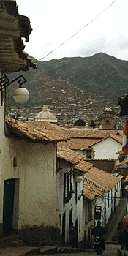
An hour's flight away one is back at the altitude and dry heat of Cuzco. The great Inca fortresses and Spanish churches loom above the arched colonnades and intricately-carved wooden balconies. As you wander about the cobbled streets and myriad markets, trains and treks to Machu Picchu are advertised everywhere you look, but having been off the beaten track, one is keenly aware that there is so much more to see.
• In the Realm of the Incas, by Max Milligan, is published on October 1. To order a copy for £26 plus p&p (rrp £29.95, HarperCollins), call the Guardian book service on 0870 0667979. To contact Max about forthcoming lectures, exhibitions and photo tours of Peru, visit maxmilligan.com. He will be giving a lecture at The Royal Geographical Society on January 23 2002. Tickets £10 for Share a Capital Christmas.
Way to go
Getting there: BA (0845 7733377, british-airways.com) flies to Lima via Miami from £441. Iberia (0845 6012854, iberia.com) flies via Madrid from £473 plus taxes.
Tours: A nine-day Amazon jungle tour, including several nights at an exclusive wildlife lodge, costs £1,100. A 16-day horse-supported mountain trek to a remote Inca city costs £1,900, excluding international flights to Lima. For details, email adventure@manuexpeditions.com.
Inca Trail packages: Adventure Bound (020-8742 7111, adventurebound.co.uk) offers a nine-night visit to Peru with four days spent on the trail. The tour also takes in Cuzco and Pisac. From £720 inc flights. Bridge the World (0870 44474747, bridgetheworld.com) offers an 8-day trek from £972 inc flights.
Tourism office: 020-7235 1917, perutourism.com
Flight time from London: 16 hours.
Time difference: -5 hours
Country code: 00 51
£1= 5.36 PEN
