
Well, here I am in the land of Oz. It doesn't feel as far away as it should. I suppose it's not the same without the 24-hour flight, although it did take me five months to get here.
It feels strange to be normal again. I no longer stick out like a sore thumb. I was getting quite used to being unusual, and even beginning to like it, but having said that, I'm quite enjoying being around some of the normal things, like recognisable food and Woolworths.
I have met up with my sister, Daliah, here. She arrived from London a few days after me. We met in Cairns, on the north-east coast of Australia, where the rainforest meets the Great Barrier Reef. I keep being amazed by the variety of natural environments here.
Australia is ridiculously well-organised in the backpacker department. I arrived at the airport without a clue where I was going, to find a free shuttle bus waiting to drop me at a hostel of my choice. From then on it just got easier and easier. I have to say I do miss the wildness and freedom of the east, particularly India. Things here are just a little bit too organised for my liking.
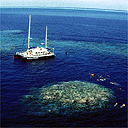
We began exploring with a trip out to the Great Barrier Reef. We took a boat to the outer reef, which is less spoilt and more dramatic, and it was fantastic. I did some snorkelling and swam with the most beautiful fish, some of which were bigger than me! The coral was fabulous, of course, with shapes ranging from brain-like to branchy to spiky - and all in beautiful, iridescent colours.
I watched the fish feeding off the coral and felt like I was on another planet. The vastness of the ocean fascinates me and fills me with fear at the same time. I really wanted to do a scuba dive but unfortunately my asthma prevented me. I went in a glass-bottomed boat to get a closer look at the coral and underwater world. It was so wonderful to see the formations of the reef and the constantly shifting colours - just like the photographs.
On the boat journey back we saw some humpback whales breaching in the water. They migrate here from Antarctica for the winter, mate, give birth here, then rest before heading back south. The calves wouldn't be able to survive in the icy Antarctic waters during their first few months. It was lovely watching them play in the water, especially when they were joined by a school of dolphins who danced around them for a while.
Cairns has a tropical climate, so the bird-life is particularly beautiful. The city centre has a huge colony of lorikeets which goes crazy at dusk, and there are hundreds of water-birds along the beach, ranging from pelicans to spoon-bills to herons. I love it!
We went on a three-day rainforest tour to the Atherton Tablelands, an area of lush, rolling hills which were formed from ancient volcanic lava. It reminded me a bit of England, actually. The soil is very fertile and rich with nutrients, so they grow wonderful fruits and vegetables, but the Tablelands also contain cane toads, which were introduced about 50 years ago as predators for a bug which was ruining the sugarcane, the region's main crop. Unfortunately, this proved unsuccessful, as it soon transpired that the toads preferred the sugarcane to the bugs, and their numbers soon grew out of control as they have no natural predator in Australia. They grow to a huge size and secrete a poison on their backs which discourages larger animals. In the 60s some loony discovered that if you lick the secretion on their backs, it has a hallucinogenic effect. Soon cane toad licking became a popular pastime, cane toads were placed on the national illegal drug list, and nowadays the locals play cane toad golf to curb their numbers. Strange people.
We spent lots of time walking through rainforest and mangrove swamps and observing the flora and fauna. I especially liked the buttress roots, fern and vine. The vine is actually called the strangler fig, and it's an amazing creature. It attaches itself to other trees and grows around them, slowly strangling them. It lives off their nutrients, and eventually kills the host tree or outlives it. We saw one that was 500 years old, one of the oldest in the world. It was called the Curtain Fig Tree because of the way its roots hung down from the dead host trunk.
My favourite trip was a night safari to spot some of the nocturnal wildlife: fruit bats, flying kangaroos and possums. It was very exciting hearing all the strange night sounds - I would have liked to sleep out there but we opted for an odd little pub in the middle of nowhere.
We travelled up to Cape Tribulation, a beautiful secluded beach in the midst of rainforest, stopping at a nature reserve on the way in Port Douglas and fed kangaroos and wallabies - I even got to cuddle a koala. It felt just like a teddy bear. They have the best life, sleeping 17 hours a day.
On the last day, we spent the morning on Cape Tribulation beach and then went on a crocodile river tour in the afternoon. We sat in a small, low boat and spent a few hours spotting crocodiles, snakes and water-birds. We had quite a close encounter with one croc, after the boatman manoeuvred the boat until we were practically on top of him. The crocodile leapt up off the bank into the water but nearly landed in the boat with us. Luckily I was on the other side of the boat, but some poor Japanese tourists were terrified and covered in mud.
Freshwater crocs, apparently, are not dangerous to man: their jaws are too small to chew us, though they do sometimes bite if provoked. They opt for fish and reptiles. The dangerous ones are the estuarine, who live in both salt and freshwater, and can grow up to 8m in size.
Well, enough nature talk!
Donna
