
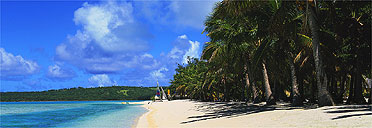
In my experience, gentlemen of a certain age do not generally climb coconut trees. Nor do they cook food in underground ovens or make fire with their bare hands. So when you find yourself on a stretch of white sand, in the fading light of a tropical evening, watching 60-year-old Piri Puruto III - the latest in a long line of tree climbers - doing just that, you know you are a long way from home. Welcome to the land of parrotfish and chips, where lizards chatter like birds and buildings can't be higher than a coconut tree.
Spend a little time in the Cook Islands, and these things will start to seem normal. Stepping off the plane on the main island of Rarotonga, you will be garlanded with a floral necklace, and welcomed by a ukulele-player named Jake. Out on the streets, you'll have to dodge stately Polynesian women on motor scooters and pick-up trucks filled with waving children.
In part, the Cooks owe their eccentric character to their isolation. The 15 islands are scattered over 2 million sq km of the Pacific Ocean, but have a total area of just 240 sq km. Since the arrival of James Cook and the Christian missionaries in the 18th century, the islands have developed a blend of western and Polynesian ideas. The twin pillars of family and church underpin everyday life, and on a Sunday the islands virtually shut.
But beneath a westernised, Christian surface, tribal traditions remain strong, with the land divided between several clans, or ariki, each headed by a tribal chief. Cook Islands Maori is widely spoken and ancient laws prevent the sale of land to foreigners or high-rise development.
Rarotonga is the most developed island, but still retains tracts of pristine wilderness, native rainforest and virgin sand. A coral lagoon and almost unbroken white beach circle the entire island, from where the land rises through lush fields and rural farmland to the forested mountains at its heart. Thanks to its volcanic soil, everything grows with abandon here, and in the heat of a tropical afternoon, the scent of flower blossom, ripe fruit and clear sea air becomes overpowering.
Getting around is simple. A single 32km coastal road circumnavigates the island, passing through the main town of Avarua on the northern shore, and never straying more than a few feet from the enclosed lagoon and its snorkelling, watersports and multicoloured marine life. An erratic bus service circles the island and mopeds and bicycles are available for hire; use your own transport to cruise the rural back roads and craft shops, stroll along deserted beaches, or explore new stretches of the lagoon.
Inland, however, there is a second, much older road, that tells a different story. Originally built from coral and lime by one of the island's first chiefs, the Ara Metua passes through farmland and rambling homesteads in the foothills of Rarotonga's mountainous centre.
Here, you might spy some of the island's more ancient history - green marae fields, the meeting places of tribal chiefs of old; valleys of basalt and jungle ferns; and the occasional forgotten relic lying in the grass. Make the stunning cross-island trek through the rainforest to Te Rua Manga, the Needle, a towering volcanic pillar which emerges high above the forest canopy for views across the island.
Accommodation ranges from backpacker hostels to exclusive resorts. Either way, a visit to a local takeaway for some lagoon fish, fried island-style is recommended. As are the "island nights", with their feasts of traditional cooking and dancing. Wallflowers be warned: you won't remain in your seats for long.
And for real Robinson Crusoes, the outer islands are all accessible by small plane. But time, like most things in the Cook Islands, has a character all of its own. So find an empty stretch of beach, take to the warm waters of the lagoon, and just watch those fiery sunsets and golden dawns roll by.
