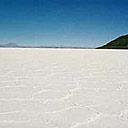
The biggest salt lake on Earth is as close as you can get to nothingness. Nothing feels quite so infinite, or clean, or pure, or surreal as the expanse of perfect whiteness that is the Salar de Uyuni, in Bolivia.
My first thought was that it had to be a trick. My brain, struggling with reality, told me nothing this big could be this white, flat or empty. Surely this was a Hollywood set standing in for heaven? Or if not heaven, perhaps limbo. This seemed like the kind of ludicrous location where a movie star in a white Armani suit would appear from somewhere, tot up my life's sins from a white clipboard, and send me off for my punishment.
Initially, I looked for the join where the real salt stopped and some painted backdrop began. Yet as we drove for mile after mile, my brain grudgingly accepted that the place really did exist. We never hit that Truman Show wall. The salt just went on and on and on. From horizon to horizon, the visible world is an unbroken flat white surface - a purity matched by the cloudless blue sky.
You find yourself walking in the simplest possible environment, a bisected universe: just blueness and whiteness. It feels as though you have left reality and entered a three-dimensional abstract painting.
Forty thousand years ago, the whole of southern Bolivia was covered by a vast, high-altitude inland sea, with no outlet. Over the following 15,000 years, this sea evaporated, leaving behind 10 billion tons of salt.
Ten billion tons of salt may not be everyone's idea of a great tourist attraction - I can't see them building one in Florida - but after you have stood in the middle of it, no other place will ever seem quite so perfect. No other place will ever give you sunburn on the inside of your nose, either. The sunlight bouncing up off the salt is almost as powerful as that beaming down.
The 12,000 square kilometres of utter white flatness is broken only by one small island in the centre, covered in a forest of giant cactus,populated by a few extremely scared slugs.
The wildlife on this island consists of a unique variety of long-tailed chinchilla that was stranded there when the sea evaporated, and unless they evolve chinchilla-sized water bottles on some part of their anatomies so they can make it across the plains, it doesn't look as though they will ever find a way to leave.
Best of all, in this awe-inspiringly beautiful place, the only humans you will see are the other five travellers sharing your four-wheel-drive and driver. In a day's journey, you will see perhaps three or four other cars. How can somewhere so beautiful be so empty of tourists?
Well, there's a catch. The Salar de Uyuni is, to put it mildly, a little tricky to get to. For a start, you must reach Bolivia. And if that country ever created a tourist board and it launched an international advertising campaign, the slogan would have to be something along the lines of 'Visit Bolivia - a nation where every journey is hell'.
The discomfort and danger of getting from place to place has already been turned into a tourist attraction by a cycle-hire company which advertises all over the capital, La Paz, its offer of the opportunity to 'cycle down the most dangerous road in the world'. This is no overstatement. That particular road is so steep that you can't even see the burnt-out wreckage of crashed buses at the bottom of the valley. Waterfalls from high above overshoot the road, water tumbling past your bus windows on its way to land somewhere in the jungle far below.
In terms of comfort, however, the most dangerous road in the world is a breeze compared with the route to the Salar de Uyuni. The best way to see the place is by crossing the border from Chile, which knocks a day off the journey time, leaving you only three days to be driven across the 4,000-metre-high desert, where night-time temperatures drop to -20C.
Accommodation is in dormitories that the RSPCA would be unhappy about putting dogs in. The food we were given on the journey was all but inedible, although the nausea induced by the migraine-like symptoms of altitude sickness removes the appetite.
The other travellers willing to take on this adventure are on the whole young, hardy-looking Europeans in the middle of long, slightly traumatic holidays. The tours are bought from small operators based in two tiny towns at either end of the trip: San Pedro de Atacama, in Chile, or Uyuni, Bolivia.
The Bolivian drivers give the word 'hardy' a new meaning, their faces showing the effects of several decades of daily sand-blasting by sub-zero winds. Like drivers of Toyota Landcruisers all over the world, none feels fully dressed without Top Gun -era aviator sunglasses. Tom Cruise had a slightly better skincare routine, though.
Despite the hunger, the cold, the nausea, the insomnia-inducing headaches, the discomfort and the danger, I will always remember this journey as three of the most astonishing days of my life. There is simply nowhere more beautiful.
Quite aside from the exquisite Salar de Uyuni, there were stops at several high-altitude lakes famous for their startling colours. Drained only by evaporation, their water has become concentrated with dense stews of minerals leached out of the mountains. Sodium, magnesium, borax and sulphur fill these wide, shallow pools, each having a unique mix of chemicals, algae and plankton, producing a white lake, a blue lake, a green lake and even a red lake.
Many of them are populated by rare breeds of flamingo, the varying pinkness of the birds dictated by the chemical mix of the lake they inhabit.
Between the lakes are extraordinary varieties of desert landscape. One valley is filled with a giant, perfectly smooth sweep of orange pebbles, as if raked flat by 100,000 gardeners; the next filled with jutting rocks eroded into Dali-esque shapes by the wind. There is even a hot spring for a quick bathe, and a collection of bubbling mud pots and steaming sulphurous fumaroles to clamber across to a small signpost, warning that you are in danger of burning to death if you have walked close enough to be able to read it.
This journey, which in many ways was close to torture, is simply one of the greatest travel experiences anyone could hope for. The high plain of southern Bolivia is a perfection of wildness, emptiness, strangeness and sheer beauty.
If it didn't require a masochistic streak to get there, the place would be as busy as Venice. Thankfully, there is no luxury tour; no air-conditioned buses full of middle-aged Germans. The gruelling ride by four-wheel-drive is the only way. Long may it remain so.
Factfile
William Sutcliffe bought his tour from Colque Tours which has offices in San Pedro de Atacama, in Chile, and Uyuni, Bolivia. The price was $80 (£56.33) for three days, including what was humorously described as bed and board.
Journey Latin America (020 8747 8315) has flights leaving from Heathrow to Santiago on American Airlines and returning from La Paz starting at £645. The flights go via Miami.
JLA also has a three-week group Oriole tour, starting in Lima and taking in Cusco, Machu Picchu, Lake Titicaca, La Paz, Sucre, Uyuni and the Atacama Desert, and finishing in Santiago. Prices start at £2,077, including a guide, flights, land transport, 22 nights' accommodation and excursions. The tours run throughout the year.
