
It seemed a fair compromise. Luxury mixed with a spot of adventure. And so it was agreed. A honeymoon in Brazil incorporating five nights in five-star luxury in Rio de Janeiro and a week in the Amazon jungle. "But it's your honeymoon," complained a girlfriend. "You don't want to put that sort of stress on your relationship when you've just got married."
Agreed. I'd always thought of a honeymoon as a chance to relax after months of stressful preparation; an opportunity to spend uncomplicated quality time together: sunset walks along deserted beaches, dinner in stylish restaurants and plenty of pampering - not to mention late mornings and early nights spent in a kingsize bed and luxurious baths as standard.
So how come I ended up sleeping in a hammock and washing in a river? My new husband, Tim, had done Operation Raleigh in the jungles of Belize and the regulation two-year round-the-world backpacking trip. He was hungry to try out his survival techniques. I live in London. I work in TV. The closest I'd been to survival was when I got lost orienteering on a school trip around the Brecon Beacons.
So there we were, flying out of Rio after a week of pure luxury on Ipanema beach, on our way 1,600 miles north to Manaus, the capital of the Amazonas and the gateway to the rainforest. We had malaria tablets, mosquito repellent and sterile first-aid kits. We'd been inoculated against yellow fever, TB, hepatitis A, tetanus and rabies, and we'd even treated our clothes with a 50% Deet anti-mosquito solution for extra protection.
Our destination was the Amazon Lodge, described simply in the brochure as "basic". We were to stay there for seven nights, during which time we'd venture deeper into the jungle to camp for three nights.
We were met at Manaus airport by Mocinho, a Brazilian with perfect English who was to be our guide for the next seven days. Because the main form of transport in the jungle is a small boat or canoe, you can only take a maximum of 5kg luggage per person, so we repacked our rucksacks and handed one over to be stored at the lodge's Manaus office. Farewell to kitten heels and expensive bikinis; hello to heavy-duty walking shoes and combat shorts.
Reaching the Amazon Lodge involves a four-hour, 115km trip by van and motorised canoe. Speeding at 40kmph along the river and weaving from one tributary to the next, we got our first taste of the rainforest, and of the awesome skill of our guides. How do they remember when to turn left or right? The Amazon Lodge guides know these rivers and channels like taxi drivers know London streets.
Every now and then, we passed a house on stilts or a floating shop. We also saw the local school boat ferrying the children home. Orange-beaked toucans glided across the sky. White heron perched gracefully on riverbanks. Butterflies and dragonflies whizzed alongside the boat.
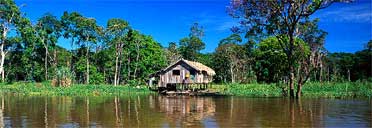
Eventually, the motorised canoe slowed down, we took a left turn off the river and on to Lake Juma, and there was the lodge, floating serenely on the calm black water. The journey was timed to perfection - we arrived just before sunset to see the lodge bathed in the golden light of the magic hour.
Built in 1982 (refurbished in 1994), it was the first floating lodge in the Amazon, a palm-thatched building with 18 bedrooms, all with bug screens, twin beds and fans. There are three central toilets and three central showers (cold water only). Electricity is provided by a generator that is switched on in the evenings. The communal area has a bar and hammocks. There's also an eating area above the bar.
The food was delicious and always freshly prepared - breakfast consisted of platefuls of tropical fruit (melon, papaya, pineapple and orange) followed by eggs and bread. Lunch was rice, salad, fried plantain and manioc (a Brazilian root vegetable that is crushed, dried and then roasted to form a crunchy "flour") and a freshly caught fish or chicken dish. Dinner was a similar affair followed by a wickedly sweet dessert made with fruit, condensed milk, fruit juice and strong coffee (this is Brazil, after all) in abundance.
It was a long way from the "basic" accommodation I'd imagined. The lodge is beautiful. Swinging in one of the hammocks, you simply relax and try to take it all in. There were no TVs, radios or mobile phones in sight. The nearest telephone was 15km away and we were surrounded on all sides by lush rainforest. The only sounds we could hear came from somewhere deep in the trees - the loudest being a wolf whistle made by a small grey bird called the screaming piha, nicknamed the Captain of the Forest.
Most visitors to the lodge book a three-night/four-day stay and use it as a base for half-day guided trips, including jungle walks and visits to the caboclo (river people) dwellings and night-time caiman (alligator) spotting. More adventurous travellers can book the extra three-night, deep-jungle safari. So, just when I was getting used to the relative luxury of the lodge, we packed again, this time leaving more than half our belongings behind, and the two of us climbed aboard a Tom Sawyer-esque diesel-powered boat with Mocinho and a second guide, Jose.
On the boat, we had a single gas ring and a small freezer powered by the boat's generator. We had hammocks and towels, four plates, four knives and forks, four glasses and basic cooking equipment. The freezer was filled mostly with beer and water. We also had two dugout canoes tied to the back of the boat, a bagful of fishing lines and two machetes. Now this is what I would call basic.
Mocinho is one of the caboclo, a race of river dwellers descended from the Moura Indians and Portuguese settlers. To qualify to be an Amazon Lodge guide, he has learnt English and studied tourism. But it's not these qualifications that make him the perfect jungle companion. Both Mocinho and Jose were so calm and at home in the rainforest that they somehow managed to take the fear of the unknown away. If they said it's safe to do something, you did it unquestioningly.
So, when we arrived at our little camp, about two hours from the lodge, I wasn't nervous at the prospect of sleeping in a hammock 10m from the riverbank with only a mosquito net for protection. When I realised that going to the toilet would mean squatting in the forest, I thought I could handle this. And when Mocinho said, "You can use the river for washing," I was only mildly panicky about piranha nibbling at my toes.
Piranha. The Jaws of the jungle. But on the first day we arrived at our camp I fancied a swim. It was hot and sticky (100% humidity) and I'd watched Jose splashing about in the river. So Tim and I climbed into one of the canoes and, following Jose's example, we paddled into the centre of the river. Tim got in first, of course, and I sat on the edge of the canoe for a while. And then I did it. I slipped into the water, slowly and nervously, and went for a swim. It was great and I felt fine.
During our four days in the jungle, we caught several black piranha only metres away from where I had swum and barbequed them on our campfire. They're delicious - if a little bony - and all the more so because we caught them ourselves. Mocinho told us that, under normal conditions, piranha pose little threat to humans, preferring a diet of fish. It's only when water levels drop and the source of food diminishes that piranha will attack other sources of protein.
Our days at the camp consisted of hours spent paddling through flooded forests in the dugout canoes. Mocinho and Jose taught us how to spot beautiful, though very shy, wildlife including pink river dolphin, caiman, howler monkeys, hairy monk sakis and the long-tailed capuchin (known as the organ grinder's monkey)
Mocinho also taught us about some of the trees in the forest. The sapupema has huge buttresses, and if you thwack them with a machete the sound echoes for miles. The matamata tree has a strong fibre between the wood and the bark that is used for making ropes, fishing line and tying hammocks. The babacu is the young palm used for roofing and weaving. And then there's the Brazil nut tree, at 45m one of the tallest in the rainforest.
When the sun went down (around 6.30pm), we'd have a dinner of fish, rice and salad, all prepared by Jose, and then we'd climb into the canoes again to explore the flooded forests in the darkness. With only the occasional flash of torchlight to show the way, our two guides paddled silently through the water. Leaves brushed against our arms. Fish, frogs and water rats made loud splashes in the water. Something rustled in the undergrowth. It was thrilling, a little scary and indescribably beautiful.
So what is there to be afraid of in the jungle? Back at camp over shots of cachaca (sugar cane rum), Mocinho and Jose shared heart-stopping stories about near misses with 12m-long anacondas, the heaviest snake in the world and native to the Amazon waters. But then Mocinho revealed that he had only seen 10 anaconda in his life. He showed us scars on his arm and leg where he was bitten by piranha.
And then there are the bugs. If you're really afraid of them, you'll meet your nemesis because the Amazon Rainforest is teeming with them. One tree may contain more species of ants than can be found in the UK. And yes, I was bitten by mosquitos - lots of them - despite my 50% Deet solution. Because of this I would recommend a large packet of anti-histamine tablets as the one piece of essential jungle kit. At least the bites stopped itching, even if they looked hideous.
But our honeymoon in the rainforest is something I will treasure long after the scars from the mosquito bites have gone. Far from putting stress on our relationship, it did the opposite. In fact, the most stressful thing for me was working out how to sleep most effectively in a hammock. Diagonally, actually, is the best way, according to Mocinho, and he should know.
Way to go
Getting there: Journey Latin America (020-8747 8315, Journey Latin America) offers trips to the Amazon Lodge (Amazon Lodge) from £566pp. British Airways (0845 7733377, British Airways) and Varig Airlines (0845 6037601, Varig Airlines) operate direct flights to Brazil. Varig flies to Manaus direct from São Paulo and Rio de Janeiro. When booking your ticket to Brazil, you should consider adding an air pass for up to five internal flights.
When to go: There's a 10m difference in the water level between the dry and rainy seasons. The highest is June and the lowest is November. The extra water allows maximum access into the forest, so the best time to visit the area is between April and August.
Further information: Brazilian Embassy (020-7930 9055).
Country code: 0055. Flight time London-Rio de Janeiro: 13hrs. Time difference: -4hrs. £1 = 4.55 real.
