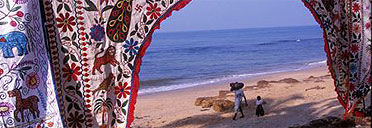
It was Christmas Day in sun-drenched Goa. Multi-coloured tinsel, plastic reindeers and plenty of cottonwool snow decorated our hotel, the Cidade de Goa, a distinctly Portuguese-influenced building set in lush gardens strung alongside the small beach of Vainguinim, near the capital, Panaji.
Our sons woke to find Father Christmas had done his work, thanks to their well-timed letter to him explaining precisely where we would be. As the sun warmed the air, we took a walk along the beach and played in the sea. Nearby, Vincent and Roberto were preparing a traditional mango-wood canoe for our outing, and blasted out "I saw three ships come sailing in" as we approached.
After fresh papaya for our poolside breakfast followed by a quick swim, we boarded our canoe - a fairly large wooden barque strapped together with coir and oiled with cashew nut oil - and set off up the Cumbarjua canal for Old Goa. We stopped to visit a farm for a home-cooked lunch, spotted elegant egrets and electric-blue kingfishers, and watched mudskippers and mugger crocodiles among the mangrove trees.
On other days, we mixed lazy hotel life with land trips, renting a car and driver - only a fool would drive his family around India, even in laid-back Goa. At Margao, Goa's second biggest town, we found the fish market where fisherwomen crouch, cheroot between lips, beside baskets of shrimp, sardines and prawns. Nearby, past piles of watermelons and rough-skinned breadfruits, the spice-scented covered market had flower garlands, fresh pickles and sackfuls of knobbly turmeric, garlic, Goan red chillies and dried tamarind.
One night, we sat in the front row at a spectacular circus that included elephants playing cricket, daring trapeze flyers, and a dozen hungry-looking lions. On others, we went down the coast to the uba dando, or straight rod, the 12-mile stretch of beach in south Goa, stopping at little villages such as Baga to take a sunset walk along the beach and pause at one of the little beach shacks for a dish of grilled tiger prawns and a glass of feni .
Sometimes, we drove inland past dozens of white-washed baroque colonial Portuguese churches reflected in the well-watered paddy fields, and through tiny villages where locals sat on their balcãos - built-in seats by the front door - like any self-respecting Portuguese villager. On these trips, our goals were a visit to a spice garden one day, on another day seeking out Goa's hidden Hindu temples around Ponda. We visited some old Portuguese mansions, such as the vast and ornate Menezes Braganza palace, and Rachol seminary with its tiny but choice museum of Goa's Christian art. And we forged through the forest to find the magical Tambdi Surla temple, a robust 10th-century wonder isolated among the trees, which has survived waves of plundering Muslims and Portuguese.
What distinguished our days was the richness of the culture - and the singular lack of tourists wherever we chose to go. This was not because there are no visitors to Goa. Quite the contrary. As one of India's newest states, officially becoming part of the nation in 1987, its people have used tourism to help haul it from medieval backwater into modern holiday destination. After iron ore, tourism is Goa's most lucrative industry. The hippies of the 1960s did little to help the economy; but when the charter flights began to come directly into Goa, the tourist floodgates opened.
Today, tourism employs 20% of the working population, who serve visitors from both other parts of India and abroad. And despite the strong ecology lobby that has ensured hotels are now built well back from the beaches, it looks set to continue to grow.
Goa's 1,446 square miles, roughly the same size as Sussex, is a tiny drop in India's vastness. But it has a particular exoticism. Behind 66 miles of sandy coastline lie palm-shaded fishing villages, paddy fields, and then the richly forested hills of the Sahyadri mountains, part of the Western Ghats that run down the west side of the Indian peninsula. The coast, with its creeks and estuaries, gave Goa its strategic position on the Arabian sea trading routes, while its hills cut it off from all but the most determined invaders.
As you travel around Goa, traces of its multicultural history appear here and there. The early settlers called the land Konkan and spoke Konkani, today one of the official state languages. Later, having stood on the sidelines while the great empires of the hinterland wrangled and warred, the powerful Kadambas made their port-capital up the Zuari river in the 11th century and became India's finest home-grown maritime power. They established Goa's trading credentials, while Arabs supplied them with good horses which they introduced into India's battle-thirsty hinterland.
As Goa's wealth grew, so a succession of Muslim conquerors from Delhi and then from the southern Muslim sultanates forged south in search of plunder, ending with the ambitious and wily Yusuf Ali Adil Shah of Bijapur, who made Goa his second capital. Yusuf built the blueprint for the city that the Portuguese would capture in 1510 under their general, Alfonso de Albuquerque, and make the capital of their vast maritime empire that stretched from Africa to Malacca.
Portuguese influences quickly permeated every aspect of commercial, religious, social and cultural life. Most dramatically, Christianity was introduced, then reinforced in 1542 when the Jesuits arrived, led by St Francis Xavier who was later buried here in regal splendour in an Italian mausoleum. The new faith was often forced upon locals who secretly remained Hindu - hence the temples hidden in the wooded dells around Ponda. In Old Goa today, the sheer quantity of gilding in the baroque interior of the Church of St Francis of Assisi and the Cathedral of Se astonishes, as does the soaring tower of the church and monastery of St Augustine - 17th-century visitors compared the rich content of its library to that of Oxford university. Meanwhile, hundreds of churches were built across the state, and most still retain their grand altarpieces, annual feasts and showy processions.
Goa's power peaked at the end of the 16th century, before British and other European adventurers hungry for India's wealth eclipsed its maritime prowess. Portugal itself became weak, and although it clung on to its territories in Goa, they brought in no more wealth. Monasteries and convents struggled on, but even they began to close.
When India's first prime minister, Jawaharlal Nehru, increasingly annoyed by Goa's wholesale whisky smuggling through its port, took firm action in 1961, the region's fortunes turned once more. That year, just three of its 374 villages were electrified; today, European visitors can arrive by direct flight, choose between a range of deluxe hotels or friendly guesthouses, paraglide off the beaches, and while away the evenings eating delicious and sophisticated hybrid Portuguese-Indian food - plenty of fish, some spices, and local cashews introduced, as it happens, by the Portuguese via their colonies in Brazil.
European visitors tend to see Goa as the soft option for visiting India, and with good reason. Its heritage of Hindu and Muslim cultures has been so tempered by four centuries of Portuguese rule that the first-time visitor to the country feels more comfortable here than leaping whole-heartedly into the full Indian experience. There is nothing wrong with this. Goa is the springboard for seeing the rest of India, and using a package deal in and out of the state usually helps keep the prices down.
After that great Christmas week in Goa, I took my family to Nagarhole National Park in Karnataka. Another year, we drove up the undeveloped west coast to Bombay. Who knows where we shall go after our next Goa visit? There is always more to see in India.
· Louise Nicholson, based in New York, is a personal travel consultant on India and has been travelling there and writing about the country for more than 20 years. To know more about her tours and customised itineraries, e-mail her at loulounic@rcn.com.
Other exotic escapes
· On Mauritius, you'll find hotels with something for parents and children. The recently refurbished Le Saint Geran Hotel, Spa & Golf Club has it all, including a complimentary Sun Kids Club open from 10am to 10pm.
Where to book: Abercrombie & Kent Family Holidays (0845 0700611, abercrombiekent.co.uk) has seven-night minimum stays over the festive period from £1,089pp (Minimum 12-night stays December 26-31).
· Weather-wise, East Africa is at its best at this time of year. Be the first to stay at Zanzibar's The Palms, which opens on December 20. Six sophisticated open-plan villas right on the beach, next door to the island's Breezes, where you can use the watersports facilities.
Where to book: Farside Africa (0131-315 2464, farsideafrica.com) offers seven nights all-inclusive from £1,656pp. A cheaper option is ultra laid-back Chapwani Island, where seven nights cost £626pp full-board (not inc drinks). Prices do not include international flights.
· Dubai guarantees sun, and lots of it. The Oasis Beach delivers a great beach, four restaurants and good sporting facilities, plus a children's club.
Where to book: British Airways Holidays (0870 4434439) offers seven nights from £1,089pp including flights.
· Get away from it all on the northeast coast of Malaysia at the Tanjong Jara Resort. Rooms are traditional-style Malay buildings, the beach attracts as many turtles as guests and the spa facilities are first-rate.
Where to book: Kuoni (01306 747001, kuoni.co.uk) offers five nights, room only from £882pp.
· Family-run Tongsai Bay on Koh Samui has the island's only private beach, plus a spa run by deceptively frail looking Thai therapists. Each room has a bath on the balcony for sunset washes.
Where to book: Tailor Made Travel (01386 712000, tailor-made.co.uk) offers seven nights from £882pp including flights.
Ways to go
Getting there: British Airways (0845 7733377, www.ba.com) flies Heathrow-Goa via Bombay from £667 return. Kuoni (01306 747008) has seven nights' all-inclusive from December 21 at the Goa Renaissance for £1,589pp (two sharing) including flights and transfers, or B&B at the Majorda Beach Resort for £1,289pp.
Where to stay: The Cidade de Goa (+832 245 4545, cidadedegoa.com) costs $250 per room per night between December 23-27 including gala dinners. At other times from $100 per room per night B&B.
Further information: India Tourist Office (020-7437 3677, indiatouristoffice.org). Country code: 00 91. Flight time: Heathrow-Bombay 9hrs, Bombay-Goa 55mins. Time difference: +5hrs. £1= 68.27 rupees.
