
"Only two of us have had malaria so far," said Heidi as I joined the group of seasoned 'overlanders' in their 5th week of a truck safari from Nairobi to Cape Town.
"Weren't they taking malaria stuff?" I asked naively. "Yeah, but it doesn't always work," was her heart-stopping response.
I added contracting permanently relapsing malaria to my list of African hazards to watch out for - it was something I thought I'd taken care of with a quick trip to Boots. The Lonely Planet health guide to Africa, with its excruciatingly detailed descriptions of Bilharzia - not to mention rates of HIV infection in the region - had nearly put paid to me before I even got there.
To top it all off, I had banked on picking up an emergency first aid kit complete with sterile needles at the airport, to have on my person at all times - but since September 11, I was informed at the check-in, airport chemists no longer sell them - far too many sharp objects for their liking. There was nothing for it but to launch myself towards Africa and what it held in store with nothing to protect me but some vitamin C and a packet of Immodium.
From Johannesburg it was a short hop to Victoria Falls - probably Zimbabwe's only remaining tourist trap, reassuringly close to the border with Zambia. Victoria Falls was a shadow of its usual self. Lack of rain had combined with the seasonal drop in water levels and much of the gorge usually covered in thunderous gallons was exposed - still an overwhelming, gut-wrenching sight, particularly when I made out some figures making what looked like a suicidal traverse of the Zambian side of the gorge. It turned out that I must have been the only tourist in town not to have braved the crossing for a refreshing dip in the reportedly calm waters of a rock pool set only a few metres back from the waterfall's frantic edge.
The town - supported by its namesake attraction and a range of extreme sports - also seemed drained of its usual quota of tourist, as well as petrol and food. This didn't stop the inevitable gap year and Antipodean hordes from partying: the nose-diving local currency proved an irresistible lure at the casino tables of the pristine Kingdom Hotel, while around the corner, taxi drivers squared up for a fight over the rare fares and even scarcer fuel that guarantee their livelihoods.
In terms of exchanging money, visitors must choose between playing it by the book with a 100% chance of getting ripped off (the official exchange rate in late November was US $1 to Zim $55) or doing business on the black market - you can get up to Zim $1400 from the touts on the main roads, but they are just as likely to steal it back or report you to the police. Dealing with travel agents and waiters inside my hotel seemed to be the best idea and netted me a satisfactory Zim $800 for each of my greenbacks. I was grateful I'd ordered single dollar bills as I only needed to change $4 for my two-and-a-half day stay.
Anything worth paying for - including the entrance fee to the falls and the must-do Zambezi rafting trip - could be paid for in US$. My rafting adventure was $85 dollars well spent, although my legs were shaking like springs as I clambered down the gorge at the start of the day. The raft was bobbing up and down like a dead insect in the swirling river; the two sheer faces of the enveloping gorge meaning there was no turning back.
"When you fall in, avoid getting stuck under the boat, then look for a canoe to save you - you shouldn't be under for more than 30 seconds," came the instructions. In the event, I was tossed from the raft like a piece of popcorn three times, including one solo attempt when I lost my contact lenses and docked with another boat altogether, but since we were descending in convoy, no matter. Each time I can't have been under the water for more than a few seconds before being spat out at the sun-drenched surface once more.
Most of the rapids are classed as grade V (out of VI) and all but one are navigated, even by novices like me. All you have to do is obey orders such as "Paddle or die!" and cling on as much as possible. I wouldn't do it again in a hurry but it was easily one of the most thrilling experiences of my life. I didn't buy the video of our exploits, however - it probably wouldn't go down too well at Christmas.
It was time to move on, although our safari was leaving a day late (for no particular reason). Something was said about Mozambique and waiting for something or someone and I saw no point in pressing the guide further. In Africa, time takes on a different meaning: minutes stretch into hours and timetables are casually discarded. Apparently we'd still see everything on the itinerary, we'd just see an awful lot of road on the last two days to reach Jo'burg in time. So it fell to get to know the posse on board our overlander, a converted truck with all mod cons - that is, a loud stereo, coach seats, cool boxes full of beer and soft drinks and adjustable side flaps for thunderous ventilation. Under the seating deck, an elaborate storage system meant first-class meals could be prepared in the most extreme conditions, while our backpacks, tents and general clobber could be stored away in relative safety. This was to prove invaluable as we travelled through Zimbabwe, Botswana and finally South Africa, as we didn't have the continuous security worries we would have done had we been travelling independently.
The first stop was a few hours over the border into Botswana - described to us as Africa's success story. Comparatively rich due to its mineral deposits, tribal harmony and decent standard of government, the country's biggest challenge is the Aids pandemic, with an official infection rate of 38%. As we pulled into Chobi Safari Lodge and a beautiful riverside pool, chalets and bar swung into view, I wondered at the quality of our lodgings. But alas, I was immediately given a hefty reality check as we trudged passed all of this to the adjacent campsite. I promised myself that I would return one day and stay next door. Still, we could use the pool and bar and the location was perfect for access to the national park and hippo-filled river. The park was swarming with elephant during our morning game drive, as well as hippo, kudu and African stalks. There was no particular fence to mark the end of the park and the beginning of a nearby village, so it's no wonder the elephants didn't play ball.
Next up was an afternoon river cruise complete with onboard bar, very civilised. It meant we could get right up close to a picturesque group of elephants and crocodiles. It was impossible not to take a good snap.
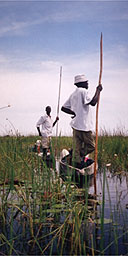
The next morning we packed up camp and headed for the most remote location we would visit on the trip: the magical Okovango Delta. Our journey took 90 minutes in the bus, then a couple of hours' slow progress in a dugout canoe. We'd have been no match for a peckish hippo or even a large fish, as the canoes were so unstable you had to lie down to stop them tipping over. Happily, no hippos emerged from the mud and we reached base camp by mid-morning. It was already 40C and there was nothing for it but to huddle in the shade of the only large tree and while away the day playing cards. Only the odd speedboat - driven by the well-to-do Botswanans - broke the spell of absolute wilderness with a flurry of colour and noise.
All game-watching was to be done at dusk and dawn to synchronise with the animals' hunting patterns and to avoid the heat of the day. And so it was that one fine morning, on foot and without an armed guide, I was confronted by a lion. We'd set off soon after dawn with the reassuring guide David. "We have very dangerous animals here," he told us. "When they charge, run." Hmmn, sounds sensible so far... "but don't run in a straight line, run in zig zags, and if possible, in a spiral up a tree." I glanced around to locate my nearest safety exit but could see no trees within running distance, just sand and open scrub, and a group of mad humans forming the centrepiece of an appetising breakfast plate. No time to worry though: we had soon found lion tracks in the sand. David was sure of it: "It's a big one. He was here 'now now', with two others." None of us honestly wanted to follow the tracks, but bravado overcame instinct and we followed David into the bush. A few unsuccessful but extremely tense minutes later we were thinking of giving up, when an almighty roar filled the air. The lioness was 50m away but her greeting shook my bones. Subconsciously disobeying orders to stand still, the group shuffled into a single file line behind the ice-cool (and unarmed) David, until she had run out of sight in a breathtaking flash of speed and power. Just a 10-second encounter, but we were thoroughly shaken and surprised at the strength of our animal instincts.
I was sad to leave the tranquillity of the delta, even though it meant another fantastic canoe ride back to dry land. It also meant we were heading out of stunningly beautiful Botswana, across the Kalahari desert. Along the way, you couldn't help noticing the incredible profusion of cemeteries, where new graves far outnumber old - a reflection of the impact of Aids. At the South African border a macabre delivery of coffins was another reminder of the scale of the tragedy.
Having been born in Johannesburg but having left for England aged barely two, it was with mixed feelings that I entered South Africa for the first time by road. Despite its raw edges and clear and present danger, the country will always have a pull over me. This decade has been one of aspirations and excitement but also fear and despair, and it is certainly a fascinating time to visit. The change in landscape as we crossed the border was minimal, but the quality of the road, the petrol stations with ATMs and the regular electrification served as reminders of the country's chequered history and huge potential.
Despite a slight school-trip feel as our pocket money was doled out along with the evening meal in Johannesburg, the expedition was about as far removed from a 'this is Tuesday it must be Belgium' tour as possible. A group dynamic between the 20- and 30-somethings on board was encouraged by a communal approach to cooking and washing up - and, of course, tent sharing. As well as excellent food, life on the truck was amazingly hygienic with regular handwashing in Dettol and only the odd outbreak of the squits. The worst harm to befall me, for all my exotic fears, was a particularly vicious bee sting.
And there were other benefits to the organised tour: expert guides to change your currencies, discounted excursions and - hopefully - some kindred spirits to get to know along the way. The other huge advantage was the price: just £275 for the week's travel, excursions and camping accommodation. There was a local payment to your guide of another £60 towards food, but £20 of this was returned at the end of the trip as we were under-budget despite the eating out and generous spending money. If you're looking for glamour or luxury, this isn't your bag, but if you're looking to see an awful lot of Africa for your pennies, you couldn't do much better.
Ways to go
Liane Katz travelled with Kumuka Expeditions (www.kumuka.com, 0800 068 8855). A week with the operator costs £275. Rafting on the Zambezi was operated by Safari par Excellence www.safpar.com, +260 332 0606/7/8).
