
There is a scene in Monty Python's Life of Brian in which the lead character stumbles across a naked hermit who has been living in a pit for 18 years, maintaining a strict vow of silence. Asked for directions, the hermit replies with increasingly frustrated grunts until Brian jumps into the pit. "Oh, my foot!" shouts the hermit - and then, realising what he has done, "Damn! Damn! Damn!"
Anyone expecting a similarly unfriendly reaction from Lebanon's only remaining hermit is likely to be pleasantly surprised. Father Escobar, who inhabits the centuries-old hermitage in Lebanon's Qadisha Valley, is an affable Columbian monk who welcomes us with a smile when we turn up unannounced at the start of our mountain walk. Not only that, he already seems to have a house full (or, to be strictly accurate, a cave full) of visitors.
When even those who have chosen to live out their days in strict isolation greet strangers with a warm smile and friendly chatter, you can be sure of a similar welcome further down the line in Lebanon. Shunned for years because of the protracted civil war, the country has for the past decade been re-establishing itself as a tourist destination and is now desperate to welcome foreigners - particularly western ones. So much so that the one word of English just about everyone in Lebanon seems to know is "welcome".
It is hard to believe, walking around Lebanon's deserted archaeological sites, that the country was once teeming with tourists who came to enjoy its Mediterranean climate, live the high life in Beirut and even, believe it or not, ski. Although it is now 10 years since the end of the war, instability in neighbouring Israel continues to deter visitors, though today's culture enthusiast can enjoy some of the world's most impressive Roman ruins, with no camera-wielding hordes getting in the way.
In fact, with its low crime rates and relative political stability, Lebanon is now a pretty safe place to go - as our (Danish) guide put it, "I used to live in south Tottenham and that was a lot scarier than Beirut". Walk around the centre of Lebanon's glamorous capital at night and you could almost be forgiven for thinking you were in Paris rather than the infamous centre of the civil war; cafe tables spill out onto the pavements and perfectly turned out locals sit around drinking and smoking. Only here the smoke of choice is not Gauloises but delicious-smelling apple- and strawberry-flavoured hookah pipes.
The French-built centre of Beirut, which spans from the central Place d'Etoile, or Nejemeh Square, has been painstakingly reconstructed thanks to a Tell Sid-style scheme whereby the city was effectively privatised and shares sold to the public to raise money for rebuilding. A proportion of the money was spent on excavating the old Roman city, which has been fenced off to protect it from the building frenzy that has seen concrete high-rises spring up across Beirut.
Venture outside the centre, though, and it's a different story. Around the famous Green Line, which divided Christian East Beirut from the Muslim West, you can still see bombed-out buildings and walls strafed with bullet holes. The National Museum, which happened to be right at the centre of the action, reopened just three years ago after being completely reconstructed. Museum staff encased its exhibits in plaster for protection for the duration of the war and smuggled them into the cellar or, for the most valuable items, out of the city. Visitors can watch a 15-minute film showing heavy Roman tombs being released from their plaster casts and pre-historic urns being retrieved from the basement where they had been hastily piled up, one on top of the other.
Move down the coast to Byblos, the small seaside town from which the Bible takes its name and which claims to be the world's oldest continuously inhabited town, and you get a real taste of what it must have been like to visit Lebanon in the swinging 60s, when the French still held sway. The walls of Pepe's famous Fishing Club are lined with photographs of the eponymous owner arm-in-arm with everyone from Brigitte Bardot to Charles Aznavour and a very youthful-looking Jacques Chirac. It being November, we were the only diners in the restaurant and, quite understandably given his pedigree, Pepe barely spared us a glance as he strolled out for his evening constitutional.
Head inland and you hit Lebanon's mountains, used as a sanctuary by persecuted Christians from across the Middle East who, like Father Escobar, made the mountains' caves their home. We chose the rather more comfortable surroundings of the Hotel Chbat in Bcharre, a small town nestling precariously on the edge of the Qadisha Valley and which claims to have the biggest television set in Lebanon.
The Qadisha valley offers some stunning walks, and a lengthy hike is recommended for anyone planning to indulge in dinner at Chbat's, which is a hearty affair of hot lentil soup, mezze and lamb kofte, followed by fresh oranges - all washed down with plenty of Lebanese red from the nearby Bekaa region.
Mr Chbat, the hotel's Sean Connery lookalike proprietor, has been welcoming visitors here for almost half a century and is clearly optimistic about the future of the tourist industry in Lebanon - he's planning a major expansion of his hotel, which already has 41 bedrooms.
The Qadisha is a predominantly Christian area, and Bcharre, with its three churches and Heidi-style alpine architecture, has an almost European feel to it. But travel just a few miles further inland and you are in the Bekaa Valley, home to the Hezbollah and a Shi'ite Muslim stronghold where the streets are plastered with images of the Iranian Ayatollahs.
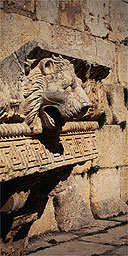
The main reason to visit the Bekaa is Baalbek, a massive Roman temple complex that easily ranks as the most impressive Roman site in Lebanon, and possibly the whole of the Middle East. Originally a temple to the sun god Baal, the complex was appropriated by Roman invaders who re-dedicated it to Jupiter. Only six massive columns remain from the main temple, although another, dedicated to Venus, has somehow managed to survive both earthquakes and invaders and is said to be the most ornately decorated temple in the Roman world. Despite this, when we visited Baalbek, it was deserted but for a couple of Lebanese teenagers keen to test out their English on some female tourists.
You could stay in Baalbek for as little as £5 a night, but really the only place to go is the Hotel Palmyra - a wonderfully incongruous French colonial-style building that housed the hordes of Victorian-era tourists who came to Baalbek. General de Gaulle stayed here, as did the artist and writer Jean Cocteau, whose paintings hang in the hotel lobby and who described Baalbek as "the best place in the world for the soul of the poet to take flight".
Don't expect efficient service or reliable plumbing, but there are few more pleasant experiences than sitting out on the first-floor terrace, sipping hot Turkish coffee and listening to the muezzin's call to prayer as the sun goes down over the giant columns of Jupiter's Temple.
