
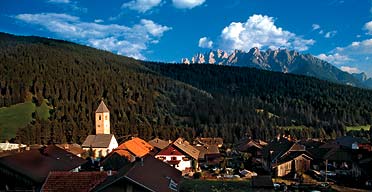
Out of our hotel window, luscious pine trees spread across the mountainsides below the jagged white peaks. Pristine chalet-style houses dot the grassy valleys, each window box festooned with flowers. We even saw a man with a feather in his cap. But forget all the Heidi and Sound of Music cliches. This is Italy.
One local tells us the flowers are not just for decoration - red geraniums signify "burning love", while red carnations indicate support for the regional socialist party. Like I said, this is Italy.
This corner of north-west Italy is officially called Alto Adige, but most of its citizens call it Südtyrol (South Tyrol). South Tyrol has only been part of Italy since 1919, when it was taken from Austria-Hungary. German is the first language of 85% of its inhabitants, though everybody seems to speak Italian.
Our hotel manager, Erwin Lanzinger, took us on a horse-and-cart ride through the Alto Pusteria valley, limestone peaks stretching to the heavens, only a few crested with snow during the summer months. Destination: a sharpener of peach schnapps in an alpine chalet bar. Later we made full use of his Bad Moos Sportshotel's health spas, including a local treatment called a hay bath. A bit like lying in bed, only with more hay.
Refreshed and relaxed, in dry sunshine with a light breeze we walked around the Three Peaks, symbol of the Dolomites. Towering above us, climbers scaled the terrifyingly vertical rock faces while us part-timers watched agog from the safety of the path below. Outside the skiing season, it is possible to indulge in climbing, dry tobogganing, abseiling, sleighing and paragliding, and even something called base jumping. The world's greatest mountaineer, Reinhold Messner, is from the region and still lives there.
But those of us who regard table tennis as an extreme sport can also enjoy the Great Outdoors of Alto Adige without risking life and limb. The path around the Three Peaks snakes along banks of bright alpine flowers and past rocks bearing dinosaurs' footprints and other geological wonders. Mobile phones temporarily incapacitated, the only sound to break the stillness was the gentle clunk of cows' cowbells.
The route not only offers staggering views of deep ravines plunging from monstrous rock faces - it also leads to a great restaurant. After a stroll past some of the world's most breathtaking scenery, lungs full of clean mountain air, you're ready for some fabulous Italian food.
Alongside the gorgeous pasta dishes, Mediterranean fish and antipasti on the region's menus are pretzels, sauerkraut and a kind of smoked meat called speck. Local cheeses are delicious, and South-Tyrolean wines are considered to be among the best in Italy. Franz Ladinser, owner of the Hotel Orso Grigio and Grauer Bar in San Candido, recommended the sweet white Gewürztraminer and the red Lagrein. His hotel has been in his family for 10 generations, so he should know.
Each Thursday in the middle of the night it is possible to be taken to a mountain peak to see the sun rise. Sounds great doesn't it? But such were the attractions of the bar that we didn't make it out of bed on this visit.
Next day we cycled 20 miles (downhill all the way) on immaculately maintained footpaths down the spectacular Alta Pusteria valley to a turquoise lake, where we had yet more delicious Italian grub before hiring a pedal boat and crawling round the water.
The so-called Sesto Dolomites form a natural clock face - when the sun falls on the Third peak, it's 3pm, if it falls on the Fourth, it's 4pm, and so on. This area is beautiful in the summer. Skiiers will miss the dazzlingly beautiful mountain flowers which are in an abundance at even very high altitudes. But there are plenty of reminders of how treacherous it can become. There was ferocious fighting here during both world wars. The bodies of soldiers are still occasionally found in the ice.
The mountain looming over San Candido is called Haunold, named after a giant said to have helped build the town's amazing Romanesque church. According to local legend, in a fit of pique, Haunold ripped out his own rib, which adorns the wall of the church (in fact, it probably belonged to a woolly mammoth). The church also boasts a fresco by 15th-century Tyrolean artist Michael Pacher, whose work adorns many buildings in Bruneca (Bruneck), a 20-minute drive away through the valley. Best of all are the Roman depictions of Christ, charmingly innocent beside all the centuries of Catholic iconography in such abundance in Italy.
Back in the 21st century, Bruneca was host to a jazz festival when we were there, with bands from around central Europe on stages around the town. I was secretly expecting fat men in leather shorts doing Louis Armstrong impressions, but the jazz was mostly of a high standard. It did not seem incongruous to hear jazz in the Alps, though disappointingly there was no yodelling, nor not an alpine horn in sight. "Here, we call it kitsch," explains our guide. Yes, I explain, that's what we call it, too.
The best place to eat in Bruneca was the rustic splendour of The Lamb, a 500-year-old bohemian snug whose wood-panelled walls are crammed with works by the artistic types who have dined there down the centuries. It's not hard to imagine this area inspiring creative work: disco record producer Giorgio Moroder is a local lad and Mahler used to take holidays here.
As elsewhere in Italy, you cannot escape the sense of history. It has more castles per square centimetre than almost anywhere in Europe. Mussolini did Alto Adige at least one favour by excavating many Roman remains. He did so in an effort to prove to the German tribes that the area had always been "Italian". You can go and see the results of a recent dig at St Lorenzen.
More recent (and more Alpine) history is celebrated at the South Tyrolean Museum of Local Ethnic Tradition features a range of traditional rural buildings - farmhouses, blacksmiths, dairies and so forth - transplanted onto a mountainside overlooking Bruneca and populated by farmyard animals. It was here that we saw our only pair of lederhosen.
Leather shorts and feathered caps aside, South Tyroleans take their fashion cue from the Italians. Though small, Bruneck offered more than enough designer-label shopping opportunities to sate the appetites of the fashionistas among us. There were bargains to be had, even though Alto Adige is among Italy's wealthiest regions.
Even outside the ski season, South Tyrol is a big tourist magnet. From the end of the 18th century the British were the first tourists in the South Tyrol, and even taught many of the locals how to climb. These days, however, northern Italians, southern Germans and Austrians are the most frequent visitors, and the area is blissfully free of English or Americans.
"People are strange here," affirms our guide. That's part of the charm, but anyway, who cares when the scenery is this breathtaking and the hospitality is this good? Alto Adige remains strangely aloof from the rest of Italy, but also from Germany and Austria. It's fiercely proud of its traditions but it's also chic; it's ordered but also unpredictable. And it's Italy.
Way to go
· British Airways (0870-850 9850, ba.com) flies from Gatwick to Venice from £90.20 per person, including taxes. BA also flies from Glasgow to Venice (via Gatwick) from £158 per person, including taxes. The price is subject to availability.
· Sport & Kurhotel Bad Moos in Sesto/Sexten, Alta Pusteria (0039 0474 713 100, badmoos.it) offers twin / double rooms from £41 per person per night, on a half board basis.
· Hotel Corso, in Bruneca/Bruneck (0039 0474 554 434, hotelcorso.com) offers twin/double rooms from £28 per person per night, on a bed and breakfast basis.
Further information
· Hotel Orso Grigi in San Candido, Alta Pusteria (0039 0474 913115, orsohotel.it)
· South Tyrol tourist board (suedtirol.info)
· Holidays in South Tyrol (south.tirol.it)
· Alta Pusteria tourist office (0039 0474 91 31 56, altapusteria.net)
· San Candido tourist office, Alto Adige (0039 0474 913149, innichen.it)
· Dobbiaco tourist office (0039 0474 972132, toblach.it)
· Sebatum archaeological museum, St Lorenzen (sebatum.it)
· Alta Pusteria (three-peaks.info)
· Bruneck (bruneck.com)
