
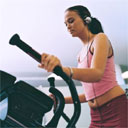
One of the mysteries about skiing and snowboarding is how many of us forget how physical it is. When I think about skiing - like many I suspect - I tend to idealise it. Big puffs of powder, strong legs, and endless stamina - rather than the reality of tense days of poor light, aching thighs and the last icy run that has unfrozen and refrozen, and has to be taken on wobbly legs drowning in lactic acid just when you want them to be really solid.
Being fit for skiing is more than just avoiding running out of steam and not enjoying it as much as you should, it is also about safety.
Since the mid-Seventies when binding technology improved on skis, there has been a quite dramatic drop in the number of serious accidents. If a skier is going to have an accident now, there is a good chance it will be related to lack of fitness and loss of control. It seems that most accidents occur, according to anecdotal evidence, halfway through a two-week ski holiday, when the legs are tired from the unexpected shock of exercising hard every day and the confidence, perhaps, a bit too high.
Pre-skiing preparation is not just for more advanced skiers - training is valuable for skiers of all levels, especially if you are having to lever yourself off the ground after repeated falls.
Even now there is still plenty of time to make a difference to your fitness for skiing and snowboarding and enjoy your winter holiday more.
So where do you start? According to ski fitness experts there are three basic components to ski fitness that are necessary for improved performance and fewer injuries: cardiovascular endurance, flexibility and strength training.
And while this sounds a bit hardcore it doesn't need to be.
'People forget that when they go skiing it is not going to be the equivalent of 40 minutes playing squash, but that they are going to be out for the whole day,' says Fiona Sweetman of the Ski Club of Great Britain. 'You need to think about that if you are not going to wake up on the second or third day and feel as though you can't move your legs out of the bed.'
Sweetman recommends light cardiovascular (aerobic) exercise such as jogging, cycling or swimming to raise the heart rate; slow stretching for joint mobility to avoid injury; and thigh-blaster type exercises to work on the specific muscle groups (of which more later).
She also recommends the use of a wobble board or inflatable balance cushion for those who wish to improve balance and work their calves.
While snowboarders might like to believe that they have little in common with skiers in terms of what groups of muscles they need to train, they have more in common than you might assume. The best exercises for boarding work the body's postural muscles - also very important for skiers - the major muscles in the thighs and around the body core.
Graham Bell, former British Olympic skier and now a presenter on the BBC's Ski Sunday, believes that even when people do train for skiing they have a tendency to ignore core stability and exercises that can help with co-ordination.
Bell is marketing a range of new ski fitness machines in the UK called the Skier's Edge, which addresses both these training problems by simulating different terrains from bumps and trees to powder.
He says: 'When people ask me what they should be doing to help train for their skiing, one of the things I say is just to take the stairs or go hill walking whenever they have the opportunity.' Options that are something rather less gruelling than the hill sprints he would do for racing training.
For core stability and balance, he recommends - as well as his Skier's Edge - training sessions with a 'Swiss' or 'gymnastic' ball, which are used a lot by the British team and are extremely good for abdominal and lower-back strength. Courses on how to use the ball are offered at most gyms.
Before launching into strenuous exercise you should always consult an expert at your gym, a physio or your GP if you are beginning a conditioning programme and you are worried it may not be suitable for you.
· For more information about the Skier's Edge visit www.skiersedge.co.uk.
