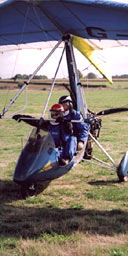
The little wheels bounce over the rough grass, rattling bones against the hard seat, as the propeller pushes the machine along the ground. Single engine at full throttle, the speed is suddenly enough for the plane to lurch into the air, climbing into the sky above hedges and trees. Wind rushes through the open cockpit, turbulence buffets the fabric-covered wing, but amazingly this tiny, ramshackle thing is actually flying.
It could have been Wilbur Wright, wowing the French crowds in 1908 with his record-breaking flights from the racetrack at Le Mans. But it isn't, it's 2003, it's a field just south of Poitiers, and it's me. I'm piloting this delicate insect-like machine thousands of feet above France. Yes, less than a century after the Wright Flyer first left the ground at Kitty Hawk, flying has become an affordable activity holiday thanks to microlight aircraft.
A microlight is an aeroplane that weighs less than 450kg including pilot, passenger and fuel. Although my hosts, G S Aviation, can teach you to fly in Wiltshire, an intensive week at their French airfield means less problems with the weather, cheap but good living, and complete removal from any distractions. Instructor Graham Slater teaches only one or two students at a time, so it can be an intensive learning experience, though you might prefer just to add a new dimension to a rural retreat by doing an hour a day.
It's a strange way to see a country. The airfield at St-Secondin is as obscure and basic as anywhere the Wright brothers flew. Facilities consist of a hangar, a toilet, and an outside tap, and the village itself is a few kilometres away along winding, muddy lanes. There are two runways - mown and rolled from cow-cropped grass, and plagued with moles - and a red windsock, to which I will become intimately attached. It doesn't sound like enough entertainment for a week, but it is.
Because inside the hangar lurks the Quantum 912, a deceptively delicate-looking creature that will teach you things you'd never dreamed of doing. It all seems so simple - there's a single wing, shaped like a hang glider, with a single bolt (they call it the Jesus bolt) attaching it to the "trike" - the sidecar-thing where pilot and instructor sit behind a tiny windscreen. On the back is the engine and the single propeller. That's it. No air traffic control, no check-in desk, no emergency exits here, here and here. Helmets and seatbelts on, shout "clear prop!" in case some reckless visitor is about to slice off a finger, and hit the start button. A minute later you're in the air, looking down on a landscape that you thought you knew.
Students tend to fly morning and evening, when the air is less turbulent. Fortuitously, this is when sunshine hits the land at an oblique angle, casting shadows that throw every detail into relief. Each field has its own texture - the soft suede of bare earth, the corduroy of crops in rows - hugging the contours of the earth. Hills become a chiaroscuro of curves and hollows, bellying the flat road map in your mind's eye. Chateaux come into their own as ornate jewel boxes, their innermost gardens exposed to our airborne view. As the autumn sun sinks low, a tiny blob of a tree spreads its shadow across half a field, every branch drawn in deep blue ink against the gold.
But it depends how seriously you take the flying. If, like me, you are hooked from the first moments of hurtling skywards, the only thing to do is go for your pilot's licence. Sightseeing becomes a rare luxury as you fight to master the plane, terror and exhilaration battling inside you. It's no harder than learning to ride a motorbike, but the stakes feel higher. You can park a motorbike without having to let the engine idle at 500 feet and glide towards the hard, uninviting ground at what seems like a suicidal speed and angle.
Knowing that it's all dual control, and that the instructor can grab the control bar and throttle at any point, is not as much comfort as I'd hoped. A ropey take off turns rapidly into an out-of-control banking dive, and all Graham does is say "sort it out, then". I haven't been so scared since I last asked somebody out on a date.
But with a couple of pointers through the intercom, I do sort it out. Graham's good at the "if the instructor has confidence in you, you will have confidence in yourself" approach. As I bring us round for yet another attempt at landing, muttering the checklist to myself "fuel- we have enough; wind - blowing straight across the runway..." he's looking the other way and talking about what the neighbour's got on the back of his tractor.
Sadly we can't be in the air the whole time. More time is spent hanging around the airfield than in the air, in fact. Even in central France rain, low cloud or too much wind can keep us grounded, tantalised, nipping out every few minutes to check the angle of that red windsock. This is one holiday pastime where a flaccid droop is my most fervent hope.
In a week, I lose one day to thunderstorms and wind. Time to sample the delights of St-Secondin. Which are the bakery (open only till noon) and the bar. Frances, the barman, doesn't bat an eyelid when we say we're student flyers. He has a microlight himself, which we've seen at the back of the hangar. No wonder Wilbur and Orville came here to fly - in France nobody thinks it's strange to want to fling yourself aloft in something that weighs less than a motorbike. In England all the neighbours complain about the buzzing noise from the air, but here they drop in to watch.
Since the distractions of a beer or brandy must wait till flying is over for the day (eight hours between bottle and throttle is the strict rule) it's a coffee and back to the chalet for Ground School. For a UK private pilot's licence (even for microlights) I have to pass five written papers, so every afternoon is spent studying for my "air law" and "air technical" papers. I pass both but, alarmingly, one of the questions I get wrong is how to get out of a spiral dive. Still, I know a lot more than I did about how aeroplanes stay up and why everyone gives way to a balloon.
Far too soon, the week is over, and I'm not even ready to fly solo. I can take off, and I can nearly land. In fact, on my last lesson Graham says he thinks I'd probably get it down in one piece. Which is a start. In the early days of flying they used to say that a good landing was one from which the pilot could walk away and a great landing was one where you could use the plane again. Thankfully, the Quantum is a lot more robust than the old cotton-and-balsa-wood machines, and can take a few rough touchdowns.
So I'm on my way home, stopping off in Le Mans to pay my respects at the Wilbur Wright Memorial. It's thanks to tenacious adventurers like him that I'm able to treat flying as a holiday thrill. I know there's not the same danger in these days of proper instruction and aircraft inspections, but I like to feel I'm tasting a little of the freedom the early flyers knew, the exhilaration of no longer being earthbound. In 1902 it seemed impossible, and now leaving the ground under your own control is something even I can do.
Way to go
· Timandra drove to Poitiers after crossing the Channel with Brittany Ferries. You can also fly to Poitiers from Stansted with Ryanair. Local accommodation from camping to gîtes can be booked through G S Aviation. Timandra paid just under €10 a night for chalet accommodation in St-Secondin.
