
"Be kind to us, chaps," our skipper Don pleaded as he struggled with a series of ropes and pulleys in an effort to shift the 40-foot yacht from her mooring. I wasn't entirely sure whether he was appealing to the winds, which seemed determined not to let us out to sea, or to the better natures of a group of hacks on a press trip. Either way, it seemed a futile gesture.
I didn't expect a trip around the islands off the west coast of Scotland to be all plain sailing, but hadn't thought we would hit trouble before we'd even left the marina. Actually, the idea of being stuck in harbour wasn't entirely unappealing. To date, my sailing experience had consisted of being sick on cross-Channel ferries and an ill-fated kids' activity holiday in the south of France when, frustrated by our unwillingness to get our hands dirty on deck, the sailing instructor ordered my brother and I to take a dinghy out on our own. The resulting drama, involving two slightly hysterical sailors being blown out to sea, some even more worried parents and, eventually, a rescue boat, had almost (but not quite) put me off sailing for life.
Twenty years on and I figured I had got over the famous dinghy disaster. This time was different. For a start we were travelling in style, on the Chantilly of Oban, a brand new yacht with a gleaming white hull and expensive-looking wooden interior. We were also accompanied by an experienced skipper and the opportunity of seeing the Inner Hebrides up close without having to negotiate the ferry routes made braving another boat worthwhile.
Eventually, after much pushing and pulling, we set sail for the island of Kerrera, just off the mainland. It was a suitably tame beginning for a bunch of rookie sailors, but nonetheless we were fully harnessed, life jacketed and travel-sickness-pilled up. Don set us to work getting the sails up but as soon as we'd achieved our task the wind died down leaving us to rely on the on-board motor to get us to the island. Still we looked the part and could at least claim to have sailed for our supper, which had magically appeared.
It's amazing how hungry a bit of rope pulling can make you and I wasn't sure what to expect from the tiny kitchen (or galley, as it was known on board). But the food was actually one of the high points of the trip, varying from fresh salmon on the first night to a hearty venison pie, with at least two courses every evening and bottles of wine appearing from the benches we ate on.
Sleeping arrangements on board are certainly cosy, and not for the claustrophobic. If you weren't good friends with the person you shared a cabin with at the start of the trip, you certainly were by the end. But while you can't expect five-star luxury the cabins are perfectly comfortable and on ours even had neat little curtains covering up the windows.
We spent the nights anchored in sheltered bays and inlets, though some were more sheltered than others. The pleasantly soporific swaying of the first night gave way to some pretty serious rolling around on the second night that had a slightly less relaxing effect. Still, all that fresh sea air meant getting off to sleep wasn't ever a problem, particularly after a few night-time whiskies.
The next day, we set sail for Scarba, one of the bigger islands in the area and entirely uninhabited. We sailed south from Kerrera and down towards Seil, a tiny island known mainly for being home to Princess Diana's mother Frances Shand Kydd. Also there is the charmingly named House of the Trousers, a pub that once marked the spot where islanders travelling to the mainland would swap their illicit kilts for trousers to comply with an 18th-century ban on Highland dress.
Next to Seil is Easdale, whose slate quarries once supported nearly 500 inhabitants. The industry was wiped out in a massive storm in 1881, although many of the old workers' cottages still stand, some now serving as holiday homes in the summer.
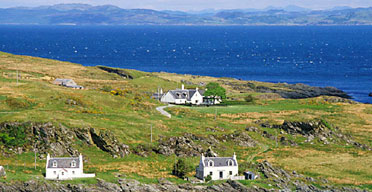
This time the wind was on our side and we quickly made it to Scarba, a wildlife lover's paradise teeming with red deer and bird life. A deer stood calmly outside the small bothey overlooking the bay and we had barely stepped onto the island when we spotted a rare golden eagle. The bothey turned out to be deserted but surprisingly homely complete with what looked like pre-war camp beds and, bizarrely, a long list of first aid instructions, including what to do in the event of appendicitis. Feeling very Famous Five, we yomped up the hill passing more deer before heading back to the boat to find hot soup and freshly baked rolls (though sadly no ginger beer) laid out for lunch.
Fortified for the afternoon, we sailed further south to the next island, Jura, our home for the night, passing the Gulf of Corryvrechan, the narrow channel of water that runs between Scarba and Jura. The gulf has been described as the most dangerous stretch of water in northern Europe thanks to the underwater whirlpools that can cause 15-foot waves when everything around it is calm. George Orwell, who spent a year living on Jura while he wrote 1984, nearly drowned there when his dinghy overturned, turfing him and his son into the sea. They managed to cling to a rock before being rescued by a passing lobster boat. Orwell's diary entry for the day read: "... only serious loss the engine and 12 blankets - all in a day's work."
Fortunately the 15-foot waves were having the afternoon off although just looking at the bubbling water was enough to make me feel queasy. Don, whose story-telling skills kept us entertained for much of the trip, wisely waited until after we'd passed to tell us the legend of the Scottish prince who was drowned in the gulf trying to prove his worth to the father of his beloved.
We passed Orwell's house, an impressive white-fronted affair, as we sailed down the Sound of Jura to Craighouse, a scattering of houses inside a bay that make up the island's only village. Just 24 hours at sea and I was already getting excited at the prospect of civilisation. Even more exciting, we were practically within sniffing distance of the Jura whisky distillery.
We saved the pleasure of actually venturing onto shore until the next day, by which time the sight of a small shop had us practically sprinting through the doors, but as we approached the distillery, disappointment loomed when it turned out we had picked the one day it was shut to visitors for stock-taking. Fortunately, the staff took pity and agreed to give us a tour at the end of the day once we had done a bit of walking to justify our free dram.
We passed up the opportunity to climb the forbidding peaks of the Paps of Jura and opted instead for a more townie-friendly hill walk, a four-hour round trip that took in several deer sightings and lots of munching on wild raspberries, arriving slightly windswept and very muddy back at Craighouse.
The distillery has only been open since 1963 but continues in a strong tradition of (previously illegal) whisky making on the island. Brewer Willie Cochrane (who admits he never touches the stuff for fear of overindulging) explained with pride that Jura's distillery was set up to make something different to the more famous whiskies distilled on the neighbouring island of Islay, home of Lagavulin and Laphroaig. Jura single malt has a much cleaner, less peaty flavour.
The next-door Jura Hotel provided very welcome hot showers and a few more glasses of Jura whisky (the hotel has its own exclusive variety) in the glass-fronted bar, offering views over the bay while the sun went down. Heaven.
The next day we got up feeling slightly the worse for wear to discover just what you don't want when you're on a boat with a hangover. The winds had got up and were creating some disconcertingly large waves in the Sound of Jura, where we were heading. Hurriedly donning waterproofs, life jackets and harnesses (not easy when you're being chucked from one end of the cabin to the other) we dashed up on deck to find a grinning Don at the wheel, having a wonderful time.
Don had been in the 1979 Fastnet race, when 18 entrants died in a ferocious storm, and probably viewed this little local difficulty as the sailing equivalent of a walk in the park. I tried - not very successfully - to fix a grin to my face and clung on for dear life. A few hours of this continued, with Don getting chirpier and chirpier, as we surfed the 10-foot waves and I deeply regretting that breakfast fry-up.
As we motored back to Oban the next day, the sea was glassy smooth and all signs of the previous day's rollercoaster ride had vanished. On our return, we discovered a new-found respect for Don when we heard we were the only boat that managed to leave the windswept marina four days ago - the others had given up and gone home. Perhaps, I thought, I will be kind after all.
Claire Cozens travelled with tour operator Wilderness Scotland (01309 673691), and travelled on the Scotrail sleeper train from London to Glasgow (08457 550033).
