
I feel as if I am cycling around a Willow Pattern plate. This is Yangzhou, right in the heart of rural China. Ahead of me is Moon Mountain and around me is China in a time warp; paddy fields, barefoot villagers, farmers in bamboo hats working their land with water buffalo, assorted animals snorting and snuffling for titbits of food and all accompanied by the pungent, deep brown smells of nature unharnessed.
I am tagging along with a group of teachers on an extraordinary two weeks in China, organised by a small, niche operator called Master Travel, with a mission to provide something different for special interest groups. Our leader, mentor, general factotum is one half of Master Travel, a mild-mannered Lancashire man, Harry Field, with a knowledge of China that is only surpassed by his passion for the country and its people.
This is a trip Harry has done literally dozens of times, but his enthusiasm, his energy and his determination to give every one of his charges the opportunity to see and experience as much as possible of China and the Chinese way is indefatigable. The itinerary he has put together with Cheung, our local guide, includes all the tourism "must-sees" and a few besides, but the ingredient that makes the trip unmissable for this group of 18 educators is that it offers the chance to get into the classrooms of China. Yes, we've seen Tiananmen Square and the Chinese acrobats; we've haggled at the silk market; picked up bargains from street vendors and marvelled at the Terracotta Warriors and the enormity of the Great Wall.
But we've also been inside local schools, day nurseries, teachers training institutes, both in the glamour cities where the facilities are awesome to the countryside where books are a rare commodity. We've also seen the practice of both western and Chinese medicine and we've been to a maternity hospital where we watched a three-day-old baby gently massaged to encourage peace and relaxation. What normal package tour could offer that sort of experience?
These insights provide the highlights of the trip. Falling into a familiar groove, learning more about your own profession is only part of it. There is a sense of purpose in the air. June Callister, Early Learning lecturer at East Devon College believes that seeing how modern China works at grass roots level brings a greater understanding and appreciation of the culture on offer. "It makes everything more interesting, brings it into focus' she says, 'and seeing the discipline and motivation in the classrooms makes it easier to understand the veneration they feel for their past."
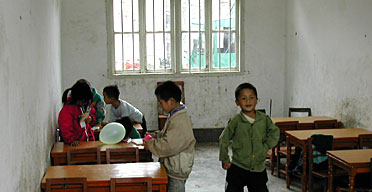
Back to Yangzhou and our cycle ride. We are hoping to visit another nearby school. It's a last minute idea and hasn't been set up. Hester, our neighbourhood guide for the day, is cheerfully optimistic but neither the head nor the teachers and pupils have any idea that we're in the area. We arrive and are virtually mobbed by around 50 primary children. This is a remote region and foreign visitors are few and far between. We provide welcome novelty.
Everyone but me is well armed with presents and gifts. As I now realise, this is no junket for these teachers; everyone is well briefed and even better prepared. June never goes anywhere without her carrier bag of goodies; toys, crayons, pens and teaching aids made by her students back in Devon. Very popular are hand-made lotto games with Chinese writing down the side.
"We clicked into a Chinese dictionary on the internet," says June, "and found the right calligraphy for simple words. You know, 'horse', 'house' 'dog', the sort of thing that appeals to young children. And dolls of course, lots of dolls." They all went down particularly well here, where not only toys, but teaching aids of any kind are rare. One little boy gave us back a packet of crayons because he had a pen already. Luxury is obviously comparative.
It was all in such contrast to Shanghai only hours away. This is wealthy China, China with an upwardly mobile middle-class, China taking the world of luxury labels by its freshly pressed lapels and enjoying every moment. Down at the Marina I see a proud union flag flying alongside the Sunseeker logo. The most luxurious yacht manufacturer in the world has just opened a dealership in Shanghai. That says it all really.
We'd travelled there first class (TV, piped music, tea at your bedside and a charming female "butler" on tap) on the overnight Shanghai Express; just the name conjured up visions of Somerset Maugham and movies starring Peter Lorre and Sydney Greenstreet. Not any more.
Warned by Harry that we'd be expected to do a "party piece" at one of the schools we'd be visiting we spent most of the evening speeding across China and rehearsing a game called "We're Going On A Bear Hunt". I had never heard of this game and suggested the more universal, "Hokey Pokey" but was over-ruled. A good thing too. "We're Going On A Bear hunt" was gravely, but warmly received at the kindergarten we visited. We also did "Heads, Shoulders, Knees and Toes," which, although it hadn't entered my mind for around 20 years, came back to me in a flash.
Ever onwards we set off to the sort of primary school any city would be proud to show off; state-of-the-art facilities, dedicated teaching staff and six to seven-year-olds, already confident in English and extraordinarily self-possessed. "How old are you?" asked this small person of possibly six-and-a-half, hair in stiff little bunches, blue beads in her ears. "What's your name? My name is Su Li."
We learned of a daily routine that included hours of solid, intense learning interspersed with Tai Chi classes and eye and brain exercises. I knew of the Tai Chi, I hadn't heard of the emphasis the Chinese curriculum puts onto what they call "recharging the brain". Natalie Taylor, a day nursery teacher from Kent was fascinated. "You would think," she says, "that this sort of tough blackboard learning would be too much at this age. But the evidence is there, in front of you. These are healthy, motivated children who do eye exercises twice a day. How many wear glasses? None in the school and outside hardly any as far as I could see. I wear glasses. Why didn't I learn about eye exercises?"
We were impressed, of course. I had been expecting more regimentation, less spontaneity. I had thought top facilities, but a colder regime. If pressed I might admit that I expected a more superior attitude from the Chinese teaching professionals, willing to show us their methods but unwilling to show interest in the western approach to education. Again, I was wrong. That extra dimension I found as the trip went on worked both ways; professionals travelling 8,000 miles not only to learn but to give of their own expertise. This has been a two-way dialogue.
I haven't spoken of the food; sometimes delicious, sometimes nerve-wracking, especially when a rural menu includes water buffalo, antelope and dog. Nor of the extraordinary bargains - a hand-made wall carpet for £20, an emperor's silver nail protector for £2. Nor of the characters we met like the old man who discovered the terra cotta warriors and has a happy and lucrative life these days signing autographs and posing for pictures.
China has to be seen with a good guide, that goes without saying. For that guide to be warm, knowledgeable and passionate is a bonus. To have the added insight of China's vision of its future through the education of its children seems to me to be the most valuable of all.
Way to go
Early Years and Primary Education in China
19th March - 2nd April 2005
Who goes?
Education professionals at all levels. Anyone who is reasonably fit and has a spirit of adventure.
What does it cover?
The tour is multi disciplinary and early years and primary school teachers and nursery nurses will be accompanied by secondary school teachers who may follow a separate programme. Partners are welcome.
How flexible is it?
Very. Master Travel prides itself on its adaptability.
How much is it?
£2,495 per person.
More info?
www.mastertravel.co.uk +44 (0) 207 501 6742
