
The Berber pointed to the arch towering over the main Avenue de l'Istiqal, in the centre of Essaouira's medina. "Tap it," he told his friend, his face creasing with laughter as the hollow sound of fibreglass rang out.
For the second time in seven months, the picturesque military port on the Atlantic is playing host to film crews, drawn by its 16th-century Portuguese battlements, superb light and dramatic ocean backdrop. Last October, Oliver Stone's Alexander The Great was in town, and the souks hummed with talk of Angelina Jolie and Irish heartthrob Colin Farrell. Last month, Italian film crews built a tower, gates and two arches for Ridley Scott's Kingdom Of Heaven, which completed filming this week.
The late 18th-century fortified town has a history of being in the movies: in 1959, Orson Welles filmed the opening of Othello along the ramparts of the Skala du Port, and spent six months in the town when his Italian backers withdrew their financial support.
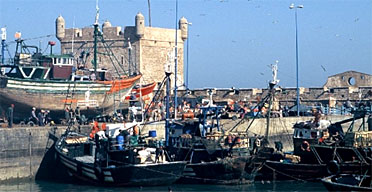
And it's easy to see why. Essaouira, known as Mogador before Morocco gained independence in 1956, means "little picture" and each new turn down an alley provides fresh photo opportunities, from the honey-coloured stone battlements with 18th-century bronze cannons; to the whitewashed, blue-shuttered homes on the edge of the sea; to the men carrying nets of gleaming fish in the port and barbecuing them at tiny stalls overlooking the ocean, where you can feast on red mullet and salad for the equivalent of a couple of pounds.
Wander through the souks and the colours become even more vibrant: mountains of saffron, henna and cumin in the spice stalls; rust and cobalt rugs; fuschia lamps and pink leather slippers; and the golden glow of polished thuja - a local wood used to make inlaid boxes, furniture and bowls.
Much of the town's appeal comes from its elegant marriage of Arabic and Mediterranean architecture, deemed so superb it was designated a Unesco world heritage site three years ago.
While the Portuguese made the battlements, most of Essaouira was built in 1766 when the Sultan Sidi Mohamed ben Abdallah commissioned a French engineer, Théodore Cornut, to design a town that could vie with the rebel port of Agadir, where the Berbers were importing vast quantities of weapons.
The plan proved successful, with Essaouira soon handling 40% of Morocco's maritime trade, including ostrich feathers, spices, gold dust and slaves from the Sudan, Mali and Nigeria who were traded at the port before being sent on to Europe.
Cornut, believed to be a prisoner who earned his freedom through his design, surrounded the town with ramparts similar to those of St Malo, and planned the main streets on a grid system, bringing some sense of order to the medina that can still feel, to a disorientated traveller, a little like a warren.
The French influence is so strong that the Place Moulay El Hassan, a large square fringed with bars and cafes serving Italian ice cream and cappuccinos, would not be out of place in southern Europe. But pass a mosque and wander into the medina's main street, and you could be in ancient Arabia - complete with veiled women, stalls of figs, dates, spices, and even opium, and donkeys drawing barrows of mint.
All that's needed to complete the Arabian Nights cliche are the camels - and you can find those nearby on the sandy beach.
Ask Moroccans and the growing number of Europeans moving to Essaouira what they love about the place, and the universal answer is: "It's so relaxing." In part, this is due to the lack of traffic, and relatively gentle pace, of the medina - only bicycles and donkeys being allowed due to its narrow streets.
But the sea also plays its role - as does the alizee , the wind that, at its worst, howls through the town, slapping residents against the walls with its force and, at its best, sends kite- and windsurfers haring across the bay.
"Wind City, Afrika" is now a must on a tour of north African surf spots, but even those who mutter at its force - at its strongest from mid June to August - welcome it for curbing the oppressive heat that afflicts inland Morocco. Sitting in the French-owned Café Vagabond, overlooking the Venetian ruin that inspired Jimi Hendrix's Castles Made Of Sand, I found it too strong to kite surf but deliciously envigorating.
Relaxation of a less bracing kind is also central to Dar Baida, a newly renovated early 19th-century house in the heart of the medina yet tucked away from the bustle of the raucous streets. The result of a two-year project by Emma Wilson and Graham Carter, antique shop owners from Islington, London, whose store has been frequented by the Beckhams, Anna Friel and Alan Rickman, the white troglodyte house eschews the hackneyed Arabian Nights style of decor (all bronzed lamps and terracotta walls) to mix Moroccan cool - tailormade soft white leather pouffes, traditional tadalekt bathrooms, carved sandstone columns and arches - with bright retro fabrics and antiques from the 50s and 60s.
Shell chandeliers by Joe Columbo and Verner Panton lights and furniture combine with vintage fabrics and objects culled from Essaouira's beach - driftwood, a perished football eroded into a delicate bowl, goat skulls, or a puffer fish, its insides blown out to make a delicate lamp.
Some antiques have been shipped over from the couple's shop in London, but many of the more idiosyncratic parts of the house have been sourced in Morocco, such as the Eero Saarinen "Tulip" table, spotted outside a cafe on the road to Casablanca and restored to take pride of place in the kitchen, surrounded by Arne Jacobson "Oxford" chairs.
Others are organic. I spent much of my time reclining on one of two large sun terraces under an arbour constructed by Graham from local driftwood, olive, citrus and thuja branches. I also spent time pondering the framed spell, found in a downstairs wall when Graham gutted the house. It had been placed there by one of two wives of a polygamous previous owner, to lure her husband from her rival's bed.
Dar Baida (meaning The White House, as in Casablanca) could so easily have gone wrong - a clash of Moroccan flea-market finds mixed with international retro. But instead it's soothing, quirky, quietly luxurious, and very, very cool.
It's been described as a mix of "Moorish-troglodyte-meets-Gaudi-garishness", but while that might sum up how hip the place is, it doesn't do justice to its tranquillity or its sheer stylishness. It's a potent combination that no doubt accounts for the crew of Alexander, and the director of photography for Kingdom of Heaven, opting to stay here during filming instead of in an anonymous hotel.
One word of warning though: go now. Graham, who first came to the town as a hippy in 1968 - around the same time as Hendrix - laments the fact it is just starting to be discovered, tourism now vying with fishing as the town's most profitable industry. Direct flights from Paris began in April, a sure sign it will become a more mainstream tourist destination, as are plans to build a golf course complex around the bay at Diabet.
If you discover it now, you'll also beat the rush after the release of the two Hollywood blockbusters anticipated for next year. And you'll feel extra smug when you watch the movies, and pick out the real Essaouira from the film sets.
Way to go
Getting there: British Airways (ba.com, 0870 8509850) flies to Marrakech up to 11 times a week from both Gatwick and Heathrow. Fares start from £199.30, inc taxes.
Where to stay: Dar Baida (07768 352190, +6796 5386, castlesinthesand.com) sleeps seven and costs from £1,000 a week.
Further information: Moroccan Tourist Office, 205 Regent Street, London W1R 7DE (020-7437 0073).
Country code: 00 212.
Flight time Heathrow - Marrakech: 4hrs.
Time difference: GMT all year.
£1 = 16.54 dirhams.
Other places to stay in the medina
Dar Emma
Also owned by Emma Wilson, but decorated in a more traditional style. Hidden up a tiny street this tiny 19th-century house has a narrow, twisting staircase in the middle open to the elements, walls coated in cobalt and gold patterned tiles, beautiful textiles in the two double bedrooms, and - best of all - two roof terraces. Less luxurious than Dar Baida, but, at £600 a week, more affordable.
· 020-7700 0933, castlesinthesand.com.
Villa Maroc
Essouira's original boutique riad. Bob Geldof wanted to buy it, Jade Jagger loves it, and it has been voted one of the 150 best hotels in the world. Four 18th-century riads have been knocked into one, surrounding a central court festooned with plants, but with just 20 rooms it remains intimate. Vases of rose buds, candlelight and log fires create a romantic, relaxing environment, while the roof terrace overlooks the ramparts and the ocean. There's also a hammam. Attracts many well-heeled, blissed-out Brits.
· 10 Rue Abdallah ben Yassin (+44 476147, villa-maroc .com) €85-€125 a night for a double room.
Hotel-Restaurant-Hammam Lalla Mira
Morocco's first organic hotel, with solar-heated house and hammam. Mattresses, blankets and linen are also non-allergenic or made of organic cotton. The owner, Felicitas, is German but the decor is grounded in Morocco with carved keyhole-arch doors, wrought iron and four-posters in the double rooms. The magnificent hammam is the oldest in Essaouria. 13 bedrooms, one suite.
· 14 rue d'Algérie (+44 475046, lallamira.ma) 412-752 dirhams a night, including use of hammam.
