
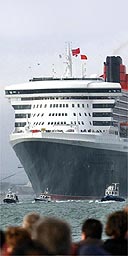
Overlooked - literally - by the 14-deck Queen Mary 2 as she slid into her berth at Pier 92 on April 22 was the dead white bird. Laid out on its funeral barge beside the USS Intrepid, as flightless and obsolete as the dodo, Concorde wasn't going anywhere. The sleek dream of supersonic speed, the princess of whoosh, the mean machine which got you there before you had started, was now, officially, a museum piece. The future belonged to the 150,000 tonnes of steel capable of grinding through the ocean at all of 30 knots (that's around 35mph to you landlubbers). The latest and most massive of transatlantic liners takes 20 times longer to carry you from New York to England than a Boeing or an Airbus. And that's the good news; the reason, in fact, for Commodore Ronald Warwick, the master of the Queen Mary 2, to brag at the quayside ceremonies that Cunard was now poised to compete with the airlines for a serious share of the transatlantic business.
Like those of us who had sailed with him through force 10 storms and 30ft swells, the commodore may have been pardonably giddy at coming through the worst the feisty spring Atlantic could throw his way on a maiden voyage, and still getting to the Statue of Liberty on schedule. But could he be right? Could this be the start of something really big and really slow? We take for granted the appeal of velocity, that there is money to be made and pleasure to be had from the gratification of the instantaneous: the three-gulp Happy Meal, the lightning download, the vital cellphone message that I am here and are you there; the soundbite homily, the febrile jump-cut, the whole damned zip-drive, wham-bam, slam-dunk, short-shelf-life, Ritalin-friendly world we have engineered.
For much of its history, Cunard has been part of this feverish hurry-up, rather than the therapeutic slow-down. In 1907 its flagship, the Mauretania, recaptured the Blue Riband for the fastest transatlantic crossing, and kept it for 22 years. But it spurred jealous and fatal competition. In 1898 Morgan Robertson's novel, Futility, had already featured a liner named Titan, which cuts another ship in two simply "for the sake of speed". Fourteen years later, the captain of the Titanic was blamed for sailing full steam, in deference to the White Star Line's determination to wrest the Blue Riband from Cunard, even in an area notorious for ice floes.
Cunard began in Nova Scotia where, following the American revolution, Abraham, who had been a Philadelphia shipwright, had settled among the loyalist diaspora. In the early 19th century Abraham and his son Samuel prospered with a small whaling fleet, built with steam-powered sawmills, and in the 1830s, watching George Stephenson's locomotive, the Rocket, hurtle along the tracks at 47mph, Samuel became convinced that on the oceans too, steam propulsion was about to replace sail.
It was only in 1838 that the St George's Steam Company packet Sirius became the first vessel to carry both mail and 40 passengers, under steam alone, on the notoriously tough westward crossing. Immediately, the journey was cut from six weeks to two. The Sirius was followed by Isambard Kingdom Brunel's Great Western, which added style to speed. It boasted 128 staterooms and a 75ft saloon decorated with panels "in the style of Watteau", painted by a Royal Academician celebrating "the arts and sciences".
Disdaining both opulence and reckless swiftness, Samuel Cunard offered something else when he and the Scottish shipbuilder Robert Napier made their tender to the Admiralty in 1839 for the conveyance of Her Majesty's Mail: dependability, guaranteed by the novel presence of an on-board engineer. In July 1840 the first of his "packets", the Britannia, docked at Boston after its two-week crossing. It was immediately recognised on both sides of the Atlantic as an epochal event; a conquest of space, time and history since it represented a coming-together of Britain and America after long and bitter estrangement.
The word "historic" was much repeated over the public address system on April 16, as the Queen Mary 2 moved out into the Solent from its Southampton berth under a classically grey English spring sky. The maiden north Atlantic crossing had been sold out for months, and, despite the famous superstitiousness of sailors, no one aboard seems to have been deterred by, much less spoken of, the appalling tragedy that cast a shadow over the ship's prospects even before it was formally launched. On November 18 2003, while still in the St Nazaire shipyard in Brittany, a gangway collapsed, throwing 48 people 50ft to the concrete bed of the dry dock. Fifteen were killed and 26 injured, six seriously.
There is nothing the British press likes better than taking down colossi, so the liner was dubbed "Bloody Mary". And those scanning the skies for signs of albatross were further rewarded (albeit much more trivially) when on an early European cruise, a malfunctioning bow thruster forced the liner to dock at Lisbon for unscheduled repairs. Irked by the carping in the press, Commodore Warwick compared the problem to something as minor as "a garage door sticking". "They wrote that we limped to Southampton," he told me, his "full set" of white whiskers barely concealing his disgust. "Limped? We were making precisely the same speed we should have made anyway!"
A defiantly exuberant send-off was in order. And for those braving the raw breezes there was wine on the upper deck terrace. But anxieties about the fat target of terrorist opportunity presented by all this slowly moving Anglo-American steel precluded all but a vigilantly screened handful from the dockside "sailaway". Massed waving of tear-stained hankies was to be seen only in the blown-up photos of Cunard's days of past glory around the ship's interior.
And where were the cows, I wanted to know? Samuel Cunard had made sure that each of his packets was equipped with at least one ship's cow, providing a steady supply of fresh milk, which, faced with modern trays of small plastic miniatures of "dairy-taste" creamer on board the QM2, seems like an idea whose time should come again. There would be risks in reinstating a herd. During the maiden crossing of Brunel's immense Great Eastern in 1859, the seas were so high that, according to one report, they not only tore off the paddles but knocked over the deck-mounted cowshed, sending one of the animals through the skylight of the saloon, where it landed damagingly on an understandably surprised barfly. This might have happened early in themorning, for in the halcyon days of the early packets, saloons opened for liquor business at six in the morning and closed at 11 at night. A decent breakfast on the Britannia in the 1840s was steak and hock, which Cunard might think of adding to room service, being a more cheering way to start a day on the tossing waves than weak tea, overstewed coffee and dried-out croissant.
What there is on the QM2 is grandeur, lashings of it: Bel-Air baroque, heavy on the upholstery and ornamentally accented lifts, in which, there being 14 decks, people spend much time. The dominant style is officially described as "art deco" but in fact the decor misses the angularities of true art deco and goes instead for le grand style Ginger et Fred: sweeping staircases (especially in the triple-decker main restaurant); long curved bars (very handsome in the Chart Room); leopard-spot carpets; and bronze wall bas-reliefs featuring disporting deities in the theatres, as in the pre-multiplex yesteryear.
And even though the ship is in fact a small floating town - 2,600 passengers and 1,500 crew - it seldom feels crowded. It helps, of course, if you have a cool £14,500 to spare, for then you get a share of the Balmoral Suite - 2,249sq ft of what the brochure describes as "sheer extravagance", including a dining area for eight; interactive plasma screen television (two); your own exercise equipment; and (the least they could do, really) "a fully stocked bar". For something like £10,600 less, you rate a less than fully stocked bar, and about 250sq ft of elegant, if rather narrow, cabin and balcony.
Though the best thing about a week's Atlantic crossing is an eyeful and a day-full of nothing other than the rhythm of the sea and the silvery curving rim of the world, and although old Cunarder hands insisted that was the way that crossings, rather than mere vulgar cruises, should be, Cunard is now owned by the mother of all cruise companies, Carnival Corporation. And the job description of their toiling entertainment directors begins with the abhorrence of vacuum. So the gym rumbles with massed treadmilling; the Canyon Ranch spa is packed with heavy massaging; the herbal sauna is crammed with oversized marine mammals (bipedal) who, when packed together about the sweaty ceramic tiles, gave new meaning to the term aromatherapy. In front of the two huge ship's theatres, passengers line up by the neo-Nazi statuary to hear a glamorous string trio of Ukrainian musicians dressed in miles of retro-ballgown satin taffeta give their all to Jealousy; or to watch spirited young British actors throw themselves into greatest hits from Romeo and Juliet and A Midsummer's Night's Dream, or even listen to the likes of lecturers such as me pontificating about Atlantic history.
In the Queen's Room, a frighteningly accurate bust of the actual Queen Mary, the present Queen's grandmother, surveys Gavin and Lydia, the dance teachers, as they steer giggly novices through the baby steps of samba, cha-cha or foxtrot, the "walk-walk, side-together side" contending with the unhelpful motion of the waves. On the parquet, middle-aged "gentlemen hosts" hired by Cunard to squire single ladies through the dances glide their partners around with courtly grace.
Nothing aboard the ship, though, gets as much exercise as the jaws. Indeed, devoted chowhounds could spend the waking hours of the entire six-day voyage doing nothing but grazing the vessel, bow to stern, since, as the ship proudly boasts, there is somewhere to eat something, 23 out of 24 hours. From the swaying gait of the heavy tonnage billowing through the dining room towards the end of the voyage, it seemed as though some at least were taking full advantage of the offer. Not surprisingly, things British are done best. If fish and chips with mushy peas is your idea of spa food (and why not?), you will not be disappointed at the ship's pub. And come four o'clock, the Winter Garden is packed with tea parties gobbling perfectly trimmed cucumber sandwiches made of the regulation-issue pallid white bread triangles, while a tristful harpist completes recollections of rainy afternoons trapped in British seaside palm courts. Imperial nostalgia (or aversion) is further heightened on noticing that pretty much everyone being served is white, while most of those doing the serving are not.
The best food on board is probably to be had at the Chef's Galley where, in the style of a live celebrity chef TV programme, a group of a dozen or so diners were talked through the preparation of the meal by Sean, an exuberantly wisecracking chef. About halfway through preparing the mango and crab salad, things started to get exciting in a Quentin Tarantino kind of way. Sean capped his demo about the importance of having really sharp knives by gashing his thumb. Later, while he was merrily blowtorching the crème brûlée, Sean was asked about the problems of keeping the cookware from having a mind of its own in heavy weather, and was about to offer a breezy reply when the answer came, instead, and suddenly, from the phantom guest, who had been there all along; the Atlantic ocean lifted us all up in its big catspaw and unceremoniously set us down again.
Old man Poseidon, evidently assisted by Tritons with serious attitude, was crashing the scene. On the Beaufort wind scale of one to 12, this one, howling around the ship like a marine banshee, was a 10, eventually getting up to 70 miles an hour, not far short of hurricane force. Likewise, the motion of the sea is measured by a range going from "moderate" through "rough" to "high", the latter being well beyond a mere "very rough". That night and much of the following day our particular piece of the Atlantic was "very high", beyond which the only available term is "phenomenal", by which time your cabin is probably filling with water and men in tuxedos are ushering women and children to the boats.
As the mango and crab salad and I became unhappily reacquainted, the gale certainly seemed to be turning phenomenal. Everything that could fall in the cabin did so, including us. The Queen Mary seemed now to be locked in a frenzied dance with the elements (not at all Gavin and Lydia style), the ship reaching and rising and then on the crest of the churned water going into a wicked shimmy, its sides shaking and jangling like a belly-dancer before sinking back voluptuously into the trough.
The next morning, the sea was still "very high" but Professor Schama, due to deliver a lecture at 11.15am, was "very low". But I was billed to talk about my predecessor, who had given the very first lecture aboard a Cunarder, the Cambria in August 1845: the African-American author and orator, Frederick Douglass. Douglass was en route for what turned into a triumphal lecture tour of Britain and Ireland and had been befriended by the Hutchinson Family Singers (Asa, Jesse, Abby and Judson) from New Hampshire. Staunch abolitionists, the Hutchinsons had the inspired idea that Douglass might give a lecture on the iniquities of slavery, notwithstanding the fact that among the passengers were several slaveowners from Georgia and Cuba. Douglass - with mixed feelings, one suspects - agreed, subject to the permission of the captain, the famously capable Charles Judkin. Judkin, it turned out, was himself a former slaveowner (perhaps a slave trader) who had seen the light and was happy to oblige. Standing on the saloon deck, Douglass began to read from the brutal slave laws of the south when, predictably, he was drowned out by heckling and threats of physical assault from the outraged slave- owners, until Judkin called for the bosun and threatened to put the rioters in irons. The captain's gesture amazed Douglass, who began his tour of Britain with an unrealistically awestruck view of British racial tolerance.
This was not the kind of history that usually gets narrated in shipboard lectures so duty required that, unsteady or not, I offer it to any hardy souls who had managed to lurch and stagger their way to the theatre. But was there enough left of the lecturer to get the job done? One of the sympathetic programme directors, Penny, had the answer: "Try the injection." I did, and whatever was in the nurse's potent syringe not only banished the queasiness but effected a startling transformation, whimpering academic suddenly translated into an approximation of Russell Crowe in Master and Commander. Tempest? What tempest?
And then, perforce, everything decelerated. The ship was forced to cut its speed almost in half, whereupon the stabilisers, operating by the through-flow of water, worked less efficiently, so that we too were forced to move more warily about the decks. Even the most dedicated diners were, if not entirely off their fodder, digesting it at a more ruminative pace.
The Atlantic had definitely got our attention; its illimitable breadth, the great kick of its kinetic energy all registered viscerally in our groggy bodies. We offered it our sincere respects. Hurry, hurry? Not us, no sir. Every seat in front of the big windows was now filled with people, subdued, gawking, mesmerised, at the immense opera of the deep grey swell, the rolling and rearing waves as bulky and meaty as elephants in a temper. OK, OK, we thought, you've made your point.
But the Atlantic wasn't taking our word for it. After a day of respite, it was at it again with another gale, less brutal than the last, but serious enough for deck-joggers to be ushered inside by the crew. But this time round, most of us had got our sea legs and had learned to respect the motion of the ocean, moving with it. Foxtrot recommenced in the Queen's Room and disco caught a new beat. For that matter, the towering ship itself seemed to be having a ball, rolling with the Atlantic punches, breezing ahead to the rough music of the wind and the swell. And as the QM2 forged along, so it became, for most of the passengers, no longer a floating resort hotel, drifting innocuously into Caribbean harbours under postcard skies. This one, we told ourselves, appropriating some of the credit for its performance, was a liner, and it was made for crossing, not cruising. "Oh, the passengers would like it," said Commodore Warwick, smiling, "if I told them that was the worst weather I'd ever sailed in, but ... " The smile continued; the sentence didn't. He wasn't about to wreck our newfound talent for salty yarns. At the dockside celebrations in New York he conceded it had been "turbulent".
When the Verrazzano bridge came looming through the gentle fog and the first tugs and pilots began to spout red, white and blue jets of water in dwarfish greeting, many of us were suddenly caught offguard by an unsuspected sense of proprietorial affection. Emotions doubled. To be sure, there was the catch in the throat as, right on cue, the morning sun picked out the Statue of Liberty and then travelled from plinth to torch with telegenic precision; there was the flood of memory, the empathy - even among the Queens' Grill high rollers - with the destitute millions who had come this way through their own storms and stresses; and the sudden jolt of recognition as we made the turn up the Hudson, that this too had been, and was still, America, perhaps the one that really mattered.
All that, I suppose, could have been predicted. What took us by surprise, though, as we were ushered to the immigration desks set up in the ballroom by Gavin and Lydia, kitted out in their smart grey disembarkation suits, was a valedictory urge to wish the ship well, and to try to find the words to tell others who might normally opt for Newark airport and the five-hour airtube to Heathrow that they might want to give the QM2 a go; that, mirabile dictu , there were worse things than being made to sit down and fill the eyes with nothing but sky and rain and wind-whipped water as 150,000 tonnes of big ship does what it can to ride it at 30mph. In fact, there are few things better.
· This is an edited version of an article that appeared first in the New Yorker
