
Tax dodging, cows, collaborators ... our turboprop from Gatwick had just flattened out at its cruising altitude, and this was all I'd been able to tell my daughters about the Channel Islands. My wife Birna had supplemented these insights with little potatoes and Derren Brown shooting blanks into a sandbag when, perhaps 20 seconds later, we settled into our descent. 'It can't be a proper island,' muttered six-year-old Valdis, peering down at the gold-bordered bull's hide that is Jersey from above. 'It's too ... near.'
Happily, my 10-year-old son Kristjan had speed-read his seat pocket's bounteous promotional content, and during the three-minute drive from airport to hotel fired out a bullet-point account of the island's heritage, fauna and topography. Ten miles by five, no political parties, a lot of Portuguese workers, Britain's only green lizards. 'And when the Queen comes to visit,' he concluded, 'the Seigneur of Trinity gives her two chained mallards on a plate.'
Listening to this, and watching a chauffeur-driven Humber of the colonial era sweep past us up the hotel's carriage drive, I began to wonder what had brought us here. We didn't have a suitcase of sovereigns to launder nor, as far as I was aware, a round of Russian roulette to televise. Was Jersey appropriate for a family weekend?
Our presence on the plane had lowered the average passenger age dramatically, and the discreetly plush Hotel L'Horizon's ambience suggested we'd incite much tutting behind Daily Mails. Ravel's Bolero droned ominously from the restaurant, whose wine list eagerly referenced Tory politicians ('relaxed yet reliable - like Ken Clarke in shades'), and whose menu bore a prominent warning that anyone making or receiving mobile phone calls at the table would be expected to compensate fellow diners by settling their drinks bills.
Hushed and indoor, the pool seemed no place for three children whose aquatic careers have focused on doing every 'don't' depicted in that illustrated guide to bathing etiquette which decorated the changing-room walls of my youth. They bomb, they run, they push, they duck. Please, I thought, meeting the steady gaze of a swimming-capped breast-stroker, please do not let them pet.
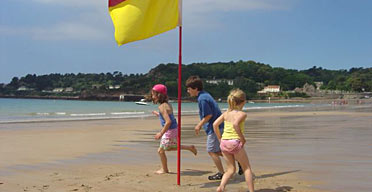
We lugged these misgivings up to our adjoining rooms, but throwing open the balcony doors they all flew gaily out. Before us sprawled the majestic apotheosis of Basil Fawlty's encapsulation of a marine prospect: over there, between the land and the sky. St Brelade's Bay is a gaping crescent of underpeopled sand, a mile-wide, come-hither sweep of soft gold that makes you want to get out there and do what dads do, and what I generally don't. In a moment there I was, getting down and dirty with the buckets and spades, becoming slightly too hearty during the French cricket. Above us were what my son would soon reveal as Britain's most dependably cloudless skies; lapping towards us, its warmest waters. Not hard to picture those first storm troopers paddling through the gentle surf, battle-ready grimaces melting into lazy smiles, Mausers hanging limply at their sides.
If we'd done nothing else for two days no one would have complained, particularly when it became apparent at dinner that our table was by no means the youngest, and only debatably the loudest. A bustling and convivial breakfast buffet 12 hours later confirmed that our child-shushing paranoia had been misplaced.
'We're trying to attract a broader variety of visitor,' confirmed tourist guide Arthur Lamy when we met him the following morning at a bike-hire shop in the capital St Helier. For broader read younger: the archetypal Jersey tourist is a dying breed. The Western world's most reliable electricity supply, north-western Europe's cleanest sewage - most of the facts that continued to leak fitfully from Kristjan's mouth seemed stubbornly targeted at elderly mainlanders with a twitching mistrust of two-pin plugs and bidets.
Jersey's modest proportions and benign climate make it well adapted to the bicycle, but its inhabitants' average wealth and age do not: there are more cars than people on the island, and ushering an unsteady six-year-old through St Helier I was made uncomfortably aware of it. Pedalling in a disjointed crocodile behind Arthur, we set off along the three-mile promenade, then turned inland and uphill, away from the traffic, past potato fields and neo-Georgian expat mansions. It was another day of brazen sun, and we had the dappled lanes to ourselves; Arthur's breezy, over-the-shoulder commentaries were the perfect accompaniment. 'See that?' shouted back Arthur, jabbing out a thumb at a Mazda dealership. 'That's the old Nazi power station.'
Tickled to have bagged themselves a British Isle, the occupying army built things all over Jersey. Being German, they're still there: every beach is bookended by hefty, squat and effectively indestructible gun emplacements, every hill topped by a radio tower. Hitler's Atlantic Wall was a 1,700-mile line of marine defences that stretched from Norway to the Pyrenees, and in a deranged fit of triumphalism, it isn't difficult to picture, he earmarked more than 10 per cent of all the concrete and iron used in its construction for the tiny and strategically irrelevant Channel Islands.
But there's only so much bitterness to be distilled from a four-year occupation, and the men of Jersey cultivate a far deeper animosity towards their neighbour Guernsey, a rivalry dating back to the Civil War and beyond.
'They went Roundhead,' called out Arthur with gleeful scorn, the cue for a detailed portrayal of the Guernseyman as horny-handed rustic, tending spuds and tomatoes with bovine deliberation as his worldly and debonair rival over the water diversifies lucratively into international finance.
With its stunted, pastel-painted buses, sun-kissed expat ambience and all those offshore banks, the Jersey we cycled through seemed a lot further away than it was; I could almost have imagined us in Bermuda. There's the same sense of slight financial iffiness, and the same sense that they're compensating for it by governing all other areas of island life with a buttoned-up, rule-bound propriety. '12 hours parking in any 24 hours' read the signs along St Brelade's Bay, and if anyone's going to dispatch the nocturnal warden patrols required to enforce such a ludicrous restriction, you can be sure it'll be some mallard-manacling Jersey Seigneur.
Accordingly, its tax exiles are lured from the low-octane end of the celebrity scale: when I asked Arthur to name and shame revenue outlaws holed up in the island's low, green hills, the best he could manage was Alan Whicker and Gilbert O'Sullivan.
At the Hamptonne Country Life Museum the children watched smocked and bonneted women spinning wool: if you want to tell a genuine Jersey jersey, look for diamond patches under the arms. (Though be aware that they're sometimes made from dog hair.) Here too they acquired a smattering of the yokelly-Gallic patois, a reminder that though the French have had no presence in Jersey for 800 years, their language was dominant until the early 20th century. 'There isn't a distinctive local accent, though,' said Arthur, in a distinctive local accent. Jersey is mild Wurzel stretched with a curious antipodean twang.
After a day and a half of billion-watt ultraviolet, it was almost a relief to throw back the curtains the next morning to find the horizon fuzzed out by a sea fog. Back in the hire car - despite my best efforts to extract full value, we'd hand it back with 21 miles on the clock - to the stoutly right-on Durrell Wildlife: 'The zoo that's not a zoo.' It is, of course, but generously proportioned and sympathetically landscaped enclosures make for less troubled-looking inmates than is the case in most such establishments: all those happy young faces pressed temptingly up to their fence, yet not one of the many primates responded with the traditional ejaculation.
For anyone with a UKTV History habit as life-blighting as mine, a visit to the Jersey War Tunnels is obligatory. When the Nazis' East European slave labourers had built all they could on the island's surface, they were set to work beneath it, hacking out half a mile of bomb-proof tunnels for artillery storage and a military hospital. The complex has now been impressively converted into an exhibition on the island's occupation - an intriguing story, imaginatively told.
As you walk into the exhibition's cool - no, cold - dark mouth, you're handed the facsimile of a real wartime identity card, featuring a sour Jersey countenance to be matched with its owner somewhere on display. I found my tattooed priest glowering defiantly at me from a glass case in the last chamber: there I read he'd been caught with a radio under his floorboards and perished in a prison camp. No happy endings for the others either, much to the delight of tragedy buff Lilja.
After Kristjan discovered my camera's monochrome mode, his sister spent almost an hour honing expressions of appropriate pathos beside life-sized cutouts of her doomed island brethren. We all enjoyed it except Valdis, who welled up badly before a caption detailing the predictable fate of 6,000 pets abandoned on the quayside when their owners fled to the mainland.
Late afternoon saw us down at the island's south-west tip for a low-tide walk out to Corbière lighthouse with marine biologist Andrew Syvret. Stumbling between rock pools across the pinkish granite that paves the streets of Westminster, we gleaned what we could from those parts of his commentary not brutally censored by brain-dislodging blasts from the lighthouse foghorn. Nearly all the UK's lobsters live in Jersey waters, it seems, along with half the dolphins and the detritus of an exciting proportion of our most terrible nautical tragedies. Then hotfoot, or wet-foot, back across the causeway as the sea turned on us: the Channel Islands are home to some of the world's most reckless tides. 'At low water,' panted Kristjan as we jogged past the rising rock pools, 'Jersey's effective land area is doubled.'
You'll spot the lighthouse on the back of a Jersey fiver, and so will the unsmiling shopkeepers of mainland Britain when you make the mistake of taking seven back home with you. (After alienating most neighbourhood tradespeople with my inept dupery at their tills, I finally managed to offload the lot on a hapless bureau-de-change cashier at Helsinki airport.)
Still, it's swings and roundabouts with Jersey's paper-based denominations. By keeping faith with the £1 note, the island bank has endeared itself to parents of today's fiscally fixated children. Even the most tirelessly grasping examples of this breed - and I have fathered two - can be stunned into overwhelmed silence with a crisp note in their hands. Attempt to placate those shrill demands at the seaside crap stall with a hair-ruffling jingle of change - even one of superior value - and see those beastly faces contort into gurns of painful scorn.
Bribed and soothed by the cash and sun that define the island, after a last evening on that stupendous beach the children were at last fully compatible with Jersey's sense of well-heeled, well-ordered civic compliance. Watching as they quietly transferred food from plate to mouth, we began to wonder where all those pent-up decibels had gone. In the morning, of course, we found out. 'Jesus,' I muttered croakily, forcing my earplugs further in to blot out a squawking, flailing hysteria that screamed out of their open windows and filtered in through ours. 'Sounds like they're wrestling a bloody seagull.' Birna wearily rolled out and trudged off to bring them to heel, returning at a different speed to inform me that, in fact, they actually were.
· Tim Moore's latest book, Spanish Steps: One Man and his Ass on the Pilgrim Way to Santiago, is published on 26 August by Cape at £16.99. To order a copy for £14.99 plus UK p&p, call the Observer Books Service on 0870 836 0885.
Factfile
Tim Moore and family travelled with Channel Islands Direct (0870 889 0858; www.premierholidaysdirect.co.uk). A three-night package based at the Hotel L'Horizon in St Brelade costs from £274 per adult and from £89 per child based on B&B and including flights from Gatwick, Southampton or Birmingham with Flybe (0871 700 0535; www.flybe.com). The child rate is based on one child sharing with two adults. Car hire booked through Channel Islands Direct costs from £9 per day.
· For further information contact the Jersey Tourist Board (01534 500700; www.jersey.com)
Channel your holiday plans
· Tiny Herm is pollution and car free. The island's sole hotel is the White House Hotel (01481 722159) where there are no phones, TVs or clocks, but there is a croquet lawn, outdoor pool and tennis court. Rooms from £78pp per night half board, or rent a cottage in the grounds from £67pp per night. Boats from Guernsey £8 return with the Trident Charter Company (01481 721379).
· Alderney has excellent birdwatching and bracing air. Self-catering holidays suit the relaxed atmosphere. Stay in the grounds of Fort Corblets, a Victorian building overlooking Corblets beach, with Alderney Accommodation (01481 823332; www.alderney-accommodation.com). The Northern Ramparts sleeps four from £950 per week, and includes the observatory, a double with 180-degree views of the island. The Southern Wing sleeps four from £637 a week.
· Sark, the smallest Channel Island, is blessed with bays, coves, caves and deep crystal pools. Transport is by foot, cycle, horse-drawn carriage or a tractor-drawn bus called 'the toast rack'. Stay in Stocks Hotel (01481 832001; www.stocks-sark.com) for gourmet fresh fish and outdoor swimming. Three-night half-board breaks cost from £199pp, including transport from Guernsey.
· Boutique hotel Les Burrins Hotel (01534 746777) in St Aubin, Jersey, is close to the cobbled streets of Rue de Crocquet, with views of speedboats in the bay. It's more than 400 years old, with wooden beams and floors, and granite walls. Rooms from £38pp per night off peak.
· Guernsey has no Vat, so hit the shops in St Peter Port, or scramble along cliffs and enjoy al fresco eating. Channel Islands Travel Service (01534 496600; www.jerseytravel.com) has a two-night offer, including B&B in a three-star hotel of their choice, anywhere on the island plus flights or ferries. Crossings from Poole, Weymouth or Portsmouth cost from £78pp, with flights from Gatwick from £129, or £175 from Manchester. Other regional airports available.
· Flights to Guernsey from Gatwick (£56), Manchester (£88) , to Jersey from Stansted (£79), from Southampton to Alderney (£49pp) return in summer with Aurigny (01481 822886; www.aurigny.com).
· Gemma Bowes
