
"And they're off," said the ranger, as dozens of turtle hatchlings clambered over each other, propelling their tiny shells down the moonlit beach and into the ocean as though their lives depended on it. And they did. "It's a sad fact," he explained, "that only one in a 1,000 of these baby turtles will make it to adulthood."
Those hatchlings momentarily disorientated were guided on their way by a beam of light from torches held by the children in our group. A couple of weaklings, too tired to make the 20m down the shore, were given a helping hand by the ranger and in only 15 minutes the miniature creatures had disappeared into the Pacific Ocean, leaving behind a cluster of broken eggshells.
We were standing on Mon Repos beach. By day, a sweeping bay of squeaky amber sand, a secluded spot for locals to sunbathe, surf and fish. By night, home to the largest concentration of endangered marine turtles on the eastern Australian mainland. Between November and March access to the area is restricted and rangers patrol the beach for signs of nesting and hatching.
It was 10.30pm and 22C as we sat under the neck-achingly clear night sky in the rookery's open-air amphitheatre. Our guide, who had worked in the conservation park for 20 years, explained the threats posed to the endangered creatures we were about to see. "Turtles are rare and you may not see any hatchlings tonight." The audience sighed with disappointment. "You could even be here for hours, but it's worth the wait. These creatures may be extinct within a generation."
Marine turtles have struggled to survive in the modern environment. Caught in fishing nets, propellers and hunted illegally, as well as having to avoid the usual predators such as sharks, they have little chance of survival, especially as they do not reach maturity until they are between 30 and 50 years old. There are only a few large nesting populations of the green, hawksbill and loggerhead turtles left in the world. Conservation depends on detailed research, tagging and tracking and on protecting breeding environments such as Mon Repos.
Fortunately we only had to wait half an hour before we were summoned to the beach. By the time our hushed group reached the nest, the first loggerheads had burrowed through the sand, closely followed by a fountain of their brothers and sisters. It was an astonishing sight as the small creatures, barely two minutes old, raced instinctively to the sea. If they survive the same hatchlings will return in 50 years' time to lay eggs on the very beach where they first emerged.
I was now fascinated (and somewhat obsessed) by turtles and wanted to see the adults in their natural environment. To continue our marine safari, we headed north up the Queensland coast to the Capricorn and Bunker islands, in the southernmost part of the Great Barrier Reef national park. Less visited than the Whitsundays, most of the islands in this group are uninhabited and a rife breeding ground for many different species of marine turtles.
We'd heard that Lady Musgrave island was a good bet for spotting turtles, and took a day trip to its coral cay. After a stomach-turning journey, our boat finally moored in the calm waters of the lagoon. Stepping onto the tiny tropical island was not the castaway experience I had imagined: the intense heat simmers off the crushed coral sand and the glare makes you squint and retreat thankfully into the turquoise water.
The huge circle of coral wall that protects the lagoon means that the reef is exceptionally well preserved and flourishing here. In an afternoon of snorkelling, we spotted Nemo-like clown fish, speckled parrot fish and black and white sargeant majors, all flickering in the coral, without a care for the forty-odd humans who have joined them in the cay.
It was a good time to visit the Capricorn group: further north, the Queensland coast is infested with jellyfish from November to April and it's not advisable to swim in the waters north of Rockhampton without a stinger suit. Snorkelling is significantly less enjoyable when you are head to toe in a pair of tights and in danger of a lethal sting from the silvery, almost translucent tentacles of box jellyfish; here we could jump fearlessly off the boat straight into a shoal of colourful fish.
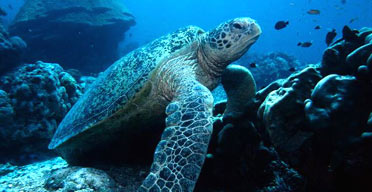
After about an hour of happily bobbing above the reef, I found myself face to face with an adult green turtle. Curious to see what was going on, it glided over and hovered at arm's-length, just enough time for me to gulp several mouthfuls of seawater and flood my snorkel in my attempts to catch my boyfriend's attention without distracting the prehistoric giant. We swam above it for a while, its tessellated shell a hand's stretch away in the clear water, its flippers the size of my arm.
As the tide went out, more of the coral was revealed in the cay and it was possible to go deeper, even without actually diving. However, even spotting a white-tipped reef shark and a moray eel (slightly alarming when we discovered later it will lunge at anything for a spot of lunch) in the afternoon's snorkelling session, did not match up to the elation of swimming with the magnificent turtle.
Heading north to the Whitsunday islands, the marine creatures were to make more appearances throughout the rest of our trip. Sometimes small ones would swim alongside the boat or an adult would bob up out of curiosity in the calm tropical waters.
Visitors to the Great Barrier Reef often fly directly to the island resorts of the Whitsundays and miss spots like the secluded Mon Repos and the abundant wildlife of the lower Capricorn group. With the ever increasing threat of extinction, now is the time to see the turtles in the wild before they disappear.
Way to go
· The nesting season is from mid-November to February. The best time to see hatchling turtles is at night from mid-January until late March. Adult turtles can be seen in the waters of the tropic of Capricorn all year round.
The rookery at Mon Repos has a visitor centre with an excellent exhibition. The guides are knowledgeable and friendly. The visit, although long, is child friendly and there are good facilities on site. The rookery is a 15-minute drive from Bundaberg. Open daily from 7pm from November to mid-April.
· There are two ways of getting to Lady Musgrave island. The spirit of 1770, departs the town of 1770 and takes 75 minutes one-way and costs $130. If you are staying at the Backpackers in Agnes Water the trip costs significantly less at $98. You have six hours on the island, snorkelling equipment and lunch and tea are included. 1770reefcruises.com.
The MV Lady Musgrave operates on Monday, Thursday, Saturday and Sunday from Bundaberg Port marina and takes two and a half hours, with around four hours on the island. Snorkelling gear, lunch and a glass-bottom boat trip are included in the $140 price. See lmcruises.com.au. The company also operates the The MV Discovereef from Round Hill Creek (Town of 1770) every Tuesday, Wednesday, Friday, Saturday and Sunday, price $133.
Take sea sickness tablets, the journey is fast and can be choppy.
Useful links
Great Barrier Reef marine park authority - facts about turtles.
Queensland parks and wildlife service - more information about Mon Repos rookery.
Department of the environment and heritage, Australia - good information about different species of marine turtles and conservation programmes.
