
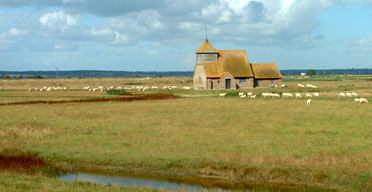
I must admit that the prospect of catching the train to Kent, hiring a bike, pausing at pubs, sleeping at B&Bs and paying the occasional visit to a decrepit church had a certain retro appeal. Don't we all seize the opportunity to pollute our own sweet way to Malaga these days? Can a destination within 100 miles of home really be considered a break?
John Major, who daydreamed about old maids cycling through English villages, would be disappointed. Judging by the empty lanes around Romney Marsh on a hazily beautiful day in early September, rural cycling is out of fashion. On 30 miles of road and lane, I encountered just three other holidaying cyclists: a racer in pink and black Lycra who overtook me two miles in, shouting a cheery "Morning!"; and a middle-aged American couple, who were sitting on a bridge holding hands and gazing at the reed beds.
My childhood enthusiasm for bikes faded after an accident, the details of which I cannot recall. I returned from a ride covered in blood, wheeling a pranged bike and, briefly, unable to remember my name. Fourteen years later, in Holland, the threat of peer humiliation forced me to confirm the old adage: you do, indeed, never forget how to ride a bike. In fact, I rather enjoyed it. Still, I was careful to wheel the bike out of sight of Romney Cycles and any interested passer-by before clambering on to the saddle. There was no point in risking another bout of amnesia.
Wobbling, fiddling nervously with the gears and weighed down by a rucksack packed with Eccles cakes, dried figs, a cagoule (in case it rained), a sweater (if it turned cold), and a range of accessories (my mother had donated a first aid kit), I set off to explore the 100 square miles or so of Romney Marsh. In a timely effort to appeal to fat Britons wheezing in the grip of super-sized self-loathing, the trip's organiser, Rural Ways, is promoting inexpensive and environmentally sensitive breaks like these. Most of them are within a short train ride of London.
The Romney Marsh Countryside Project suggests several cycling routes around the Marsh. One of them traces the route of the old sea wall, another identifies smugglers' haunts, and a third follows William Cobbett's rather bad-tempered horseback ride across the area, described in his 1830 book Rural Rides. My itinerary, a tour of 15 churches in various states of disrepair, was a "40-mile pedal" which, I was told, a fit cyclist would have no trouble completing in a day. Even with frequent stops - to give the bike a rest, obviously - I managed just under 30. The only ill effects were mild exhaustion and the odd spasm in my thigh muscles.
If you're looking for a really easy ride, try the Fens instead. Romney Marshes may be absolutely flat - a great deal of the land is reclaimed from the sea - but the wind comes straight off the Channel, blows past the decommissioned nuclear power station at Dungeness, and whistles through the long lines of pylons stretching away from the coast. There's talk of replacing the power station with a wind farm, and you can feel why.
This part of England has long been a buffer zone against potential invasion, and the landscape has suffered periodic upheavals at the whim of central planners. The Vikings conducted frequent raids here during the ninth century, rowing inland in longboats and terrorising the Marshmen. As Napoleon was advancing across the continent, navvies were drafted in to dig the Royal Military Canal to halt his progress. When Hitler threatened to invade Britain, the Romney Marsh sheep were evacuated to safety; the locals, however, weren't, and the construction of Dungeness added to their sense of disgruntlement.
Yet despite the flatness of the landscape, the power station doesn't loom as large as one might expect. If it were perched on a cliff, you might notice it. But the Marsh's low sea level and the lack of spectacular coastal views draw the eye inland and away from Dungeness. In other words, don't be deterred by the proximity of the nuclear power station: Dungeness is a national nature and RSPB reserve, and apparently much sought after as a film location. It's also very fragile, and cyclists are banned from riding across the shingle.
Much of the Marsh is criss-crossed with watercourses known as ditches and sewers: the name of the latter refers to a stretch of water more than two metres wide, and has nothing to do with a drain for human waste. Medicinal leeches, water voles and marsh frogs inhabit the waterways and ponds. (The marsh frog is a Hungarian amphibian which was introduced to Kent in 1932. If you want to be able to recognise its distinctive croak, you can listen to it online here.) The protected great crested newt, Britain's largest species of newt, also lives here.
The newt proved elusive. But there were compensations. One of the Marsh's countryside officers, Richard Haynes, pointed out woodpeckers, fat, sleek Romney Marsh sheep, and the lookers' huts which used to house the shepherds guarding them. As I was trampling through the nettles surrounding the ruins of Eastbridge church, I spotted a small rodent clinging to blades of grass. The shrew consented to a close-up.
There were other delights, too - the soon-to-be-outlawed spectacle of the local hunt returning across the fields at sunset, and the sight, a couple of minutes later, of a fox crouching by the roadside, watching the procession of red-jacketed riders. I watched as it made an attempt on the life of a rabbit, which dashed away into the hedge.
The darkness took me by surprise. I had set out for the Woolpack pub near Brookland for supper, been distracted by the discovery of a depot full of decommissioned London Routemasters, and ended up sinking a few gin and tonics and talking to the locals. By the time I left, it was perfectly dark outside. Trying to find my way back to the B&B along unfamiliar roads bounded by ditches felt like trying to escape from a coal bunker. Half an hour later, clinging to the tarmac, I began to fear the worst. I would end up in a ditch - exactly how deep were these ditches? - mauled by hungry leeches ... it was at this point that I stumbled into a Land Rover. Why the driver - who had apparently been out hunting - was sitting stationary in the darkness, I can't imagine. But his headlights enabled me to regain my bearings, locate the B&B and collapse into an extremely soft mattress.
Londoners, eh? Still, for the record, the bike was returned intact, and the first aid kit never saw action. Next stop, the South Downs.
Way to go
Ros's trip was organised by the Romney Marsh Countryside Project (01797 367934). She hired a bike from Romney Cycles (01797 362155) and stayed at Martinfield Manor B&B in New Romney (01797 363802) and Dean Court B&B in Brookland (01797 344244).
Copies of the Cycle South England guide are available from tourist information centres throughout the five counties of Surrey, Hampshire, East and West Sussex and Kent, priced at £1, or by emailing: info@ruralways.org.uk. Cycling information is also available at Ruralways and Go South.
