The second or third time you sign an indemnity form on safari, you can get almost blase. There's barely a trace of nerves in the collective chuckling - eaten by a wild animal, me! And once the sun is up, well, all those disturbing noises fade from memory. What's to stop you stepping out of the tent and taking a little stroll?
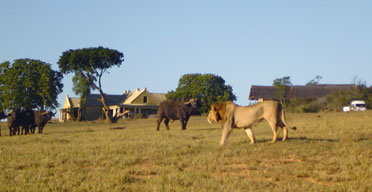
At Gorah, in the Eastern Cape, the answer quickly becomes obvious: two lions, emerging from the bush and wandering across the short grass ahead, barely a hundred metres away. A couple, in a neighbouring tent, are also awake and we edge to the limits of our camp, set for a speedy retreat indoors should the cats so much as spot us.
Instead, a bigger target will emerge: a herd of buffalo making for the watering hole in front of Gorah's main lodge. It's an astonishing moment, watching as the herd, apparently unaware, comes within springing distance of the lions. And then the predators make their move, sprinting towards the buffalo, who cry, snort, stamp their feet and disperse in a cloud of dust, before reassembling in a wary, defensive circle, the gigantic males with their massive horns making a formidable barrier for the rest.
The ensuing standoff lasts some time - enough for us to join the camp's safari guides on a jeep, to edge even closer. Here we learn that the lions are by no means the favourites any more; indeed that even the powerful males are more likely to be tossed on the horns of a buffalo than to sink their teeth into a tasty flank. But it's great drama - and we've not yet reached breakfast.
At Gorah Elephant Camp, as you might guess, lion and buffalo aren't top of your most likely sights. There are only six lions and a herd of buffalo that rarely emerge in daylight after their ancestors were nearly hunted into oblivion. It's not just elephants who never forget: 70 years have passed since the last big animal was shot here, but this new generation is now instinctively fearful. A night drive to search for the buffalo herd produced nothing; our daylight sighting is, the guides say, an extraordinary event.
What you do of course get is elephants in abundance: chewing up trees, occasionally (as the brochure shows) trampling your lawn, and all too frequently blocking the roads. During one game drive in the ranger's jeep, we spotted a van hemmed in by two enormous bull elephants, who showed no sign of clearing the path. We backed slowly away from the advancing animals for 30 minutes; the van' s driver - unable to reverse with a trailer on board - took the nuclear option of dashing through a small gap between the two and speeding away for dear life.
Gorah doesn't quite have the same feel as other safari destinations; it's relatively small, although expanding fast with the Addo national park (of which Gorah forms a small part). The landscape was shaped by farmers, who cut back the bush in huge swaths, leaving a patchwork of greenery in among the undergrowth. And while the animals are undoubtedly wild, there's something slightly deflating in the knowledge that some have been imported from elsewhere. A number of elephants come from the Kruger, while all the lions were recently brought in from the Kalahari, partly in an attempt to curb the burgeoning populations of other species such as warthog.
That said, Gorah has an enviable setting, green and hilly, with spiky mountains on the horizon and views down to the sea and Port Elizabeth, an hour's drive away. And the camp itself is just about everything you could hope for. The centrepiece is an old hunter's lodge, where we breakfasted on the veranda overlooking the very watering hole where the buffalo and lion had been sizing each other up. Afternoon tea takes place on some neighbouring sofas, with a telescope handy for when something interesting wanders into view. And come the evening, when the winter chill descends (and in the back of a moving jeep, it really does) the log fires quickly restore the heat to your bones. Meals were wonderful; the individual tented accommodation superb. The staff were friendly to the point of knowing all our names instantly, as if welcoming us as old acquaintances to the family house, which was perhaps a bit Stepford Wifey for some tastes.
In fact, you could quite imagine settling down there for a few days just enjoying the food and the sofas - which is handy, because safari sightings are never guaranteed. Our night drive threw up nothing more than a couple of spring hares (which I liked, but are no crowd-pleasers); and apparently the American visitors who had just left didn't spot a lion in a week. Naturally, having been so spoilt, we left ruing the fact that there hadn't been an all-out inter-species barney on the lawn while we sipped cocktails at sunset. But, even at Gorah, you can't have everything.
Way to go
A night at Gorah costs from 2,250 rand (approx £200) per person, including all meals and game drives. For reservations: +27 44 532 7818 or email: res@hunterhotels.com. See gorah.com for details.
Gwyn flew with South African Airways to Port Elizabeth, via Johannesburg. Transfers or car rentals from PE airport can be arranged on request.
