At 3am on my first night in Damascus, two loud explosions in quick succession startled me from sleep. I suspected something sinister at first. Only a month before, the Israelis had assassinated a member of Hamas, the militant Palestinian group, in a car bombing in the Syrian capital.
I need not have worried. The loud bangs were part of Ramadan, the month-long period during which devout Muslims refrain from food, drink and sex between sunrise and sunset. The sound of cannon was immediately followed by the muezzin's call to prayer and for the faithful to take sohour, the first meal of the day before fasting begins.
For the next hour, verses of the Qur'an blared out from speakers from hundreds of minarets, marked out from the darkness by bright green neon signs. Traditional Islam is embracing modern technology to spread its message.
During a ride in a service taxi - a shared taxi for crossing the Syria-Jordan border, one of my fellow passengers, a man in his late 20s, had the latest Nokia mobile complete with large screen and bright colour graphics. When his phone went off, the ringtones were chants of the Qur'an from different mosques in the Middle East, including Medina. He then spent a good hour programming an identical Nokia belonging to another passenger.
Coming from the UK, where the nearest thing to the muezzin's call is the occasional peal of church bells, the religious backdrop proved just as fascinating as the Roman ruins of Palmyra in the Syrian desert, the stone-carved city of Petra in Jordan or the souks of Aleppo and Damascus.
In Innocents Abroad, written in 1869, Mark Twain described Damascus as "so crooked and cramped and dirty that one cannot realise he is in the splendid city he saw from the hill-top. The gardens are hidden by high mud-walls, and the paradise is become a very sink of pollution and uncomeliness."
The uncomeliness is still there. Faded billboards advertising Siemens washing machines, Rover and Kia cars, Sumitomo tyres and various snacks mark the outskirts of Damascus, followed by the ugly breezeblock buildings, sooty from black exhaust fumes.
All the while, cars and trucks in bumper-to-bumper traffic honk in a ceaseless cacophony. About one in five vehicles seemed to be yellow taxis, buzzing about like giant bees, in search of fares. Drivers engaged in a perpetual game of chicken, to see who would give way first. The last time I had seen bedlam on the roads was in Saigon, Vietnam, back in 1994.
But it is easy to escape the breezeblocks and traffic of modern Damascus by plunging into the old city, with its Umayyad mosque and its souk, a vast market covered by a curved corrugated iron roof, pockmarked with holes that let in shafts of light. Damascus is not just a souvenir hunter's paradise, it is also a supermarket selling household goods, toys, shoes, and food, a place where women covered from head to foot carefully finger bras and underwear.
Besides the numerous shops - some barely larger than a pantry - selling jewellery, backgammon sets, rugs, scarves, fabric and curved daggers, there are premises selling the most delicious cashew and pistachio nuts. The spice shops display cumin, coriander, saffron and cardamom in a visual and olfactory feast.
Some shop owners napped, others pored over the Qur'an, oblivious to potential customers. Some asked inquisitively: "Japan? China, Korea?" as I walked past.
Initially I said England, to be greeted by baffled stares. As a transplanted Vietnamese I looked nothing like an Englishman to them. Finally I said: Vietnam. That did the trick.
"Vietnam! Ho Chi Minh! You stand up to America. Very good. You are welcome in my country," they would cry. Even after all these years, Vietnam and Uncle Ho retain powerful brand recognition in this part of the world.
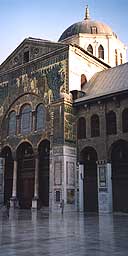
For those seeking respite from material temptations, the Umayyad mosque makes a refreshing stop. The huge mosque with its internal square reminded me of St Mark's Square, not least because of the plague of pigeons. Treading carefully on the smooth marble to avoid their droppings, I admired a fabulous mosaic panel, full of golds and greens, depicting spires and trees. The mosque also has stained glass windows of detailed geometric patterns - utterly different to those found in western cathedrals but just as breathtaking.
The atmosphere inside seemed quite casual. While some were on their knees praying, bowing towards Mecca, others lounged against the wall or pillars chatting quietly, while others lay flat on their backs, sleeping.
Meanwhile, groups of tourists - the women clad in hooded grey robes that made them look like monks - peered at the shrine of John the Baptist, supposedly containing his head.
After the din of Damascus, Palmyra was calmness itself. Once visited by Hadrian, these ruins sit in the desert, three hours from Damascus. Palmyra alone is worth the trip to Syria. As we looked over the site from a mound at sunset, when the stones take on an amber hue, a German tourist said: "You can go home now, there is nothing more to see." He was exaggerating of course, but only slightly.
A wonderful peace pervades Palmyra. Next to an oasis, overlooked by a medieval fortress, it stands quite undisturbed by the modern world. Even the few Bedouin hawkers puttering around on their ancient motorbikes selling kaffiyahs and cold drinks do little to disturb the serenity of the place. It is quite fitting that Palmyra and Petra in Jordan are mentioned in the same breath. Both spectacular in their own right, Palmyra eclipsed Petra as it took over the role of main trading city between the east and the Mediterranean world in the early second century AD.
Unlike Petra, whose facades are wonderfully carved out of the rock face in a narrow valley, Palmyra sprawls out in an airy expanse. Whereas Petra's dominant colour is red, Palmyra's is gold. The stones and pillars have been marvellously preserved by the desert air. Although smooth from a distance; up close the ruins are ridged and crinkly like an old person's face and have the texture of sandpaper. It is as if the centuries have sucked every drop of moisture from the limestone.
A short walk away lies a clutch of hotels, restaurants and shops selling local varieties of dates. No more than a few square blocks, they form a compact ensemble, with a relaxed hippie-like feel - except the visitors range from 20-something backpackers to those in the Saga age bracket travelling round on huge tour buses. Palmyra, the city of palms, is a perfect place to chill out.
I headed next to Hama, famed for its huge water wheels. The city is also remembered for the ruthlessness with which the former president Hafez al-Assad suppressed an uprising by the Muslim Brotherhood in 1982. The former dictator pounded the old city with heavy artillery, causing an estimated 10,000 deaths.
My official Syrian guide book unsurprisingly carried not a single word on the incident, and even now people are reluctant to discuss it. During a walk along the smelly river Oriontes, which runs through Hama, an Australian fellow tourist and I came across a gentleman who looked like Salvador Dali. My Australian companion asked the man where the shelling had taken place.
Even though no one else was around, he stiffened. He then brought a finger slowly to his lips and said: "This we do not talk about. This caused much pain, for all of us and for me." With that, he walked off, one hand clutching the small of his back as if an old wound had been re-opened.
Hama is a good base for Krak des Chevaliers, the mother of Crusader castles, and another impressive Roman ruin, Apamea. A group of us visited those sights in torrential rain in an immaculate white 1950s Pontiac complete with electric windows, a DVD screen, and a Nissan 2.5 litre engine. The driver must have been in his 60s but he drove like Michael Schumacher.
Aleppo, dominated by a massive citadel, marked the end of my Syrian tour. Here I bought olive soap in a gentler, kinder version of the Damascus souk and took a side trip to Qalaa't Samaan, mentioned in William Dalrymple's superb book about the shrinking Christian communities in the Middle East, From The Holy Mountain.
The ruins of a Byzantine church are perched on a hill at Qalaa't Samaan. The centrepiece of the church is an octagonal space framed by round arches. A boulder lies in the middle, all that remains of a pillar once occupied by St Simeon, the stylite.
Simeon was a hermit who attained huge celebrity status in the fourth century. When he tired of people coming to his cave, he erected a three-metre pillar, and perched himself on top so people could not touch him. Simeon spent the last 40-odd years of his life chained inside an enclosure on top of the pillar, preaching to crowds of pilgrims. By the end of his life, the pillar had been extended so that it stood 18 metres high, presumably so he could get closer to God. Simeon's fame grew so much that he started a craze for hermits living on pillars. The pillar has shrunk to the size of a boulder, having been chipped away by pilgrims or souvenir hunters over the centuries.
Way to go
Getting there
Air France (airfrance.com/uk, 0845 0845 111) flies London-Damascus direct from £377, all taxes included.
Further information
Syria Tourist Information
Country code: 00 963
£1 = 101.922 Syrian Pounds
Time difference: +2hrs.
