
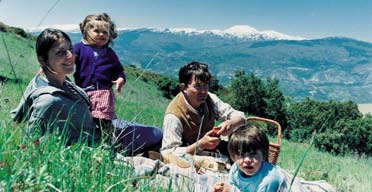
The first time we visited the Sierra Nevada, Spain's highest and most southerly mountain range, was before our restaurant, Moro, opened in 1997. Armed with a few maps, a couple of ancient bicycles and minimal essentials, we set out on a three-month culinary adventure of a lifetime in a 1974 two-tone VW camper van called Max.
The concept of Moro (born of a fascination with food from Spain and the Muslim Mediterranean linked in history by the Moors' 700-year occupation in Spain) had already been decided upon. And now we wanted to absorb as much of the atmosphere, soul and tastes of the food as possible.
En route we drove through the province of Granada and up to the Sierra Nevada, a region that was to get under our skin for ever.
After a lunch of fresh fried anchovies and pepper salad in Almeria, we climbed through the Alpujarras, the foothills of these snow-capped mountains.
For the first time we had fears for the staying power of our camper van. We seemed to be managing only 10-15mph, and what we initially thought was the sound of hunters shooting partridge in the hills turned out to be backfiring from Max, caused by some dodgy petrol. These almighty bangs were beautifully synchronised with our passage through each peaceful village during siesta.
Next morning we twisted through the mountainous landscape once more, taking in the breathtaking scenery of almond groves and lush valleys with trees bearing figs, pomegranates, kakis and apricots. As we drove higher we looked down on to green gorges, gushing streams, and the white dots of villages.
Then the road, without warning, became a dirt track. Typically, we had chosen the most treacherous route on the map to take us to Granada. We passed the tree line, until we were level with the snow and clouds. The air was clean and crisp, the sky a rich deep blue. It was sunny but quite cold and the wind was beginning to pick up. The clouds wisped around us like spirits. We were on top of the world.
Only later did we realise how important that camper van trip was. Not only would it be a long time before we could travel for three months again, but the dishes we ate along the way - some of which we'd never tasted before, let alone read about - really laid the foundations for the menu at Moro.
A few years into Moro we returned to the Sierra Nevada by chance. We were going to Jerez for a friend's wedding, and a few days before we left we had been experimenting on the internet.
We typed in 'Andalucia and property' to see what would come up. Before we knew it we were swept away by looking at houses. We pulled out a map, realised that these houses were in the Alpujarras, and, reminded of our wonderful journey, made an appointment with the estate agent for the following week.
In Narila we chanced upon an old Moorish dwelling, neglected and overgrown, but its charm and wood-burning oven in the middle of the sitting room were deciding factors. We became its proud owners.
It was only after we had bought the house that we discovered we were in one of most Moorish of all the Alpujarran villages. After the Moors were expelled from Granada in 1492 they fled to these then inaccessible hills, where they remained in their last stronghold for a further 70 years.
Considering our culinary pedigree, our choice could not have been more apt, and over the years we have begun to understand the Moorish influence, not only in the local food but all over Spain. With their intricate irrigation and terraced land, still there today, the Moors introduced many of the ingredients considered central to Mediterranean cooking: almonds, oranges, rice, aubergines, quinces, pomegranates, artichokes and spinach to name a few. The food of our area is a combination of wild produce and this Moorish cultivation, and, like most Spanish country food, Alpujarran fare is uncomplicated and delicious. Some of our favourite things to eat are bowls of steaming lentils flavoured with chorizo and local wild herbs or a fennel and bean stew.
One of the first signs of spring is the bright green shoots of wild fennel along the roadsides, and it is not uncommon to see the locals clutching bunches of these to flavour a soup, stew or rice. Equally, we get as much pleasure from a wonderful local goats' cheese or morcilla (black sausage) from the local butcher. In the shop, you can't miss the chorizo hanging just above his head, and the morcilla, delicately spiced with clove or cinnamon, is soft and unctuous. Both these make a super brunch with fried eggs before embarking on a walk.
We tend to cook at home rather than eat out, as we enjoy cooking with the local ingredients and because there are not many places to eat real home-cooked food.
The villages are distinctively Moorish in the traditional Berber architecture and small white box-shaped houses with flat roofs, not dissimilar to those of Morocco's Atlas mountains.
The Alpujarras are unbelievably beautiful, whether it is the snow on the Mulhacén and surrounding peaks, the strong presence of nature or the soft golden evening light casting shadows over the undulating hills.
We love the clearly defined seasons, with the sweet smell of almond wood fires in the villages during winter or, at the beginning of spring, the delicate almond blossom on the terraced slopes, followed by a profusion of wild flowers and birds. Then there's the parched land of summer, scented with wild rosemary and thyme, followed by the kaleidoscope of colours as the trees begin to change colour in the autumn.
One of the greatest attractions of the Sierra Nevada is the walking. The famous GR7 route begins at Tarifa by the Straits of Gibraltar, and goes through Spain, France, Switzerland, Austria, Hungary and Romania to Greece. In the Alpujarras it connects all the villages from about 700m to one of highest mountain villages in Europe, Trevélez, at 1,400m. Another route, the GR142 crosses the Alpujarras at a lower level. These can also be done on horseback.
If you want to experience city life, Granada, with its Moorish palaces, gardens of the Alhambra and fantastic tapas bars, is an hour's drive, and if it is the sea you're after, that's only 40 minutes away.
It is extremely rewarding returning to the same spot over and over: the relationships we slowly forge with our neighbours, to feel a small part of what it is like to live here and, above all, the beauty and tranquillity of the mountains. It is such a precious antidote to London and hectic restaurant life.
The best of the Alpujarras:Sam Clark's recommendations
How to get there
Flights to Granada from Heathrow cost from around £240 with British Airways (0870 850 9850; ryanair.com) flies from Stansted to Almeria and Granada, and from the end of April will also fly Liverpool-Granada.
EasyJet (0871 750 0100 easyjet.com) flies to Almeria from Gatwick and Stansted.
From mid-May, Monarch (08700 406300; flymonarch.com) will fly from Gatwick to Granada.
When to come
Winter for skiing (sierranevadaski.com) and the almond blossom in February.
Spring for the wild flowers around May.
Autumn for the colours (late October to late November).
Summer is hot and harsh like most of southern Spain, but a couple of degrees cooler.
Where to stay
Hotel Berchules (00 34 958 852530). Home-cooked food and very friendly hosts Alqueria de Morayma (00 34 958 34 33 03). Food disappointing recently, but attractive hotel.
Horse riding
Dallas Love (00 34 958 763038)
Walking guide
Anton Volckaert (00 34 958 768140)
Books
South from Granada, by Gerald Brenan Shadows of the Pomegranate Tree, by Tariq Ali Driving over Lemons, by Chris Stewart
Websites
lasalpujarras.com
andalucia.com
Where the Spanish go
Golden oldie Julio Iglesias has hung out with the hot and hip including Naomi Campbell at the idyllic, glam hideaway Pikes Hotel in San Antonio, Ibiza. The 15th-century finca has a huge terrace and pool, and a Pike VIP pass will gain you entry into the island's top clubs. Rooms from €135 (00 34 171 342 222; pikeshotel.com).
Flights to San Antonio from Heathrow with British Airways (0870 850 9850; ba.com) from £240pp return.
Local recipe
Here's Moro's take on a traditional Alpujarran dish.
Collejas
Collejas is a wild variety of spring cabbage. This delicious dish has the Moorish legacy of ground almonds.
Serves 4
500g collejas (or other young spring cabbages/greens) any tough stalks removed or chopped
4 tablespoons olive oil
100g whole almonds, preferably with the skins on
1 large Spanish onion, chopped
1 leek, cut in half and thinly sliced
2 carrots, diced
2 cloves garlic
sea salt and black pepper
Place a saucepan of lightly salted water over a high heat and bring to the boil. Submerge greens and boil for 1 minute. Drain in a colander, keeping aside 100ml of blanching water, and set aside. Place a large frying pan or saucepan over a medium heat and add the olive oil. When hot but not smoking, add the almonds and fry gently 2-3 minutes until golden. Remove with a slotted spoon and set aside. Still with the pan over the heat, add the onion, leek and carrot with a pinch of salt and fry gently for 10-15 minutes until soft and beginning to caramelise. Pound the almonds in a mortar or food processor until roughly ground. Add the garlic to the pan, cook for a further five minutes, then add the greens, followed by the almonds, a tiny pinch of salt and black pepper. Add the cooking liquor and cook for another 2-3 minutes. Serve.
· Casa Moro by Sam and Sam Clark is published by Ebury Press at £25
