
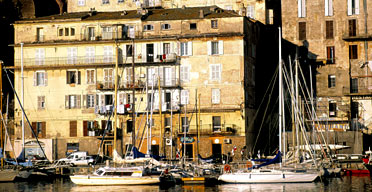
Mysterious, magical Corsica is unveiling its secrets to the casual traveller. The mountainous island rising from the Mediterranean sea with its strange customs, history, landscape, wildlife and food is declared open for weekend breaks. In the past you had to fly via Paris, take a ferry from France or Italy or take a charter flight for at least a week. Last year, British Airways began direct scheduled flights for the first time but only once a week. But its new summer schedule takes you there in two hours from Gatwick on a Thursday afternoon and back home in time for Sunday lunch.
Famous for its maquis, vendettas, pirates, witches and nationalist bomb chuckers, Corsica is more than just a Mediterranean paradise - that's just one of the trump cards it holds in its closely-guarded hand. With 260,000 people inhabiting an island half the size of Wales, it's essentially a vast, bountiful, mountain range in the middle of the sea.
Those flying into Bastia on a weekend break will find plenty to keep them occupied on the Cap Corse, a bony finger of a mountain ridge extending north out of the land mass and pointing reproachfully at Genoa which ruled the island for much of the last millennium.
The concrete revolution that spread round Europe's southern coastlines last century largely let Corsica be - kept at bay by the island's relative poverty and civil unrest. The Cap is rightly famed for its rocky coastline punctuated by quiet fishing villages, beaches and Genoese watchtowers. The Sentier du Douanier (the path used by customs officials) curves around much of the northern tip.
This region is covered in thick shrubs, stunted trees, yellow broom and purple myrtle. When the warm breeze blows through it carries a sweet herby fragrance that, if bottled, would bankrupt Chanel. This is the renowned maquis where smugglers, resistance fighters, political dissidents and future Emperors of the World go to hide. Scarlet poppies, violets, orchids, and powder blue sea hollies line the grey sand beaches. Sunbathing here is like wandering into a Klimt painting, then laying down a towel and drinking it all in.
For the active, sea kayaks, bikes, horses and diving equipment are for hire in many coastal villages. Or head for the hills and get some of Europe's most challenging walking and spine-tingling views. The Cap's spine soars up to 4,000 feet, and there are numerous great hikes starting from coastal hamlets that will make a satisfying half or full day. The mountains contain much of the island's unique plant and animal life: from the vast Lammergeiers - birds of prey with an 8ft wingspan - to the Goeland Leu cophee, a species of seagull nicknamed 'port rats'.
As you might expect of Balzac's 'French island basking in the Italian sun', Corsica keeps a great table. The Cap is the wine region, with fruity whites, delicate orange rosés and thin, tasty reds. Seafood is abundant on the coast - crabs, crevettes and mussels. Travel inland and grilled vegetables and meat - artichokes, peppers, beef, cured ham and kid goat - dominate, often cooked with pungent maquis herbs.
Many of the island's colourful festivals celebrate the local produce, be it the mountain pig, Brocciu cheese, wine, fish or the chestnut. Other impressive fetes and pageants honour Holy Week, the arrival of the Genoese governors and a local lad. Napoleon Bonaparte.
Corsica does all these classical holiday things, and does them superbly, but it's also a true one-off, and during a stay you should catch glimpses of its extraordinary past.
The locals are polite, pleasant and look as though they have a lot going on behind the eyes. Up until the Second World War bloody vendettas raged between families, tit-for-tat killings sparked off by as little as a donkey straying onto the wrong land - the result of a fierce local sense of honour.
Driving around the island - a hire car is a near-essential - you'll notice the French translations on all the road signs obscured by graffiti. Corsica is currently French, but only for the last 200 of 4,000 years spent as the property of the Greeks, Etruscans, Romans, Saracens, Genoese and even the British, plus occasional flourishes of independence. A clandestine insurgency calling for independence has rumbled on for the last 50 years, mainly bombing buildings, rarely humans, and never tourists.
Then there are the mazzeri, men and women believed to be wizards and witches responsible for sickness and death on the island through their nightly pursuit of soul-hunting. This belief is said to have died out along with the vendettas, but a night listening to the extraordinary polyphonic a capella singing of Corsican male choirs - a melange of Christian, Islamic and pagan chants said to have elements dating back to prehistoric times - and the witches begin flitting through the imagination.
Cap Corse highlights: five things you must do
1. Relax on the Plage de Saleccia, the island's most spectacular beach, a gently curved kilometre of white sand lapped by translucent turquoise sea. It is inaccessible by road, so boats shuttle from beautiful St Florent marina to the Plage de Loto. It's then an hour's stroll to Saleccia, which was used to film the Second World War epic The Longest Day .
2. Promenade round Bastia, the capital of northern Corsica, with classic 18th-century Genoese architecture, boutiques, markets, restaurants, cafes and bars. End the day sipping Casanis pastis on the quay of the charismatic old port.
3. Walk the Sentier du Douanier. This stunning cliff path runs from Macinaggio to Centuri-Port, between the wild fragrant maquis, beaches and watchtowers, with great sea views. Once used by customs officers to control smuggling, it's entirely isolated from the roads, takes eight hours in full or can be dipped in and out of.
4. Attend a concert of polyphonic singers. 'I had the impression of hearing a voice from the entrails of the earth. Song from the beginning of the world,' wrote Corsica's great chronicler Dorothy Carrington, after hearing one ensemble. The singers are technically gifted and a remnant of Corsica's amazing past. See www.bastia-tourisme.com for details of concerts.
5. Climb Monte Stello. At 1,307 metres it's the second highest peak on the Cap, and teeming with splendid flora and fauna. Set off from the medieval hamlet Pozzo early to get the best views from the top, extending across the island and across the sea to Tuscany. The climb up and then the descent should take about five hours.
The lowdown
WHERE TO EAT/DRINK
Expensive Restaurant A Casarella, 6 rue Ste-Croix, Bastia (00 33 4 9532 0232). Delicious Corsican-French cuisine served in the Terra Nova, the beautiful part of town behind the citadel. Tasty crab farcies, crevettes, veal and house specialities including casgiate - fresh cheese baked in fragrant chestnut leaves. Main courses from €15.
Moderate Le Bartavin (00 33 4 9539 0766) in Patrimonio, a village at the centre of the first Corsican wine region to gain Appelation Controlée status, serves hearty mountain fare. The pavé de boeuf with herbs de maquis is stunning, as are the grilled vegetables, acorn and chestnut-fed charcuterie and local wines. Mains from €10.
Bargain U Tianu, 4 rue Rigo (00 33 4 9531 3667), in the old port area of Bastia serves traditional Corsican dishes at reasonable prices. Blackbird pté, mutton stew and sardines stuffed with Brocciu cheese are just some of its specialities. Three-course menus from €20.
WHERE TO STAY
Expensive The roomy luxury Hotel Demeure Castel Brando (00 33 4 9530 1030; www.castelbrando.com) sits 50m from the sea in Erbalunga, a picturesque village dubbed ' nid des peintres ' as it is a favourite with artists. This 19th-century mansion set among palm trees, has a swimming pool, hammam, and airy, cool rooms, with doubles starting at €90.
Moderate Le Vieux Moulin Hotel, Centuri Port (00 33 4 9535 6015; www.le-vieux-moulin.net) a sumptuous, tranquil hotel with antique decor in the beautiful seaside village on the northern tip of the island. Doubles from €60.
Bargain The colourful Hotel Posta Vecchia, quai des Martyrs (00 33 4 9532 3238; www.hotel-postavecchia.com) is well located in central Bastia looking out over the marina, with 49 rooms costing from €40 per night.
WHAT TO READ
The Rough Guide (£10.99), Lonely Planet (£11.99) and Cadogan (£10.99) provide excellent description and detail to help you plan and enjoy your Corsican experience. Dorothy Carrington's extraordinary account of years spent on and studying the island, Granite Island: A Portrait Of Corsica , is worth tracking down from a secondhand bookseller as it gets right under the skin of the place. For a simpler introduction read the brilliant, tongue in cheek, Asterix in Corsica (£6.99).
Don't even think about...
...going for the nightlife
Until recently if you went for a walk with a girl without her father's permission you could start a bloody, decades-long vendetta. Now many Corsicans of clubbing age leave the island for university or jobs on foreign shores. Musical taste seems to be stuck circa 1989. I heard Bros and Neneh Cherry, although one particularly hip bar played Dido.
...forgetting the map and compass
Common sense, but in Corsica it's essential to take a decent detailed map (IGN are good) when you're walking in the mountains. The maquis encroaches on some of the paths and it's not famous as a hideaway for nothing. A goat herd who assassinated the island's prefect in 1998 managed five years hiding out from France's finest cops here, so you don't want to get lost.
...going south
If you're only here for the weekend, forget about exploring the west or south of the island, however tempting Ajaccio, Corte and Bonifacio may be. The serpentine roads make travelling times longer than you might imagine.
How to get there
British Airways (0870 850 9850; www.ba.com) flies from London Gatwick to Bastia and back on Thursdays and Sundays until Sunday 9 October. Return fares start at £99 including taxes and charges.
