
Skyscrapers, shopping and Singapore slings. I thought that pretty much summed up the city so clean that you can't even find a familiar blob of chewing gum on the pavement to remind you of home. And sure enough, as we sped along the highway the trademark fist of skyscrapers rose over the skyline in a triumphant salute to commerce, clusters of red-and-blue neon sparkling like diamonds on a wealthy lady's fingers.
So I was having doubts about the success of my mission to dig beneath Singapore's shiny exterior and discover its forgotten cultural heart. I scanned my eye along its curving river, the swanky bars and well dressed clientele and tried to imagine it filled with the trading ships and bum boats that carried Chinese, Malays, Indians and Europeans into its harbour on the Monsoon trade winds. I tried - and like so many visitors to Singapore, I failed. For this quest I needed to enlist some help.
Wee Tee is short, with a face dominated by a toothy grin and she is to be my guide for the next few days. Bustling me out of my hotel on a typically humid Friday morning she tells me that she has lived all her life in Singapore - her father came over from China in a bum boat - and it seems that she has more knowledge of her city than a London cabbie. If anyone could prove my preconceptions wrong this was the lady.
Hindu rites
Despite the early hour, Little India is already bustling with people here to celebrate the Hindu festival of Thaipusam. As we approach the impressive carved front of the Srinivasa Perumal temple, the crowds get denser, and the smell of incense fills the air. This is where the walk of faith begins. Wee Tee has already explained to me the frankly alarming rituals involved but this does not quite prepare me - squeamish city girl that I am - for what I am about to see. Still, I gamely chuck my flip-flops in the heap of shoes by the entrance and follow the crowd in.
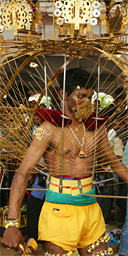
Thaipusam falls in the Hindu month of Thai, when the pusam star shines at its brightest, which can be any time between January 15 and February 15. Devotees trek for 3km carrying a kavadi - a kind of metal cage - adorned with limes, milk pots, peacock feathers and more to the point, up to 100 skewers that are hooked or pierced to the body. This act of devotion to Lord Murugan is believed to purify the soul, ward off sickness and bring good fortune.
As I walk into the temple, a burst of chanting, clanging of gongs and beating of tabla drums indicates that a devotee is preparing for the trek. At the centre of a tight knot of onlookers a man lies prostrate on his stomach before an effigy of Hamuman, the Hindu monkey god. An elderly man with a halo of Gandalf-white hair is speaking in tongues, his voice rising above the smoke and incense as he smears a devotee's back with holy ash - his only aid against infection and pain.
I try not to gawp (Wee Tee has retreated to hide behind a pillar) as about a dozen large hooks are pierced through the skin of his back then attached by string to a cumbersome effigy of a god which he will now pull around the course. Finally, a long skewer is pushed through both cheeks and a second through his tongue, leaving him looking slightly like a human kebab. Throughout the whole process his face remains locked in a trance. I look intently for signs of pain but there are none.
Just before I leave the temple I meet Dinesh, who explains to me that this is his first time taking part in the procession. He has taken a vow, and observed the obligatory 15-days fasting period when a strictly vegetarian diet must be followed and the devotee must also abstain from alcohol, tobacco and sex. He calmly tells me the different parts of the body that can be pierced - the back, chest, forehead, cheek and tongue. Doing this will bring good health and fortune to his family. I ask him how he is feeling.
He looks at me, his eyes steady and brown as a conker, "I am nervous, but I am ready." He then tells me that he is only 14 years old.
I decide not to tell him that at 14 my most challenging rite of passage was managing to drink a few cans of cider without falling over.
Chinatown
The Chinese have a saying that they will eat anything with its back to the heavens. Man, as Wee Tee explains, is therefore luckily exempt from their cooking pot. Food is the Chinese passion and we have come to Chinatown to celebrate the close of the New Year celebrations with some of the area's finest food.
To my culinary horror, this saying is proved a little too accurate when we visit the Imperial Herbal Restaurant. Here, a resident Chinese physician prescribes a meal to balance your yin and yang. Glass cases on the wall display choice ingredients originally used. In one quick glance, I spot scorpion, seahorse, snake ...
I nervously take the menu. At first glance, it's enough to send you running for the nearest Burger King - fancy a glass of deer penis wine, double-boiled crocodile soup or the fabulously named Monk Jumps Over the Wall with Cordyceps? I decide to trust Wee Tee on this one and she tells me to try the special New Year salad Yu Sheng. This dish includes finely grated vegetables, beanshoots, peanuts and croutons that must be tossed as high as possible by everyone at the table - the higher the food is thrown, the more auspicious the ritual. We wash it down with of glass of Imperial Hawthorne juice, that I am told aids digestion and lowers blood pressure and cholesterol. And it all tastes delicious.
More than three-quarters of Singapore's inhabitants are Chinese. But until recently the city's original Chinese quarter was under threat from developers. Thankfully, the area has been preserved and regenerated, the old street hawkers, once moved on for being unhygienic, are back and busy with trade. Their stalls now display starred hygiene grades to reassure customers.
The original shophouses have been also restored. These tall, brightly-coloured, shuttered terraces have deceptively narrow fronts that open up into sprawling houses. Red New Year lanterns are strung between them and along the market stalls that line Pagoda Street selling sweets, jewellery and colourful tat.
Three of the terraces are home to the Chinatown Heritage Centre. Wee Tee takes me through the maze of rooms that chart the arrival of the early Chinese, their struggle to establish a new life in the city and their poor living conditions. Incredibly, as late as the 1970s, some still lived with whole families cramped in one small room, together with all their belongings. The slops from the shared toilet were emptied by a bucket that frequently spilt on the floor.
"This is how my mother became a smoker," Wee Tee tells me. "Whenever she carried the bucket, she would light up a cigarette to block out the terrible smell. She still smokes to this day." Singapore now realises the importance of its cultural heritage and is thankfully preserving a history that would otherwise be lost with the older generation, in the relentless drive to modernise.
Colonial outpost
On my last evening in the city, I head for the famous Raffles hotel. Birthplace of the Singapore Sling, and named after the founder of Singapore, British-born Sir Stamford Raffles, it seems the perfect place to end my trip.
Whilst sipping my pink cocktail and decadently throwing monkey nutshells on the floor in this cleanest of cities, I decide that perhaps the reason Singapore's separate cultures are so easily overlooked by visitors is because they blend together so seamlessly. Chinese and Indians celebrate their festivals side-by-side. Malay and European communities, Muslim, Hindu, Buddhists and Christians meet with an absence of fuss that is refreshing, and all the more noticeable at a time when religious clashes dominate newspaper headlines the world over. My mission accomplished, I decide to celebrate with a cold beer. Well, make that a Tiger beer.
Way to go
Georgia Brown visited Singapore courtesy of the Singapore Tourism Board, +65 6736 6622, www.stb.com.sg.
She travelled with Singapore Airlines www.singaporeair.co.uk, which flies direct to Singapore from London Heathrow three times daily and daily from Manchester. Fares start from £505 including taxes.
The Gallery Hotel (+65 6849 8686, www.galleryhotel.com.sg) has rooms starting from SGD$158 (£56) per night.
For more on the Chinatown Heritage Centre, visit www.chinatownheritage.com.sg.
