
Product descriptions on beer cans make up one of those areas of life where words can become divorced from reality. "Refreshing" is common enough and makes some sense. But what about "deceptively refreshing", as is used on one lager. How could you not know? For this - and others to do with snow - the straightforwardness of the claim on a can of Molson Canadian that it is as cold as the country its from is reassuring when you are headed for a ski trip there.
Quebec, in Canada's French-speaking east, is certainly cold. Summers can hit 30C but the winters are long and largely sub-zero. It is the kind of place where a February or March day that climbs to zero is regarded as unseasonably warm. The rest of the time people wrap up warm, gritters grit, and life continues alongside the snow rather than being confounded by it.
This means you can ski. Quebec City, the oldest European settlement in mainland Canada and provincial capital, is a city of 530,000 at a narrowing of the St Lawrence River that was sailed by the first French explorers. It has a stunning location (here the narrows to a mere 1km under the strategic gaze of a rocky cliff), history (the only city walls in North America, and a Unesco world heritage designation) and a seemingly endless number of restaurants and bistros, plus orchestras, bars, galleries and theatres. But importantly for winter, it has plenty of ski areas an hour or less away by road.
The three largest ski areas offer a combined ski pass to visitors from outside the province. Available from tour operators, or in advance from hotels, the idea of the carte blanche is that you stay in the city and take a car or included shuttle bus (along clear and quick roads) to whichever resort takes your fancy. Crucially, it adds two non-ski days to the pass, meaning a three-day pass lasts for five. So if you want to take days off to try another winter activity, or simply stay in Quebec City, shop and have lunch, you are not losing out.
The furthest resort from the city is the most visually impressive. The thing with the Quebec cold is that you don't need an Alpine altitude to get decent snow. So for anyone used to regular ski resorts, Le Massif has plenty of surprises. Firstly, the 45-mile road from Quebec City, which scarcely seems to climb, delivers you to the top - not the bottom - of a 770m vertical drop, the longest east of the Rockies. A chairlift waits at the bottom to return you to base.
Then there is the eco-boho air that hangs over the place. Until 1992, there was no lift at Le Massif; you had to take a school bus to the top of the slopes. Developing along different lines to most since then (in 2002, it was acquired by former Cirque du Soleil founding president Daniel Gauthier) it is built out of local materials and, in addition to ski runs, has bird-feeders, picnic huts and a sort of slope-based farmer's market late in the season. The cafeteria (around £8 for three courses) looks to be the sort of place that Jamie Oliver got to first and confiscated all the Turkey Twizzlers. There are no burgers or chips, and regional producers are prized. Perhaps uniquely among ski resorts, snails, pastries and brussels-sprout soup were on offer the day I visited.
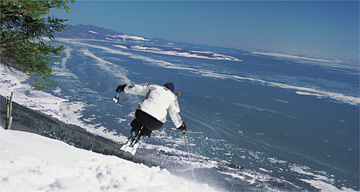
That should not detract from the skiing. Forty-two runs, an average six metres of snowfall each year and varied terrain are enough to remind you you've not stumbled into Notting Hill. Le Massif also has 1994 Olympic freestyle gold medalist, Jean-Luc Brassard, as its resident champion. But most remarkable is the view. The slopes drop down to 30 metres above the St Lawrence - 15km wide at this point - and on a clear day you can see across the icy waters to the foothills of the Appalachians while you ski. Sometimes a ship passes by.
Closer to the city are Mont-Sainte-Anne and Stoneham. Mont-Sainte-Anne is the largest resort, around 30 minutes from Quebec City, and with a good segregation between beginners and more experienced skiers. Stoneham is smaller but nearer (a 20-minute drive from downtown). On the inner side of a mountainous horseshoe, it is also remarkably sheltered. Both are at a low enough altitude to offer glade skiing (you go downhill through trees, which is almost as much fun as playing in the snow when you're eight years old). With 30 floodlit runs between them, Mont-Sainte-Anne and Stoneham also stay open until 10pm for Quebeckers, and visitors who can't ski during the day or want to try it at night. As one of Stoneham's representatives put it to me, if you don't make an effort to enjoy the winter, it will just get you down.
Back in the town, there is a city of things to do and see. The tourist literature and guidebooks, aimed largely at visitors from the United States, like to call it a European city. But the truth is more interesting. In terms of how it looks, Quebec City has old French buildings, some British ones, and then those others - such as brick townhouses with covered porches and tall steps - that could only be North American. It celebrates its 400th anniversary in 2008 and has all the heritage and culture that this implies - here is a city with a story to tell. Being here isn't, as the European tag implies, like being in France (though it has to be said that some of the local cheeses are fantastic).
For sightseeing, the main areas are the upper walled city and the lower old city by the river. The latter has antique shops and cafes clustered around Rue Saint Paul and Rue Sault-au-Matelot (vintage ski shoes are big, as are historic maps), and, in the Quartier Petit Champlain, old stone buildings on narrow streets - its church served as the backdrop to a rural French village in the film Catch Me If You Can. Interesting for ambling around are the bookshops and bakeries outside the city walls on Rue Saint Jean and in the Saint-Roche district that is regenerating through fashion, gastronomy and art. The Plains of Abraham, where the British broke through the French defences in 1759, is a wind- and snow-swept city park, which in winter allows for snowshoeing and cross-country skiing.
All the while, since its cold outside, the ice is still flowing by in the St Lawrence. From the bar of the Chateau Frontenac - an 1890s hotel that is not sure whether it wants to be a fairytale chateau or a skyscraper - you can watch it get pushed to the ocean by the river flow and then dragged back again by an incoming tide. Like a skiing holiday that is also a city break, you get to experience it both ways. It is, as a beer can might put it, deceptively refreshing.
Way to go
Simon Jeffery travelled courtesy of Quebec Tourism (ph: 08705 561 705) and Crystalski www.crystalski.co.uk, on their "Ski and See" Quebec City break, staying at the Hotel Manoir Victoria. The cost of this package for two adults departing Heathrow and staying for seven nights starts at £1,508.
Simon flew with Air Canada www.aircanada.com to Quebec City via Montreal. Prices for flights only departing London Heathrow start at £309 return, excluding fees and taxes. You can also book flights through British Airways www.britishairways.com.
