
The afternoon train from Paddington to Wargrave is packed with gently seething commuters. I squeeze myself into a corner of the carriage, trying not to jostle people with my unwieldy backpack. In it are a sleeping bag, a camping stove, a tin of pineapples and a well-thumbed copy of Jerome K Jerome’s Three Men in a Boat.
Written in 1889, the book recounts a comically ill-fated trip up the River Thames in a small rowing boat by the narrator and his friends, George and Harris. As well as being very funny, it captures the innocence of a time before adventure became synonymous with bungee jumping into ravines in faraway places. I wanted to find out if such an adventure were still possible within commuting distance of London, so I’ve enlisted my friends Alex and Judith, who are blissfully ignorant about the content of the book. More than a century later, would the Thames still resemble the ‘golden fairy stream’ which so enchanted Jerome and, more importantly, would three women fare any better than the Victorian dandies immortalised in the book?
Jerome’s trio spent 10 days paddling upstream from Kingston to Oxford. We will undertake a modified version of this trip, rowing along the picturesque sweep of Thames between Wargrave and Maidenhead (about 20 miles in all). And rather than making life needlessly difficult for ourselves (because we are women and therefore have nothing to prove), we will paddle downstream. Which makes a lot more sense when you think about it.
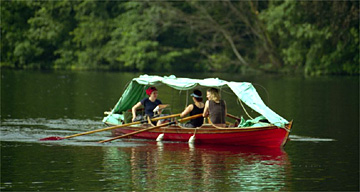
At Wargrave, Tom Balm from Thames Skiff Holidays is waiting for us on the slipway with Rosalind, a beautiful cedarwood skiff which will be our transport and our home for the next three days. She’s an authentic replica of the type of vessel that would have been used on the river in Jerome’s day, right down to the brass tacks holding her together. Four iron hoops arc across the boat, on top of which is a roll of green canvas. At night, we will moor up at a quiet spot on the bank, unroll the canvas, fasten down the sides and our boat will transform into a cosy little floating tent. That’s the idea, anyway.
Judith is wearing a purple sun visor with the word ‘Princess’ written on it in sparkly lettering. She eyes the boat with suspicion. ‘Where’s the bathroom?’ she asks. Alex is sporting dark sunglasses so I can’t read her expression, but she has gone very quiet. Tom gives us a quick run-through. He starts off using words like ‘port’ and ‘starboard’, ‘bow’ and ‘stern’ but noting our blank expressions, quickly replaces them with ‘left’ and ‘right’, ‘front’ and ‘back’. He explains how to moor the boat using a half-hitch, how to light the gas stove, how to use the tiller lines. Finally, he tells us, when mooring for the night we should always make sure the boat has its nose pointing upstream. ‘How will we know which way is upstream?’ asks Alex. A sensible question, or so I thought until I catch the look of polite despair on Tom’s face.
We clamber aboard and Tom pushes us off from the slipway. I take the tiller lines, while Alex and Jude each pick up a pair of oars and start to pull. After a prolonged discussion about which way is downstream, we settle on drifting aimlessly across stream, coming to a gentle standstill in thick reeds on the opposite bank. After some unseemly thrashing around, we eventually disentangle ourselves from the branches of a willow tree and pull off shakily into the shimmering afternoon light.
For the first hour we are convinced Tom has given us the wrong oars. They seem to be very unwieldy. So we swap them around several times until we realise that, maybe, it’s not the oars that are the problem. Eventually, we arrive in Henley just as dusk is falling, and pull up alongside the towpath between a sparkling white houseboat and a spooky old barge with blacked-out windows called Beyond Black.
As we unroll the canvas, the first fat raindrops begin to fall. None of us is feeling quite strong enough to master the gas stove, so we decide to walk into town in search of a pub. In the Rose and Crown we order fish and chips, followed by strawberries and cream – rowing sharpens the appetite – and watch the storm lash against the windows. ‘Just think how cosy it will be in our little boat with the rain falling on the roof,’ I say with a weak smile. ‘I wonder what time the last train back to London is,’ says Judith.
By the time we set off back to the boat, it’s almost midnight. The rain has stopped and a thick blanket of fog has settled over the river. None of us has thought to bring a torch. We stumble along the pitch-black towpath in single file. Miraculously, the boat is still where we left it and, even more miraculously, it’s snug and dry inside. We light the lamp and set about the complicated business of getting ready for bed in a small, gently rocking boat.
There’s barely enough room for all three of us to lie down in the boat and, after much fussing and fidgeting, I turn over and find myself nuzzled up against an oar wrapped in riverweed. A coot strikes up a mournful cry just inches from my head. Eventually, rocked by the gentle river currents, I drift off to sleep and am woken, it seems like only minutes later, by a woman’s voice shouting through a megaphone. ‘Give me long legs, Catherine, long legs! Keep the rhythm, Toby! Power on through!’
I poke my head out of the canvas flap and come face to face with a Prince Harry lookalike dressed in Lycra, sitting in a racing shell. I don’t know who’s the more startled. We seem to have moored opposite the clubhouse of the Upper Thames Rowing Club, giving us a ringside seat at their Saturday morning training session. It’s an idyllic scene, with swans gliding by, and the foggy horror of the previous night quickly evaporates like river mist in the morning sunshine as I sit in my pyjamas dangling my feet in the water and watching the rowing boats whiz by.
After a breakfast of cornflakes (without milk), we resume our journey. The stretch past Henley gives a backdoor glimpse into the lifestyles of the rich and famous with their swimming pools, stables, summerhouses and perfectly manicured lawns sloping down to the riverbank. Eventually the mansions give way to a more pastoral vision of cows grazing under willow trees. We seem to be getting the hang of this sculling lark. There are moments in fact where our oars dip into the water in pleasing unison and on one happy occasion we build up enough speed to overtake a duck.
In the book, Jerome rails against the tyranny of the steam launch, the biggest nuisance on the 19th-century river. ‘The expression on the face of the man who, with his hands in his pockets, stands by the stern, smoking a cigar,’ makes him long for the ‘good old days, when you could go about and tell people what you thought of them with a hatchet and a bow and arrows’. I decide that the 21st-century equivalent of the steam launch is the motor cruiser. With names like Crime Pays 2 or Lady Diana, they are invariably crewed by bumptious couples in matching Bermuda shorts and striped shirts, who smile down on you as they glide past, wine glasses in hand, and call out helpful encouragements like ‘Put your backs into it girls!’
As we queue to enter the locks, the watery hierarchy quickly establishes itself: motor cruisers first, then narrow boats, sailing dinghies, kayaks and, finally, Victorian camping skiffs. But whilst we may be travelling around on the riverine equivalent of a penny-farthing, I wouldn’t swap Rosalind for a floating gin palace any day. Not only is she a great ice-breaker - few can resist a smile or a jolly greeting as we pass - but pootling along at the speed of a moorhen, you are fully able to appreciate the little vignettes of life on the river bank. There’s something almost meditative about the steady rhythm of rowing and we all agree that it feels like an age since we caught the train from Paddington, even though it’s only been 24 hours.
We stop for lunch in Hurley Lock. It’s a pretty spot. Children from a nearby campsite are splashing about in the shallows. There’s a tense moment when I almost steer us over the weir but eventually we manage to moor up and stroll into the ancient village of Hurley for a ploughman’s lunch at Ye Olde Bell, a low-beamed inn hung with copper kettles which probably hasn’t changed much since Jerome’s day.
A sudden thunder clap cuts through our jollity like the crack of a whip. The skies open. No one says anything, but we are all thinking the same thing: we didn’t cover the boat. We return to find the skiff - and all our possessions - swimming in six inches of water.
‘Oh what a shame, now we’ll have to check into a hotel!’ chirps Judith. The thought of a soft bed and cotton sheets is tempting but I can’t bear to abandon our river adventure so soon. If a bunch of Victorian swells can tough it out then so can we. And anyway, ‘three women in a B&B’ doesn’t have quite the same ring to it.
The mood on board Rosalind is as dark as the sky as we pull away from Hurley. Rowing in the rain is a melancholy business. Jerome observed that when the rain is falling the Thames becomes a ‘spirit-haunted water through the land of vain regrets’. I can see what he means. This morning was all very Wind in the Willows. Now it seems to have gone a bit Apocalypse Now.
Tired and damp, we eventually pull up by a slightly seedy stretch of the riverbank near Marlow. There’s a steady drone of traffic from the A404 where it crosses the river 50 yards away. Stoically, Alex starts to bail out with an orange plastic mug. Judith is standing on the towpath. She seems to be debating whether to throw herself into the water or not. ‘Oh all right. We’ll get a B&B,’ I say in the martyred tone of one who would really much rather spend the night sleeping in the bottom of a waterlogged boat.
Reading Three Men in a Boat that night in my (oh so comfortable) bed, I see that we have, albeit unwittingly, been true to the spirit of the original adventure. By coincidence, Jerome and co had also abandoned their boat in Marlow for the comforts of an inn. This makes me feel better.
After stocking up on chocolate bars and apple juice the next morning, we leave Marlow. Lined on either side by dark green woods, the Thames becomes steadily more beautiful. Just past Cookham we pull up and clamber up the steep hill to explore Cliveden, the former home of the Astors. After a pub lunch we press on to Maidenhead, where Tom is waiting for us on the slipway. I have an unexpected urge to keep rowing past him, to go further down the river. I don’t want the adventure to end yet.
How much would Jerome recognise if he were to make this trip today? I think he’d be shocked at how we dress. The ‘bright blazers, saucy hats, and many-coloured parasols’ he so admired on the river have been replaced by football shirts, baseball caps and Goretex all-weather gear, but he’d see that, fundamentally, people haven’t changed at all - one of the reasons his book is still so funny and pertinent today - and that the essence of the river, its timeless beauty, is the same as it ever was.
Essentials
Thames Skiff Holidays (01932 232 433; www.skiffhire.com) hires out traditional camping skiffs from its base in Walton-on-Thames. Prices are from £200 for four days including camping equipment. The charges are based on a round trip. One-way rentals are possible and boats can be delivered or picked up from any slipway on the Thames for an additional charge. For information on the river see www.visitthames.co.uk.
